
Can You Write Your Own Prenup With AI in Florida?
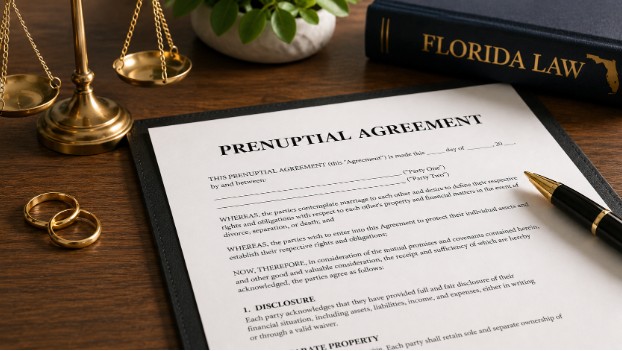
AI tools like ChatGPT can help couples research prenuptial agreement basics, but an AI-only prenup carries serious enforceability risks under Florida Statute § 61.079.
A mediated prenuptial agreement offers a structured, lower-cost alternative that produces a written agreement both spouses build together with a certified mediator — typically completed in two weeks or less, compared to one to five months through the traditional attorney-versus-attorney process.
Carolann Mazza, Florida Family Law Attorney (The Florida Bar, admitted 2001) and Florida Supreme Court Certified Family Mediator, helps South Florida couples build mediated prenuptial agreements that meet Florida statutory requirements from the first draft.
Key Takeaways
- AI-drafted prenups frequently miss Florida-specific execution, disclosure, and voluntariness requirements that courts evaluate under § 61.079 and Casto v. Casto, 508 So. 2d 330 (Fla. 1987).
- A 2025 Stanford-affiliated analysis of legal AI tools from LexisNexis and Thomson Reuters reported hallucination rates between 17% and 33%, producing clauses that reference nonexistent requirements or omit mandatory ones.
- Mediated prenups cost $1,500 to $3,500 in South Florida, take roughly two weeks, and produce an agreement both spouses reviewed with a neutral professional before signing.
- Florida courts can void an entire prenuptial agreement if one party proves the agreement was involuntary, unconscionable, or lacked fair financial disclosure.
Unenforceable clauses surface years after signing, when the costs of correction multiply. Carolann Mazza, P.A., builds mediated prenups satisfying Florida § 61.079 — schedule a confidential consultation or call (954) 527-4604.
Are AI-Generated Prenuptial Agreements Legally Enforceable in Florida?
An AI-generated prenuptial agreement is not automatically enforceable or unenforceable in Florida — enforceability depends entirely on whether the final document satisfies every requirement in Florida Statute § 61.079.
The tool used to produce the first draft is irrelevant to a court; the substance, execution, and circumstances surrounding the signing determine its validity.
AI tools consistently fail to account for the specific combination of statutory and case-law requirements that Florida courts apply.
A prenup that looks polished — organized sections, legal-sounding language, signature fields — can still collapse under judicial scrutiny if it omits disclosure provisions, uses inapplicable terminology from another state, or includes clauses Florida public policy prohibits.
Florida family law practitioners report that reviewing an AI-drafted prenup often takes longer than drafting one from scratch. The attorney must identify which clauses reflect actual Florida law, which reflect another state’s requirements, and which reflect no real legal standard at all.
That review process adds cost without adding value, because most reputable attorneys will not attach their name to a document they did not draft or cannot verify.
Couples who use AI for initial research — understanding what a prenuptial agreement covers, what questions to discuss, what financial documents to gather — gain real value from the technology. The risk begins when AI output replaces professional drafting rather than informing it.
What Does Florida Law Require for a Valid Prenuptial Agreement?
Florida’s Uniform Premarital Agreement Act, codified at § 61.079, establishes five requirements every prenuptial agreement must satisfy: the agreement must be in writing, signed by both parties, entered voluntarily, free from unconscionability, and supported by fair and reasonable financial disclosure.
Each element carries independent weight. A written, signed prenup that both spouses executed voluntarily can still be voided if a court finds unconscionability — meaning one spouse received a grossly unfair outcome without adequate knowledge of the other spouse’s finances.
The Florida Supreme Court established this analysis in Casto v. Casto, 508 So.2d 330 (Fla. 1987), and Florida trial courts continue to apply that framework.
| Florida § 61.079 Requirement | What the Court Examines |
| Written and signed | Physical or electronic document bearing both signatures |
| Voluntary execution | No evidence of duress, coercion, fraud, or overreaching |
| Not unconscionable | Terms are not grossly unfair to either spouse at the time of enforcement |
| Fair financial disclosure | Each spouse provided or expressly waived disclosure of assets and debts |
| No public policy violation | An agreement does not eliminate child support obligations or promote dissolution |
Florida does not legally require notarization under § 61.079, but practitioners strongly recommend it. Notarization and two adult witnesses prevent future challenges to signature authenticity.
When either spouse waives rights to the other’s estate upon death, Florida Statute § 732.702 requires witness signatures as a separate condition.
If you’re ready to get started, call us now!
Where Do AI-Drafted Prenups Fail Under Florida Statute § 61.079?
AI-drafted prenups most frequently fail on three of the five § 61.079 requirements: financial disclosure mechanics, state-specific enforceability standards, and unconscionability safeguards.
A 2025 Stanford-affiliated analysis of legal AI tools from LexisNexis and Thomson Reuters reported hallucination rates between 17% and 33%, meaning the tools generate clauses that reference requirements that do not exist or omit requirements that do.
Disclosure gaps. Florida courts evaluate whether each spouse had fair and reasonable knowledge of the other’s property and financial obligations before signing. AI tools are rarely built into the disclosure exchange process — the schedules, the verification steps, the timing — that Florida practitioners use to create an enforceable record.
A prenup without an attached financial disclosure schedule gives the disadvantaged spouse a straightforward path to invalidation.
Wrong-state requirements. AI models draw from training data spanning all fifty states. A ChatGPT-generated Florida prenup may include California’s seven-day independent counsel review requirement (which Florida does not mandate) while omitting Florida’s witness requirements for estate waivers under § 732.702. The result reads as a legal document but functions as a patchwork of inapplicable rules.
No unconscionability check. Unconscionability is a fact-specific, case-law-driven analysis. AI cannot evaluate whether a specific alimony waiver, property division ratio, or debt allocation crosses the line from aggressive-but-enforceable to unconscionable-and-void under Florida precedent.
A human professional assesses the balance between the two spouses’ circumstances; an algorithm produces text.
Disclosure gaps and wrong-state clauses void prenups Florida courts would otherwise enforce. Carolann Mazza, P.A., structures mediated prenups from the first session — schedule a consultation or call (954) 527-4604.
How Long Does a Mediated Prenup Take Compared to an Attorney-Drafted One?
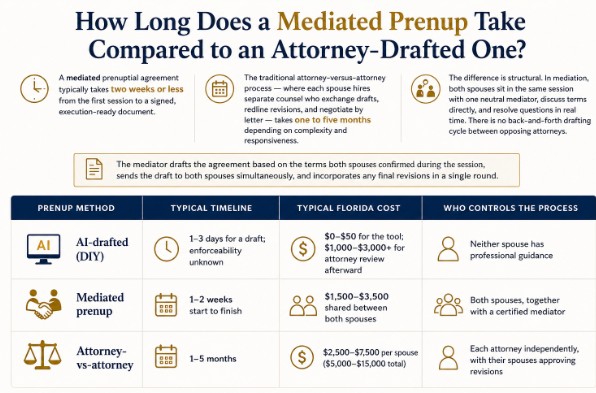
A mediated prenuptial agreement typically takes two weeks or less from the first session to a signed, execution-ready document. The traditional attorney-versus-attorney process — where each spouse hires separate counsel who exchange drafts, redline revisions, and negotiate by letter — takes one to five months depending on complexity and responsiveness.
The difference is structural. In mediation, both spouses sit in the same session with one neutral mediator, discuss terms directly, and resolve questions in real time. There is no back-and-forth drafting cycle between opposing attorneys.
The mediator drafts the agreement based on the terms both spouses confirmed during the session, sends the draft to both spouses simultaneously, and incorporates any final revisions in a single round.
| Prenup Method | Typical Timeline | Typical Florida Cost | Who Controls the Process |
| AI-drafted (DIY) | 1–3 days for a draft; enforceability unknown | $0–$50 for the tool; $1,000–$3,000+ for attorney review afterward | Neither spouse has professional guidance |
| Mediated prenup | 1–2 weeks start to finish | $1,500–$3,500 shared between both spouses | Both spouses, together with a certified mediator |
| Attorney-vs-attorney | 1–5 months | $2,500–$7,500 per spouse ($5,000–$15,000 total) | Each attorney independently, with their spouses approving revisions |
For couples with a wedding date approaching, the mediated timeline eliminates the last-minute presentation problem. Neither spouse hands the other a finished document — both spouses build the agreement together, reducing the duress and voluntariness challenges that Florida courts examine under § 61.079.
How Much Does a Mediated Prenup Cost in Florida?
A mediated prenup in South Florida typically costs $1,500 to $3,500 total, split between both spouses. This amount covers the mediator’s preparation, one to two joint sessions, the drafting of the written agreement, one revision round, and the final execution-ready document.
By comparison, the traditional attorney-versus-attorney route costs $2,500 to $7,500 per spouse — meaning total expenditure for the couple runs $5,000 to $15,000 for a moderately complex prenup.
The cost difference exists because mediation eliminates the duplicated work: two attorneys independently researching the same financial facts, drafting competing versions of the same clauses, and exchanging revisions that often change the same provisions multiple times.
The AI-drafted route appears cheapest at first. The tool itself costs nothing or close to it. But couples who bring an AI draft to a Florida attorney for review typically pay $1,000 to $3,000 for that review — and most attorneys decline the review entirely, requiring a fresh draft that starts the cost clock from zero.
The mediated approach produces a single document that both spouses shaped from the beginning. No draft arrives as a surprise. No revision cycle runs longer than the cost comparison timeline allows.
If you’re ready to get started, call us now!
What Is the Difference Between a Mediated Prenup and a DIY Prenup?
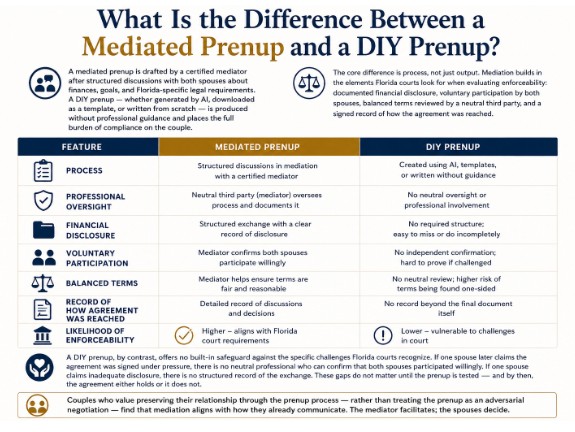
A mediated prenup is drafted by a certified mediator after structured discussions with both spouses about finances, goals, and Florida-specific legal requirements. A DIY prenup — whether generated by AI, downloaded as a template, or written from scratch — is produced without professional guidance and places the full burden of compliance on the couple.
The core difference is process, not just output. Mediation builds in the elements Florida courts look for when evaluating enforceability: documented financial disclosure, voluntary participation by both spouses, balanced terms reviewed by a neutral third party, and a signed record of how the agreement was reached.
A DIY prenup, by contrast, offers no built-in safeguard against the specific challenges Florida courts recognize. If one spouse later claims the agreement was signed under pressure, there is no neutral professional who can confirm that both spouses participated willingly.
If one spouse claims inadequate disclosure, there is no structured record of the exchange. These gaps do not matter until the prenup is tested — and by then, the agreement either holds or it does not.
Couples who value preserving their relationship through the prenup process — rather than treating the prenup as an adversarial negotiation — find that mediation aligns with how they already communicate. The mediator facilitates; the spouses decide.
How Should Couples in South Florida Prepare for a Mediated Prenup Session?
Couples should arrive at a mediated prenup session with three categories of preparation completed: financial documentation, a written list of goals, and a shared understanding of what Florida law allows a prenuptial agreement to address.
Financial documentation. Each spouse gathers recent bank statements, investment account summaries, retirement account balances, real estate records, business ownership documents, and a list of outstanding debts. This documentation serves as the financial disclosure foundation required by § 61.079 for enforceability.
Written goals. Each spouse writes down what they want the prenup to accomplish — protecting a business started before marriage, defining how a jointly purchased home would be handled, establishing expectations around spousal support, or preserving separate property. Written goals provide the mediator with a clear starting framework and reduce the time spent in sessions identifying priorities.
Legal boundaries. Florida prenuptial agreements can address property rights, spousal support waivers (with limitations), debt allocation, and rights to insurance proceeds. Florida prenups cannot eliminate child support obligations, promote dissolution, or include terms that violate public policy. Understanding these boundaries before the session allows both spouses to focus the discussion on achievable terms rather than provisions a court would void.
Couples who complete this preparation typically finish the mediated prenup process in one to two sessions. Those who arrive without documentation extend the timeline by the number of weeks required to gather and exchange records.
Contact Us Today For An Appointment
Frequently Asked Questions
Can ChatGPT write a legally valid prenup in Florida?
ChatGPT can generate a document that resembles a prenuptial agreement, but enforceability depends on full compliance with Florida Statute § 61.079. AI tools frequently produce clauses based on other states’ requirements, omit financial disclosure provisions, and cannot verify voluntariness at signing.
Does Florida require both spouses to have separate attorneys for a prenup?
Florida does not require independent legal counsel for either spouse under § 61.079. Both spouses can use a single certified mediator to facilitate the agreement. However, each spouse retains the right to consult an independent attorney before signing, and doing so strengthens the voluntariness record.
What makes a Florida prenuptial agreement unconscionable?
A Florida court finds unconscionability when the agreement’s terms are grossly unfair to one spouse, and that spouse lacked adequate knowledge of the other’s finances at the time of signing. The analysis follows the framework established in Casto v. Casto, 508 So. 2d 330 (Fla. 1987).
Can a prenup waive alimony in Florida after the 2023 reform?
Florida Statute § 61.08, amended effective July 1, 2023, eliminated permanent alimony for marriages ending after that date. A prenup can waive or limit durational, rehabilitative, or bridge-the-gap alimony, but courts retain discretion over temporary support during dissolution proceedings regardless of prenup terms.
How much does a mediated prenup cost compared to hiring two separate attorneys?
A mediated prenup in South Florida typically costs $1,500 to $3,500 total for both spouses. The attorney-versus-attorney route costs $2,500 to $7,500 per spouse, bringing the couple’s total to $5,000 to $15,000 depending on complexity, revision cycles, and negotiation duration.
Is a mediated prenup confidential in Florida?
Mediation communications in Florida are protected by confidentiality. Discussions during the mediated prenup process cannot be disclosed or used as evidence in subsequent proceedings. This protection encourages both spouses to negotiate openly without concern that proposals or concessions could be used against them later.
Can we modify a prenuptial agreement after getting married in Florida?
Florida Statute § 61.079(6) permits amendment, revocation, or abandonment of a prenuptial agreement after marriage, but any change must be in writing and signed by both spouses. A post-marriage modification effectively becomes a postnuptial agreement and must independently satisfy enforceability standards.
What happens if one spouse hid assets during the prenup process?
If a spouse proves the other failed to provide fair and reasonable financial disclosure — or that the agreement resulted from fraud — a Florida court can void the prenuptial agreement under § 61.079(7). Mediated prenups reduce this risk because the mediator structures a documented exchange of disclosures.
Do AI prenup tools account for Florida’s estate waiver witness requirements?
Most AI tools do not distinguish between standard prenup execution and estate-related waivers. Florida Statute § 732.702 requires witnesses when a spouse waives rights to the other’s estate, a requirement separate from § 61.079. AI-generated documents rarely include this provision.
How far in advance of a Florida wedding should couples start a prenup?
Florida practitioners recommend starting the prenup process 3 to 6 months before the wedding date. Mediated prenups can be completed in two weeks, but starting early prevents any appearance of duress — a recognized challenge ground under § 61.079 in Florida family courts.
A prenup proves its worth under pressure, years after signing. Carolann Mazza, P.A., builds agreements that hold when they matter most — schedule a consultation today or call (954) 527-4604.
About the Author
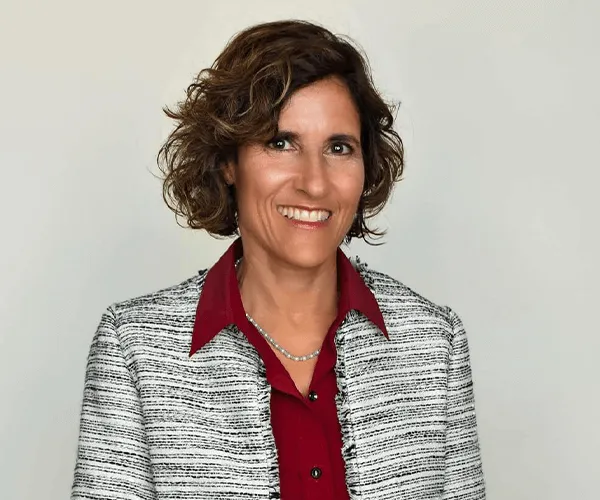
Carolann Mazza
Florida Family Law Attorney (The Florida Bar, admitted 2001) · Florida Supreme Court Certified Family Mediator (certified 2011, No. 25475F) · Super Lawyers, Family Law, 2022–2026
Carolann Mazza is the founder of Carolann Mazza, P.A., a non-litigation family law firm she opened in Fort Lauderdale in 2003. Practicing family law in Florida since 2001 and admitted to the State Bar of Texas in 1997, she resolves divorce and family conflicts exclusively through Collaborative Divorce, mediation, and out-of-court settlement — keeping families out of court while preserving relationships, dignity, and children’s wellbeing. She serves Broward, Palm Beach, and Miami-Dade counties.