
How to Prepare for Collaborative Divorce in Florida
Data last verified: March 2026
Preparing for collaborative divorce in Florida requires three categories of groundwork: financial documentation, property and asset records, and — where children are involved — school, medical, and scheduling information.
Florida spouses who complete this preparation before their first consultation reduce professional fees, compress the intake timeline, and enter the Participation Agreement under the Florida Collaborative Law Process Act, Sections 61.55 to 61.58, Florida Statutes, with accurate expectations about what full voluntary disclosure requires.
Carol Ann Mazza is a Florida Bar member, Florida Supreme Court Certified Family Mediator, and Collaborative Divorce Attorney serving Broward County, Palm Beach County, and Miami-Dade County. Preparation is the single most controllable variable in collaborative divorce.
Florida spouses who arrive at their first session with complete financial records, organized property documentation, and realistic process expectations move faster, pay less in professional fees, and experience less session disruption than those who do not.
Key Takeaways
- Florida spouses must gather three years of tax returns, all financial account statements, and a complete asset inventory before the first collaborative attorney consultation.
- The Florida Collaborative Participation Agreement requires full, voluntary disclosure of all assets, income, debts, and financial interests — incomplete preparation at intake results in delays and additional professional fees.
- Florida spouses with children must compile school enrollment records, medical provider contacts, and current schedule documentation before the first team session.
- Emotional preparation for collaborative divorce requires the same discipline as financial preparation — both spouses must sustain good-faith, interest-based negotiation across multiple sessions.
- Carol Ann Mazza conducts confidential intake consultations for Florida spouses to assess eligibility for collaborative divorce before any process commitment is signed.
Carol Ann Mazza guides Florida spouses through collaborative divorce preparation from the first consultation through final filing. Schedule your confidential consultation today.
If you’re ready to get started, call us now!
Financial Documents to Gather Before Your First Meeting
Financial preparation for a Florida collaborative divorce requires complete voluntary disclosure under the Participation Agreement.
Florida spouses who gather three years of tax returns, all account statements, pay stubs, and debt documentation before the first consultation give the Certified Divorce Financial Analyst (CDFA) accurate data from day one — preventing disclosure gaps that delay sessions and increase professional fees on both sides.
The Florida Financial Affidavit is a mandatory disclosure document in all Florida divorce proceedings under Florida Family Law Rule 12.285. Completing an accurate Florida Financial Affidavit requires the documents listed in the table below.
| Document Category | What to Gather |
| Tax returns | Federal and state returns for the last 3 years, including all schedules and K-1s |
| Income documentation | Last 6 months of pay stubs; most recent W-2s and 1099s; business profit and loss statements if self-employed |
| Bank accounts | 12 months of statements for all checking, savings, and money market accounts |
| Investment accounts | Most recent statements for all brokerage, mutual fund, and 529 accounts |
| Retirement accounts | Most recent statements for all 401(k), IRA, pension, and deferred compensation accounts |
| Debt documentation | Most recent statements for all mortgages, HELOCs, auto loans, credit cards, and personal loans |
| Business interests | Operating agreements, partnership agreements, most recent business tax returns, and any buy-sell agreements |
Property Records and Asset Inventory
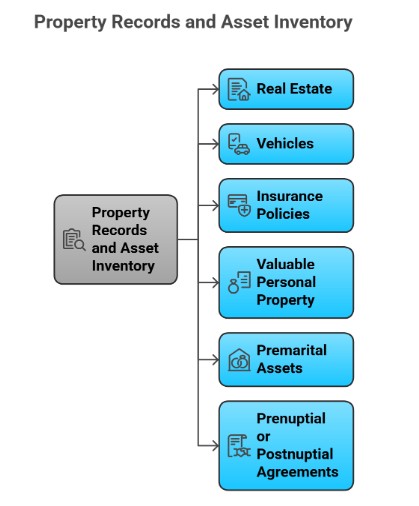
Florida divorce law requires equitable distribution of all marital assets and liabilities under Section 61.075, Florida Statutes.
Collaborative divorce uses voluntary disclosure rather than court-ordered formal discovery to establish the marital asset inventory, which means both spouses must arrive with complete, accurate property records.
Missing or incomplete property records are the most common source of session delays in Florida collaborative divorce cases.
Florida spouses must compile the following property records before the first collaborative session:
- Real estate: Current mortgage statements, most recent property tax bills, and appraisals completed within the last 3 years for all properties held individually or jointly
- Vehicles: Title documents and current loan statements for all cars, boats, RVs, and motorcycles
- Insurance policies: Current declarations pages for all life insurance policies with cash value and any annuity contracts
- Valuable personal property: Documentation for jewelry, artwork, collectibles, or any item with an appraised value above $1,000
- Premarital assets: Records establishing what each spouse owned before the marriage, including inheritance documentation and gifts received during the marriage
- Prenuptial or postnuptial agreements: The signed original document and all amendments
Children’s Information to Compile Before the First Session
Florida collaborative divorce integrates a licensed child specialist when children are involved.
The parenting plan design process requires accurate, current information about each child’s school enrollment, medical care, extracurricular schedule, and existing daily routine.
Both parents must compile this information independently before the first team session, giving the child specialist and both collaborative attorneys an accurate developmental baseline from which to design the parenting plan.
| Category | Information to Compile |
| School | Current school name and address, grade, teacher contacts, and upcoming school calendar events |
| Medical | Primary pediatrician, dentist, any specialists, current medications, and insurance coverage details |
| Schedule | Weekly routine including school hours, extracurricular activities, childcare arrangements, and transportation logistics |
| Special needs | Any IEP, 504 plan, therapy schedule, or developmental support services currently in place |
| Existing orders | Any existing temporary timesharing orders or parenting agreements already in effect |
Questions to Ask Your Collaborative Attorney at the First Consultation
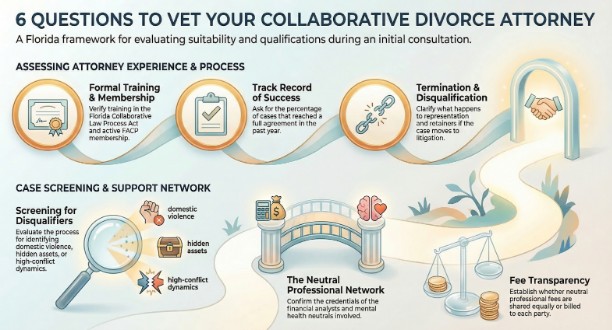
The first consultation with a Florida collaborative attorney is an eligibility and fit assessment — not a process commitment.
Florida spouses must arrive with specific questions about the attorney’s collaborative training, intake screening methodology, neutral professional network, and fee structure.
These answers determine whether the collaborative process is appropriate for the specific marital situation and whether the attorney is qualified to lead it.
Bring these seven questions to the first consultation with Carol Ann Mazza or any Florida collaborative attorney:
- What specific training do you hold in the Florida Collaborative Law Process Act, and are you a current member of the Florida Academy of Collaborative Professionals?
- What is your intake screening process for the five collaborative divorce disqualifiers — domestic violence, hidden assets, power imbalance, high-conflict dynamics, and active, untreated substance abuse?
- Who are the neutral professionals — Certified Divorce Financial Analyst and licensed mental health neutral — you typically work with, and what are their credentials and Florida certifications?
- How are neutral professional fees structured — shared equally between both spouses or billed separately to each party?
- What happens to my retainer and your representation if the collaborative process terminates under the disqualification clause and the case moves to litigation?
- How many collaborative divorce cases have you completed in the past 12 months, and what percentage of those cases reached full agreement?
- Based on what I have told you today, do you identify any conditions that may disqualify my situation from the collaborative process?
How to Approach the Conversation With Your Spouse About Collaborative Divorce
Collaborative divorce under the Florida Collaborative Law Process Act requires both spouses to opt in voluntarily before signing the Participation Agreement.
Florida spouses who frame the initial conversation as a process choice — not a concession, a legal position, or a statement about fault — achieve voluntary buy-in more consistently than those who advocate for collaboration as a personal preference.
The conversation must focus on shared avoidance goals: litigation cost, public court records, timeline delay, and the impact on children.
A four-step framework for initiating the collaborative divorce conversation:
- Lead with shared interests. Both spouses typically share the same core goals — financial efficiency, privacy, minimal disruption to children, and a functional co-parenting relationship post-divorce. Opening with those shared goals removes the adversarial framing that causes early rejection.
- Describe the process concretely. Many Florida spouses reject collaborative divorce because they misunderstand it as informal or legally unprotected. Clarify that each spouse retains an independent Florida Bar-licensed attorney, that all agreements are legally binding, and that the process is governed by Sections 61.55 to 61.58, Florida Statutes.
- Address specific objections directly. A skeptical spouse typically has one specific concern — fear of financial deception, doubt about the other party’s good faith, or unfamiliarity with the process structure. Addressing that concern directly is more effective than general advocacy for collaboration.
- Propose a joint informational session. Carol Ann Mazza conducts informational consultations for both spouses together — before either party retains counsel — to answer procedural questions and assess fit, without either party making a financial or legal commitment.
Carol Ann Mazza conducts joint informational consultations for Florida couples considering collaborative divorce. Contact Carol Ann Mazza to schedule yours. | (954) 527-4604
If you’re ready to get started, call us now!
What the Participation Agreement Commits You to — Read It Before You Sign
The Florida Collaborative Participation Agreement is a binding contract signed by both spouses and every team member before the first joint session begins.
The Participation Agreement establishes four binding obligations: full, voluntary financial disclosure; a no-litigation commitment; a disqualification clause; and a good-faith conduct standard.
Florida spouses who sign the Participation Agreement without understanding these four obligations — particularly the disqualification clause — are the most common source of costly process failures in Florida collaborative divorce cases.
| Commitment | What It Means and Why It Matters |
| Full voluntary disclosure | Both spouses must disclose every asset, debt, source of income, and financial interest completely and honestly. Concealment constitutes a material breach that terminates the process and may expose the concealing spouse to court sanctions in subsequent litigation. |
| No-litigation commitment | Neither spouse may file a court pleading while the collaborative process is active. Filing triggers immediate mandatory withdrawal of both collaborative attorneys under Florida Family Law Rule 12.745. |
| Disqualification clause | Both collaborative attorneys are permanently barred from representing either spouse in court if the process terminates. Both spouses must retain entirely new litigation counsel before any court proceedings may begin. |
| Good-faith conduct standard | Both spouses commit to respectful, interest-based engagement throughout all sessions. Persistent bad-faith conduct — including commitment reversals and deliberate escalation — constitutes grounds for attorney withdrawal and termination of the process. |
The disqualification clause is the defining structural feature of the Florida Collaborative Law process — the mechanism that aligns every professional’s incentive entirely toward settlement rather than litigation preparation.
Mindset: What Collaborative Divorce Requires Emotionally and Practically
Collaborative divorce requires both spouses to sustain good-faith engagement across multiple sessions while making binding decisions about finances, property, and children under sustained emotional stress.
Florida spouses who enter the process expecting it to function like a single mediation session — or like litigation, where an attorney advocates on their behalf — consistently underperform.
The Florida Collaborative Law process requires active, informed participation from both spouses across every session, not passive attendance at attorney-managed proceedings.
The Florida Academy of Collaborative Professionals reports that over 85% of collaborative cases in Florida reach full agreement.
Cases that terminate without agreement share a documented pattern: one or both spouses entered the process without accurate expectations about what sustained good-faith engagement requires across multiple sessions over several months.
Four practical mindset preparation steps for Florida collaborative divorce:
- Engage a personal therapist or counselor independently — outside the collaborative team — to process the emotional dimensions of the divorce. The mental health neutral in the collaborative process serves the process, not either spouse individually. Unprocessed emotion carried into team sessions disrupts financial and parenting discussions.
- Accept that interest-based negotiation requires disclosing actual priorities — not maximizing every legal position. The collaborative team builds solutions from disclosed interests. Undisclosed interests produce sessions that fail to progress.
- Understand that the collaborative process requires honest engagement with every issue — not agreement on every issue. Disagreement is expected. Bad faith is not.
- Recognize that the pace of the process is controlled by both spouses. Preparation between sessions and prompt document responses directly reduce professional fees and compress the total timeline.
30-Day Pre-Process Preparation Checklist
Florida spouses who complete the following 14 preparation steps in the 30 days before signing the Participation Agreement arrive at their first collaborative session with the financial documentation, professional knowledge, and emotional readiness the process requires.
Each completed step reduces session time, professional fees, and the probability of process disruption.
| Timeframe | Preparation Step |
| Week 1 | Gather 3 years of federal and state tax returns and all supporting schedules |
| Week 1 | Compile 12 months of statements for all bank and investment accounts |
| Week 1 | Pull the most recent statements for all retirement accounts — 401(k), IRA, and pension |
| Week 1 | List all real estate owned with current mortgage balances and estimated market values |
| Week 2 | Compile all debt statements — mortgage, auto, credit card, student loans, and personal loans |
| Week 2 | Gather business ownership documents if either spouse owns or holds an interest in a business |
| Week 2 | Locate the prenuptial or postnuptial agreement and all amendments if one exists |
| Week 2 | Document premarital assets with supporting records — bank statements, inheritance letters, gift documentation |
| Week 3 | Compile each child’s school enrollment, medical provider contacts, and weekly schedule |
| Week 3 | Write down your three highest-priority outcomes — one financial, one parenting, one timeline |
| Week 3 | Research Florida collaborative attorneys and schedule a consultation with Carol Ann Mazza |
| Week 4 | Attend the first attorney consultation with all financial documents and your seven-question list |
| Week 4 | Review the Participation Agreement with Carol Ann Mazza before signing |
| Week 4 | Engage a personal therapist or counselor to support emotional processing outside the collaborative team |
A Florida-specific financial preparation guide for the collaborative intake process is available at Financial Prep for collaborative divorce intake, and a complete Florida divorce settlement reference is available at Florida divorce settlement checklist.
Contact Us Today For An Appointment
Frequently Asked Questions
What documents do I need for a collaborative divorce in Florida?
Florida collaborative divorce requires three years of tax returns, six months of pay stubs, 12 months of bank and investment account statements, all retirement account statements, all real estate and debt documentation, and — if children are involved — school, medical, and schedule records. These documents satisfy the full voluntary disclosure requirement of the Florida Collaborative Participation Agreement.
How long does it take to prepare for a collaborative divorce in Florida?
Preparing for a collaborative divorce in Florida takes most spouses two to four weeks when financial records are accessible. Florida spouses with business interests, multiple real estate holdings, or complex retirement accounts should allow four to six weeks to compile complete documentation before the first collaborative attorney consultation.
Do both spouses need to agree to a collaborative divorce before I consult an attorney?
Neither spouse needs to agree before one spouse consults a collaborative attorney in Florida. Carol Ann Mazza conducts confidential one-on-one consultations to assess fit and eligibility. If collaborative divorce is appropriate, Carol Ann Mazza advises on how to approach the conversation with a spouse who has not yet considered the process.
What happens if I sign the Participation Agreement and my spouse stops cooperating?
A spouse who stops engaging in good faith triggers a process review by both collaborative attorneys. If good-faith engagement cannot be restored, both collaborative attorneys withdraw under the disqualification clause, and both spouses must retain new litigation counsel. The Participation Agreement requires honest engagement with each issue — not agreement on every issue.
Can I prepare for a collaborative divorce without telling my spouse?
A Florida spouse may gather personal financial documents and consult a collaborative attorney confidentially before approaching their spouse about the process. The Participation Agreement — which requires both spouses’ signatures — is not signed until both parties agree to proceed. Preparation and consultation before that conversation are both appropriate and legally advisable.
What is the most important emotional preparation for collaborative divorce in Florida?
The most important emotional preparation for a Florida collaborative divorce is engaging independent therapeutic support outside the collaborative team. The mental health neutral in the collaborative process serves the process as a whole, not either spouse individually. Florida spouses who process divorce-related emotion with a personal therapist arrive at team sessions able to engage productively with financial and parenting decisions.
How much does it cost to start the collaborative divorce process in Florida?
Starting the collaborative divorce process in Florida requires an attorney retainer of $3,000 to $5,000 at intake. Total collaborative divorce costs in Florida range from $15,000 to $30,000 per couple for the entire professional team — covering both attorneys and all neutral professionals — according to the Florida Academy of Collaborative Professionals.
Schedule a confidential consultation with Carol Ann Mazza to begin preparing for your collaborative divorce in Florida.Contact Carol Ann Mazza today. | (954) 527-4604
About the Author
Carolann Mazza
Florida Family Law Attorney (The Florida Bar, admitted 2001) · Florida Supreme Court Certified Family Mediator (certified 2011, No. 25475F) · Super Lawyers, Family Law, 2022–2026
Carolann Mazza is the founder of Carolann Mazza, P.A., a non-litigation family law firm she opened in Fort Lauderdale in 2003. Practicing family law in Florida since 2001 and admitted to the State Bar of Texas in 1997, she resolves divorce and family conflicts exclusively through Collaborative Divorce, mediation, and out-of-court settlement — keeping families out of court while preserving relationships, dignity, and children’s wellbeing. She serves Broward, Palm Beach, and Miami-Dade counties.