
The Collaborative Divorce Team in Florida: Who Does What and Why
A Florida Collaborative divorce team consists of two Collaborative attorneys, a neutral financial professional, and a neutral facilitator — and every team member serves the process, not either spouse individually.
The Florida Collaborative Law Process Act, Florida Statutes §§ 61.55–61.58, effective July 1, 2017, governs the roles, obligations, and disqualification rules applicable to all team members.
A Collaborative divorce attorney in Fort Lauderdale can assess whether the full team model fits your specific situation before you commit.
Key Takeaways
- Every team member signs the Participation Agreement under Florida Statutes §§ 61.55–61.58 and is bound by the disqualification rule if the process terminates.
- The financial neutral and neutral facilitator serve both spouses equally — neither advocates for either party.
- A child specialist is optional, not mandatory, in a Florida Collaborative divorce.
- Allied professionals — appraisers, tax planners, and mortgage brokers — can be added by team agreement for cases that require specialized expertise.
What Is the Florida Collaborative Divorce Team and Why Does It Exist?
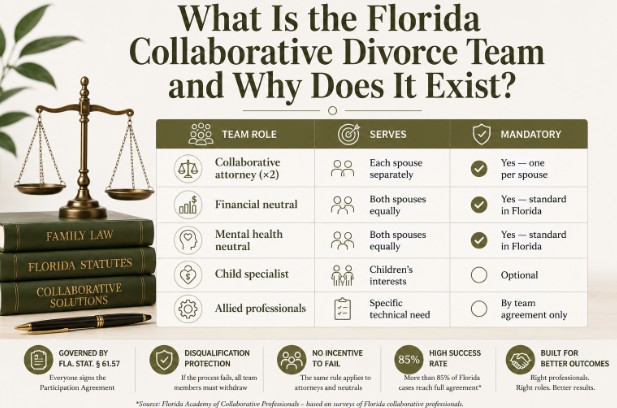
The Florida Collaborative divorce team exists because divorce involves three distinct problem sets — legal, financial, and emotional — that no single professional can resolve effectively on their own.
Traditional litigation assigns all three to attorneys and a judge. The Collaborative model assigns each problem set to the professional best trained to handle it, so legal time is spent on legal decisions, financial expertise is applied to financial decisions, and communication is managed by someone trained in human behavior.
The Florida Academy of Collaborative Professionals reports that more than 85% of Florida Collaborative cases reach full agreement, a success rate based on surveys of Florida Collaborative professionals.
Every team member — attorneys and neutrals alike — signs the Participation Agreement under Florida Statutes § 61.57.
If either spouse exits the Collaborative process and files with a court, all Collaborative attorneys must withdraw from further representation. The same disqualification applies to neutral professionals — no team member carries any incentive to let the process fail.
| Team Role | Serves | Mandatory |
| Collaborative attorney (×2) | Each spouse separately | Yes — one per spouse |
| Financial neutral | Both spouses equally | Yes — standard in Florida |
| Neutral facilitator | Both spouses equally | Yes — standard in Florida |
| Child specialist | Children’s interests | Optional |
| Allied professionals | Specific technical need | By team agreement only |
What Does Each Collaborative Attorney Do?
Each spouse in a Florida Collaborative divorce retains one separately trained Collaborative attorney whose role is to provide independent legal advice, advocate for that spouse’s interests within the Collaborative framework, and draft the final settlement documents.
The Collaborative attorney is the only team member who represents a specific party — every other professional on the team is neutral.
The Collaborative attorney’s specific responsibilities include:
- Advising their client on Florida family law — equitable distribution under Florida Statutes § 61.075, alimony under Florida Statutes § 61.08, parenting plans under Florida Statutes § 61.13, and child support under Florida Statutes § 61.30
- Reviewing the Participation Agreement to ensure voluntary consent
- Preparing their client for each four-way meeting between sessions
- Reviewing and drafting the Collaborative Marital Settlement Agreement
- Ensuring the final agreement meets Florida statutory requirements before submission to the court under Florida Statutes § 61.052
What the Collaborative attorney does not do:
Negotiate against the other spouse’s attorney in the adversarial sense, file motions or seek court orders during the process, or continue representing their client in litigation if the Collaborative process terminates.
The disqualification clause under Florida Statutes § 61.57 makes the Collaborative attorney’s professional incentives entirely aligned with reaching a negotiated resolution.
Both attorneys must complete specialized Collaborative law training — Florida Bar Rule 4-1.19 governs professional conduct requirements for attorneys practicing in the collaborative process.
The Collaborative divorce process at collaborativenow.com details how both attorneys structure each phase from participation agreement through final court submission.
If you’re ready to get started, call us now!
What Does the Financial Neutral Do?
The financial neutral in a Florida Collaborative divorce gathers comprehensive financial data from both spouses, organizes the marital estate, models multiple settlement scenarios, and provides both parties with the same financial information so every decision is fully informed.
The financial neutral does not advocate for either spouse — they serve the process.
The financial neutral’s specific responsibilities include:
- Gathering and organizing all marital financial documents — bank accounts, retirement accounts, real estate holdings, business interests, debts
- Preparing a complete marital balance sheet accessible to both spouses
- Modeling the short- and long-term financial impact of different settlement options, including tax consequences of asset division
- Analyzing income, expenses, and support scenarios under Florida Statutes § 61.08 (alimony) and Florida Statutes § 61.30 (child support)
- Explaining complex financial concepts to whichever spouse has less financial familiarity, so both parties negotiate from equal information.
The financial neutral is typically a Certified Public Accountant (CPA), Certified Financial Planner (CFP), or a professional holding the Certified Divorce Financial Analyst (CDFA) designation issued by the Institute for Divorce Financial Analysts.
The Collaborative role requires additional training in Collaborative practice beyond the base credential.
What does the financial neutral not do?
Give individual financial advice to either spouse, advocate for a particular settlement outcome, or serve as a forensic accountant building a case against one party.
Both spouses share one financial neutral — there are no competing financial experts in the Collaborative model, which reduces the total cost of the Collaborative process compared to litigation and ensures both spouses are working from the same information.
The benefit of a financially neutral approach in Collaborative divorce is how this shared model works in practice for Florida families.
If you want to understand how the financial neutral protects your interests while remaining neutral, contact our Fort Lauderdale office for a direct explanation of how the team model works in practice.
What Does the Neutral Facilitator Do?
The neutral facilitator in a Florida Collaborative divorce facilitates communication between both spouses during team sessions, manages emotional dynamics that would otherwise derail negotiations, and — when children are involved — guides the development of a parenting plan tailored to the family’s specific needs.
The neutral facilitator is not a therapist for either spouse and does not provide individual counseling to either party.
The neutral facilitator’s specific responsibilities include:
- Setting ground rules and managing communication at the start of each four-way meeting
- Identifying when emotional escalation is blocking productive discussion and pausing the session
- Reframing positional arguments into interest-based dialogue so both spouses stay focused on outcomes
- Helping parents develop a detailed parenting plan under Florida Statutes § 61.13 that addresses time-sharing, decision-making, and the children’s specific schedules
- Meeting individually with each spouse between sessions to help them prepare constructively for the next meeting
What the neutral facilitator does not do: provide therapy, advocate for either spouse’s position, or make recommendations about the legal or financial terms of settlement.
Florida spouses who need individual therapeutic support during the divorce can retain a separate personal therapist entirely outside the Collaborative team. The neutral facilitator’s role is to facilitate communication, not to provide individual emotional treatment.
The Collaborative divorce approach to parenting plans, supported by a neutral facilitator, produces arrangements that both parents understand and have genuinely agreed to, reducing post-divorce conflict and the likelihood of modification proceedings compared to court-ordered parenting plans.
The child-centered divorce framework built through this process gives children parents who can communicate after the dissolution is final.
What Does the Child Specialist Do?
A child specialist is an optional team member in Florida Collaborative divorce — not a required role — who provides a direct, age-appropriate voice for children’s needs when the parenting plan involves complex custody arrangements, young children, or special circumstances.
When a child specialist joins the team, both spouses and both attorneys gain access to a professional assessment of how the proposed parenting arrangements will affect the children specifically.
The child specialist’s specific responsibilities include:
- Meeting privately with the children to understand their needs, concerns, and relationships with each parent
- Providing the Collaborative team with a child-centered assessment that informs parenting plan discussions
- Helping parents understand the developmental impact of different time-sharing arrangements
- Advocating for the children’s voice in the process — without advocating for either parent’s preferred parenting outcome
The child specialist is a licensed mental health professional with specialized training in child development and family systems.
The child specialist does not testify in court, serve as a guardian ad litem, or continue involvement after the parenting plan is finalized.
When a child specialist adds value:
- Young children under age 5 with developmental needs requiring specific scheduling
- Children with special educational, medical, or behavioral needs
- High-conflict parenting dynamics with strongly competing time-sharing positions
- Blended family situations involving stepchildren and complex household transitions
The co-parenting mediation resources at collaborativenow.com provide further context on how child-centered decision-making works in Florida dissolution proceedings.
If you’re ready to get started, call us now!
Who Are Allied Professionals and When Do They Join the Team?
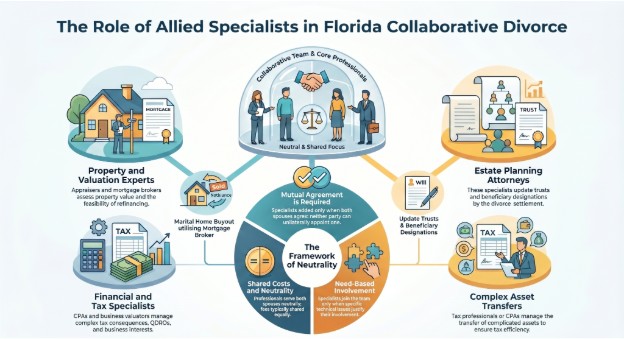
Allied professionals are specialists brought into the Florida Collaborative divorce team by mutual agreement of both spouses when the case involves a specific technical issue that the core team lacks the expertise to resolve.
Allied professionals do not join every Collaborative divorce — they are added only when a specific need justifies their involvement.
Common allied professionals and the situations that require them:
- Real estate appraiser — when the marital home or investment properties require a formal valuation for equitable distribution under Florida Statutes § 61.075
- Business valuator — when one or both spouses own a business whose value must be established for the marital balance sheet
- Tax professional or CPA — when complex tax consequences of asset transfers, QDROs, or retirement account division require specialized analysis
- Mortgage broker — when one spouse intends to refinance and assume the marital home, requiring a buyout figure and financing feasibility assessment
- Estate planning attorney — when the settlement affects existing trusts, beneficiary designations, or estate plans that require updating
Allied professionals serve both spouses neutrally, consistent with the Collaborative model. Both spouses agree in advance to retain any allied professional; neither spouse can unilaterally add a specialist to the team. Allied professional fees are typically shared equally by both spouses.
How Do All Team Members Work Together in Practice?
The Florida Collaborative divorce team works through a structured series of four-way meetings — both spouses and both attorneys present simultaneously — with the financial neutral and neutral facilitator joining the sessions as needed.
No backroom negotiations take place between attorneys. Every substantive decision is made in a meeting where both spouses are present and informed.
The sequence in practice:
- Between sessions: each spouse meets individually with their attorney and may meet with the financial neutral to review documents or with the neutral facilitator to prepare for the next session
- At each four-way meeting, the neutral facilitator opens the session, establishes the agenda, and manages communication; the financial neutral presents data relevant to the session’s topic; both attorneys advise their clients on the legal implications of each option under discussion.
- After agreement is reached, both attorneys draft the Collaborative Marital Settlement Agreement; the neutral facilitator finalizes the parenting plan if children are involved; both spouses review and sign the documents; the case is submitted to the court as an uncontested dissolution under Florida Statutes § 61.052
Florida Statutes § 61.58 protects all communications made during the Collaborative process as privileged and inadmissible in any subsequent court proceeding. Florida Statutes § 61.58 covers every team member’s communications, not just the attorneys’.
The Collaborative divorce timeline for Florida outlines how the full team process moves from the participation agreement to final court submission, with most Florida families completing the process in four to eight months, according to Florida Academy of Collaborative Professionals survey data.
Ready to understand exactly how the Collaborative team would work for your specific situation? Contact our Fort Lauderdale office for a straightforward assessment before you file anything.
Contact Us Today For An Appointment
Frequently Asked Questions
How many professionals are on a Florida Collaborative divorce team?
A standard Florida Collaborative divorce team includes four professionals: one Collaborative attorney per spouse, one financial neutral, and one neutral facilitator. A child specialist and allied professionals join only when the case requires their specific expertise. Every team member signs the Participation Agreement under Florida Statutes §§ 61.55–61.58.
Do both spouses share the same financial neutral in a Florida Collaborative divorce?
Both spouses share one financial neutral who serves neither party individually and provides both with identical financial data for every decision. The financial neutral does not advocate for either spouse. Both spouses share the financial neutral’s fees equally, which reduces the total cost compared to litigation, where each spouse retains competing experts.
What happens to the Collaborative team if the process fails?
When Collaborative divorce terminates in Florida, Florida Statutes § 61.57 requires both Collaborative attorneys to withdraw immediately. Neutral professionals are also bound by the Participation Agreement and cannot continue in subsequent litigation. Both spouses must retain new litigation counsel, and all Collaborative communications remain confidential under Florida Statutes § 61.58.
Does a Florida Collaborative divorce always require a child specialist?
A child specialist is optional in Florida Collaborative divorce, not mandatory. The mental health neutral handles the development of parenting plans for most families. A child specialist joins when the case involves young children with specific developmental needs, children with special needs, or complex custody circumstances requiring a direct child-centered professional assessment.
What qualifications does the financial neutral need in a Florida Collaborative divorce?
The financial neutral is typically a Certified Public Accountant (CPA), Certified Financial Planner (CFP), or a professional holding the CDFA designation from the Institute for Divorce Financial Analysts. The Collaborative role requires additional training in Collaborative practice beyond the base financial credential, regardless of which designation the professional holds.
Can one spouse hire their own financial expert outside the Collaborative team?
Yes, as long as it is with the knowledge and consent of the team. Often one spouse requires additional guidance on financial matters to make the best decisions going forward. A financial planner can help that spouse create scenarios based upon various options the team is discussing. In this scenario, the financial planner works closely with the team.
What is the difference between the neutral facilitator and a divorce coach?
The neutral facilitator facilitates communication during four-way meetings, while a divorce coach helps each spouse clarify goals and prepare individually between sessions. One mental health professional as the neutral facilitator usually serves both functions in Florida Collaborative teams. In other teams, two separate professionals are engaged — one shared neutral facilitator and one individual coach per spouse.
About the Author
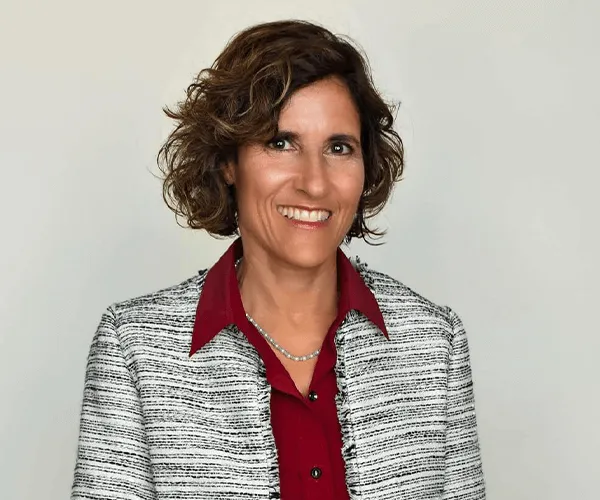
Carolann Mazza
Florida Family Law Attorney (The Florida Bar, admitted 2001) · Florida Supreme Court Certified Family Mediator (certified 2011, No. 25475F) · Super Lawyers, Family Law, 2022–2026
Carolann Mazza is the founder of Carolann Mazza, P.A., a non-litigation family law firm she opened in Fort Lauderdale in 2003. Practicing family law in Florida since 2001 and admitted to the State Bar of Texas in 1997, she resolves divorce and family conflicts exclusively through Collaborative Divorce, mediation, and out-of-court settlement — keeping families out of court while preserving relationships, dignity, and children’s wellbeing. She serves Broward, Palm Beach, and Miami-Dade counties.