
The Benefit of a Financial Neutral in Collaborative Divorce: How Expert Guidance Protects Assets

A financial neutral is a single, impartial financial professional who works with both spouses during a collaborative divorce, rather than each spouse retaining a separate advisor.
Financial neutrals gather account statements, tax returns, and property records, then organize that information into shared reports covering income, expenses, and post-divorce budgeting for both households.
Using one shared financial neutral can reduce the need for duplicate financial analysis, though it does not necessarily replace a CPA, tax professional, or business valuation expert when a case requires that specialized work.
Some financial neutrals working in divorce matters hold the Certified Divorce Financial Analyst (CDFA) designation, issued by the Institute for Divorce Financial Analysts.
Key Takeaways
- A financial neutral works with both spouses jointly during collaborative divorce, rather than representing either spouse individually.
- Financial neutrals organize financial records and build shared reports covering income, expenses, and post-divorce budgeting.
- Using one shared financial neutral can reduce duplicate financial analysis, though it does not replace a CPA, tax professional, or business valuation expert where specialized work is needed.
- The Certified Divorce Financial Analyst (CDFA) is one credential some financial neutrals hold; not every financial neutral carries this specific designation.
Financial complexity is one factor in deciding whether to add a financial neutral to a collaborative team. Carolann Mazza, P.A., discusses whether that role fits a specific case during a confidential consultation.
What Is a Financial Neutral in a Collaborative Divorce?
A financial neutral is a trained professional who joins the collaborative divorce team to organize financial information and help both spouses understand shared financial questions.
The role differs from a personal financial advisor: a financial neutral works with both spouses equally within the collaborative divorce process and does not represent either spouse’s individual interests.
Instead of each spouse hiring a separate financial advisor for the same questions, both spouses in a collaborative divorce can share one neutral professional, so both parties start with the same organized information rather than comparing separately commissioned reports.
What Does a Financial Neutral Organize and Analyze?
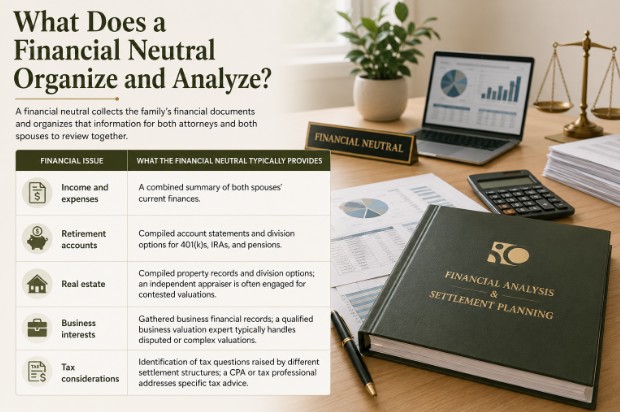
A financial neutral collects the family’s financial documents and organizes that information for both attorneys and both spouses to review together.
| Financial Issue | What the Financial Neutral Typically Provides |
| Income and expenses | A combined summary of both spouses’ current finances |
| Retirement accounts | Compiled account statements and division options for 401(k)s, IRAs, and pensions |
| Real estate | Compiled property records and division options; an independent appraiser is often engaged for contested valuations |
| Business interests | Gathered business financial records; a qualified business valuation expert typically handles disputed or complex valuations |
| Tax considerations | Identification of tax questions raised by different settlement structures; a CPA or tax professional addresses specific tax advice |
This organized information helps couples compare settlement scenarios — for example, what keeping the marital home means for one spouse’s finances compared to dividing retirement accounts instead.
If you’re ready to get started, call us now!
What Doesn’t a Financial Neutral Do?
A financial neutral does not provide legal advice or represent either spouse’s individual legal interests — that role belongs to each spouse’s collaborative attorney.
The financial neutral also does not typically perform an independent valuation of a contested business or piece of real property; that work generally requires a specialist such as a business valuation expert or licensed appraiser, whom the financial neutral may work alongside rather than substitute for.
Child support figures follow Florida’s statutory guidelines rather than the financial neutral’s own determination — a financial neutral can model how different scenarios might affect each household’s finances, but the collaborative attorneys apply the governing support guidelines to reach the actual figure.
Specific tax advice, similarly, is typically the domain of a CPA or tax professional; a financial neutral can flag that a settlement structure raises a tax question without resolving it independently.
How Does a Financial Neutral Affect Cost Compared to Separate Advisors?
Using one shared financial neutral can reduce certain costs compared to each spouse retaining a separate financial advisor, primarily because both spouses split one professional’s fee rather than paying for two separate engagements covering the same financial questions.
Whether that produces overall savings depends on case complexity, how many sessions are needed, and whether additional specialists — a business valuator or tax professional, for example — are still required alongside the financial neutral.
| With a Financial Neutral | Without a Financial Neutral |
| One shared financial professional works with both spouses | Each spouse may retain a separate financial advisor |
| Spouses generally split one fee | Two advisors may mean two separate sets of fees |
| Both spouses review the same financial analysis | Separate advisors may reach different conclusions on the same numbers |
| One set of organized financial documents | Duplicate document requests from two advisors |
Couples who each retain a separate advisor sometimes receive differing analyses of the same assets, which can add a point of disagreement to negotiations. Reviewing one shared analysis removes that particular source of duplication, though it doesn’t eliminate every disagreement a couple may have about the numbers.
When Does a Financial Neutral Add the Most Value?

A financial neutral is more likely to add value in cases involving:
- Multiple properties or investment accounts
- A business interest or complex income sources
- Retirement accounts, pensions, or stock options that need to be divided
- Questions about the completeness of financial disclosure
- Uncertainty about how different settlement options affect each spouse’s finances
A financial neutral may add less value in a short marriage with few shared assets, or where both spouses already agree on asset division and neither has complex income or property to sort through.
If you’re ready to get started, call us now!
How Does the Financial Neutral Process Work Step by Step?
Step 1: Information Gathering
The financial neutral collects documents such as bank statements, tax returns, investment account records, and property records from both spouses.
Step 2: Organization and Explanation
The financial neutral organizes the documents and explains the couple’s assets, debts, and income in plain terms, building a shared starting point for both spouses.
Step 3: Modeling Settlement Options
The financial neutral builds models showing how different property division and retirement account scenarios could affect each household’s finances. Child support figures follow Florida’s statutory guidelines, which the collaborative attorneys apply rather than the financial neutral.
Step 4: Team Coordination
The financial neutral typically meets with both collaborative attorneys to ensure the financial information aligns with the settlement being negotiated.
Step 5: Settlement Support
Once both spouses choose their preferred options, the financial neutral helps organize the numbers supporting the written marital settlement agreement.
Is a Financial Neutral Necessary for Every Divorce?
Not every collaborative divorce case needs a financial neutral. Couples with simple finances and no significant disagreement about asset division sometimes handle financial matters directly with their attorneys.
Cases involving multiple properties, a business, retirement account division, or uncertainty about the full financial picture are more likely to benefit from a financial neutral.
Carolann Mazza, P.A. discusses whether a financial neutral fits a specific case as part of building the collaborative divorce team for Broward, Palm Beach, and Miami-Dade County clients.
Contact Us Today For An Appointment
Frequently Asked Questions
What does a financial neutral do in a collaborative divorce?
A financial neutral gathers and organizes both spouses’ financial information into shared reports and models settlement scenarios. The role doesn’t include independently valuing a contested business or property, or giving specific tax advice — those typically involve a separately qualified specialist.
Is a financial neutral only useful for wealthy couples?
No. A financial neutral can help couples at various income levels build a shared understanding of their finances and clarify support calculations. Splitting one professional’s fee is often more accessible than each spouse hiring a separate advisor for the same questions.
How does a financial neutral reduce disagreement between spouses?
Both spouses review the same financial analysis rather than comparing separately commissioned reports, which removes one common source of dispute. It doesn’t eliminate every disagreement a couple may have about how to divide assets.
What credential do financial neutrals typically hold?
Some financial neutrals hold the Certified Divorce Financial Analyst (CDFA) designation, issued by the Institute for Divorce Financial Analysts, which trains professionals in divorce-related tax, property, and retirement issues. Not every financial neutral carries this specific credential.
What kinds of financial issues can a financial neutral help organize?
A financial neutral typically organizes income and expense information, retirement account details, real estate records, and business financial records, and identifies tax questions raised by different settlement structures for further review by a qualified professional.
What doesn’t a financial neutral do?
A financial neutral doesn’t provide legal advice, represent either spouse individually, independently value a contested business or property, or give specific tax advice. Those functions typically involve the collaborative attorneys, a business valuation expert, or a CPA.
What happens without a financial neutral in a collaborative divorce?
Spouses may each retain a separate financial advisor, which can mean two sets of fees and, at times, differing analyses of the same assets. That duplication can add friction to negotiations compared to reviewing one shared analysis.
When is a financial neutral not necessary?
A financial neutral may not be necessary for a short marriage with few shared assets, or when both spouses already agree on asset division, and neither has complex income, business interests, or retirement accounts to divide.
Does a financial neutral replace the need for collaborative attorneys?
No. A financial neutral is one member of the broader collaborative team alongside each spouse’s collaborative attorney. The financial neutral organizes and models the numbers; the attorneys address legal rights and the terms of the settlement agreement.
Bottom Line
A financial neutral is one impartial financial professional who works with both spouses in a collaborative divorce, reducing the need for each spouse to obtain duplicate financial analysis.
The role includes organizing financial records and modeling settlement scenarios—it does not replace a CPA, tax professional, or business valuation expert when specialized work is required, and it does not determine legal outcomes like child support figures.
Financial neutrals are more likely to add value in cases involving multiple properties, business interests, or retirement account division.
Carolann Mazza, P.A. helps Broward, Palm Beach, and Miami-Dade County spouses determine whether a financial neutral fits their collaborative divorce — schedule a confidential consultation to discuss the collaborative team that fits a specific case.

About the Author
Carolann Mazza
Florida Family Law Attorney (The Florida Bar, admitted 2001) · Florida Supreme Court Certified Family Mediator (certified 2011, No. 25475F) · Super Lawyers, Family Law, 2022–2026
Carolann Mazza is the founder of Carolann Mazza, P.A., a non-litigation family law firm she opened in Fort Lauderdale in 2003. Practicing family law in Florida since 2001 and admitted to the State Bar of Texas in 1997, she resolves divorce and family conflicts exclusively through Collaborative Divorce, mediation, and out-of-court settlement — keeping families out of court while preserving relationships, dignity, and children’s wellbeing. She serves Broward, Palm Beach, and Miami-Dade counties.