
The Shift Toward Collaborative Divorce in Florida: What Families Should Know
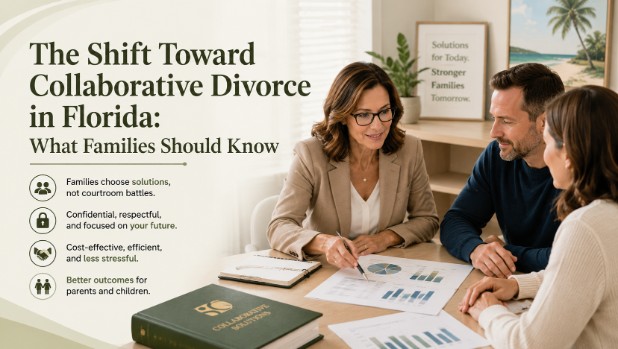
Collaborative divorce lets Florida spouses resolve a dissolution of marriage under the Collaborative Law Process Act, sections 61.55–61.58, Florida Statutes, without contested court proceedings.
The process can begin whether or not a case has already been filed — if a proceeding is already pending, the signed participation agreement operates as a request to stay it under Fla. Fam. L. R. P. 12.745.
Florida’s 2023 reforms to alimony and time-sharing changed the statutory framework collaborative teams now negotiate within, giving spouses a more defined set of legal parameters than existed before those reforms.
Key Takeaways
- Collaborative divorce operates under Florida’s Collaborative Law Process Act, sections 61.55–61.58, Florida Statutes, effective July 1, 2017.
- The process can begin before or after a case is filed; a pending proceeding is stayed once the parties sign the participation agreement.
- Florida Statute § 61.08, amended by Senate Bill 1416 effective July 1, 2023, eliminated permanent alimony for new cases, limiting awards to temporary, bridge-the-gap, rehabilitative, or durational alimony.
- Florida Statute § 61.13 established a rebuttable presumption of equal time-sharing effective July 1, 2023.
Carolann Mazza, P.A., helps South Florida spouses understand what that negotiation looks like today—schedule a confidential consultation.
How Did Florida’s 2023 Reforms Change the Legal Landscape for Collaborative Divorce?
Senate Bill 1416, effective July 1, 2023, amended § 61.08, Florida Statutes, to eliminate permanent alimony for new cases and limit awards to four defined categories: temporary, bridge-the-gap, rehabilitative, and durational alimony.
The same effective date brought § 61.13’s rebuttable presumption of equal time-sharing into force.
These changes replaced open-ended judicial discretion on two of the most contested issues in a divorce — alimony and time-sharing — with a more defined statutory starting point.
That narrows the range of outcomes a judge would likely order in litigation, which in turn narrows the range collaborative teams negotiate around.
The Collaborative Law Process Act itself has not changed materially since it took effect July 1, 2017 — what changed is the surrounding alimony and time-sharing law that collaborative negotiations now work within.
If you’re ready to get started, call us now!
How Does Collaborative Divorce Work Under Florida Law?
The collaborative process begins when both spouses and their collaborative attorneys sign a participation agreement — regardless of whether a case has already been filed.
If a proceeding is already pending in court, signing the agreement operates as an application to stay that proceeding under Fla. Fam. L. R. P. 12.745. Communications made during the process are generally privileged under Section 61.58, Florida Statutes, subject to statutory exceptions such as threats of violence or written waiver by both spouses.
Step 1: Participation Agreement
Both spouses and their collaborative attorneys sign, staying any pending court proceeding and committing to negotiate a settlement instead.
Step 2: Team Assembly
Spouses can add a neutral financial professional and, where needed, a communication facilitator or child specialist, depending on the case.
Step 3: Joint Sessions
Structured meetings address assets, parenting, and support, working from Florida’s current alimony and time-sharing statutes as a starting point for negotiation.
Step 4: Marital Settlement Agreement
Spouses sign a written agreement covering every disputed issue, which is filed with the court for final judgment.
If either spouse initiates contested litigation instead, the collaborative process terminates, and under Rule Regulating the Florida Bar 4-1.19, both collaborative attorneys are barred from representing either spouse against the other in that litigation.
How Does Collaborative Divorce Compare to Litigation?
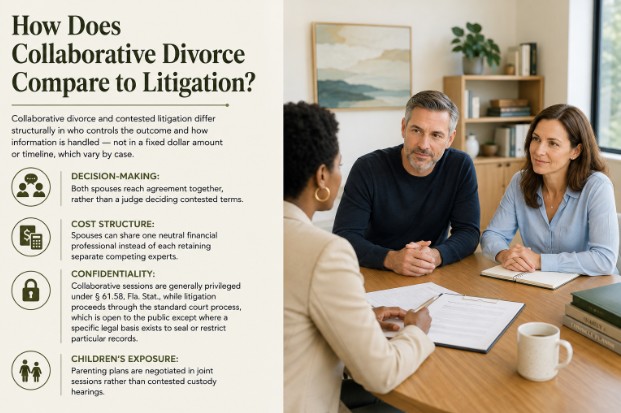
Collaborative divorce and contested litigation differ structurally in who controls the outcome and how information is handled — not in a fixed dollar amount or timeline, which vary by case.
- Decision-making: both spouses reach agreement together, rather than a judge deciding contested terms
- Cost structure: spouses can share one neutral financial professional instead of each retaining separate competing experts
- Confidentiality: collaborative sessions are generally privileged under § 61.58, Fla. Stat., while litigation proceeds through the standard court process, which is open to the public except where a specific legal basis exists to seal or restrict particular records
- Children’s exposure: parenting plans are negotiated in joint sessions rather than contested custody hearings
Families with children often weigh this last point heavily, since Florida law requires every parenting plan to address decision-making authority and the time-sharing schedule regardless of which process produces it.
If you’re ready to get started, call us now!
How Is Collaborative Divorce Different From Mediation?
Collaborative divorce and mediation are both non-litigation processes, but they’re structured differently. In mediation, both spouses work with one neutral mediator, who does not represent either spouse and cannot give legal advice to either one. In collaborative divorce, each spouse retains a separate collaborative attorney who advises them individually while all parties work toward a joint settlement, and the team can include additional neutrals such as a financial professional.
Carolann Mazza, P.A. offers both Florida Supreme Court-certified mediation and collaborative divorce and discusses which structure fits a specific case during a consultation.
Who Is Collaborative Divorce Not Right for in Florida?
Collaborative divorce depends on both spouses voluntarily disclosing financial information and negotiating in good faith.
It may not be the right fit for every situation, including cases involving domestic violence, undisclosed assets, or a spouse unwilling to participate voluntarily.
Couples with complex financial situations can still choose collaborative divorce, but often add specialized professionals — such as a business valuation expert or CPA — to the collaborative team to address those specific issues.
Whether collaborative divorce, mediation, or litigation best fits a specific situation depends on the facts of that case, and is a determination made with an attorney rather than from a generic checklist.
How Can Couples Prepare for Collaborative Divorce?
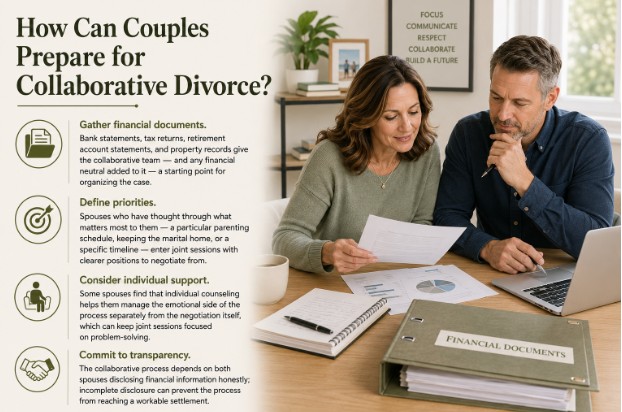
Gather financial documents. Bank statements, tax returns, retirement account statements, and property records give the collaborative team — and any financial neutral added to it — a starting point for organizing the case.
Define priorities. Spouses who have thought through what matters most to them — a particular parenting schedule, keeping the marital home, or a specific timeline — enter joint sessions with clearer positions to negotiate from.
Consider individual support. Some spouses find that individual counseling helps them manage the emotional side of the process separately from the negotiation itself, which can keep joint sessions focused on problem-solving.
Commit to transparency. The collaborative process depends on both spouses disclosing financial information honestly; incomplete disclosure can prevent the process from reaching a workable settlement.
Contact Us Today For An Appointment
Frequently Asked Questions
Is collaborative divorce legal in Florida?
Yes. Florida’s Collaborative Law Process Act, sections 61.55–61.58, Florida Statutes, took effect July 1, 2017, and governs collaborative divorce cases statewide.
Does a case have to be filed before starting collaborative divorce?
No. The collaborative process can begin before or after filing a case. If a proceeding is already pending, signing the participation agreement requests a stay of that proceeding under Fla. Fam. L. R. P. 12.745.
How did Florida’s 2023 alimony reform affect collaborative divorce?
Florida Statute § 61.08, amended by Senate Bill 1416 effective July 1, 2023, eliminated permanent alimony for new cases and limited awards to four defined categories. This gives collaborative teams a clearer statutory starting point for negotiation.
Do both spouses need separate attorneys for collaborative divorce?
Yes. Each spouse retains a separate collaborative attorney who signs the participation agreement. Both attorneys are barred from representing either spouse in litigation against the other if the process later terminates.
How is collaborative divorce different from mediation?
Mediation uses one neutral mediator who works with both spouses and cannot give legal advice to either. Collaborative divorce gives each spouse a separate attorney who advises them individually while the team works toward a joint settlement.
How does collaborative divorce affect children?
Spouses negotiate parenting plans and time-sharing schedules in joint sessions rather than contested custody hearings. Florida Statute § 61.13 governs the required content of every parenting plan, whether reached collaboratively or through litigation.
What happens if collaborative divorce fails in Florida?
The process terminates, and under Bar Rule 4-1.19, both collaborative attorneys are barred from representing either spouse against the other in the resulting litigation. Spouses must retain new litigation counsel.
Is collaborative divorce confidential?
Communications made during the process are generally privileged under Section 61.58, Florida Statutes, subject to statutory exceptions such as threats of violence or written waiver by both spouses.
What should couples gather before starting collaborative divorce?
Bank statements, tax returns, retirement account statements, and property records give the collaborative team a starting point. Clear priorities around parenting, property, and timeline also help sessions run more efficiently.
Bottom Line
Collaborative divorce lets Florida spouses resolve a dissolution of marriage under the Collaborative Law Process Act without contested court proceedings, whether or not a case has already been filed.
The Act itself hasn’t changed materially since 2017, but Florida’s 2023 alimony and time-sharing reforms gave collaborative teams a more defined statutory framework to negotiate within.
Both spouses retain separate attorneys, communications are generally privileged, and either spouse can end the process at the cost of both attorneys’ ability to continue representing them in litigation.
The process isn’t right for every situation — it may not fit cases involving domestic violence or undisclosed assets, among others.
Carolann Mazza, P.A. helps Broward, Palm Beach, and Miami-Dade County spouses evaluate whether collaborative divorce fits their circumstances — contact Carolann Mazza, P.A. today.

About the Author
Carolann Mazza
Florida Family Law Attorney (The Florida Bar, admitted 2001) · Florida Supreme Court Certified Family Mediator (certified 2011, No. 25475F) · Super Lawyers, Family Law, 2022–2026
Carolann Mazza is the founder of Carolann Mazza, P.A., a non-litigation family law firm she opened in Fort Lauderdale in 2003. Practicing family law in Florida since 2001 and admitted to the State Bar of Texas in 1997, she resolves divorce and family conflicts exclusively through Collaborative Divorce, mediation, and out-of-court settlement — keeping families out of court while preserving relationships, dignity, and children’s wellbeing. She serves Broward, Palm Beach, and Miami-Dade counties.