
Collaborative Divorce Attorney Broward County, Florida- Carolann Mazza
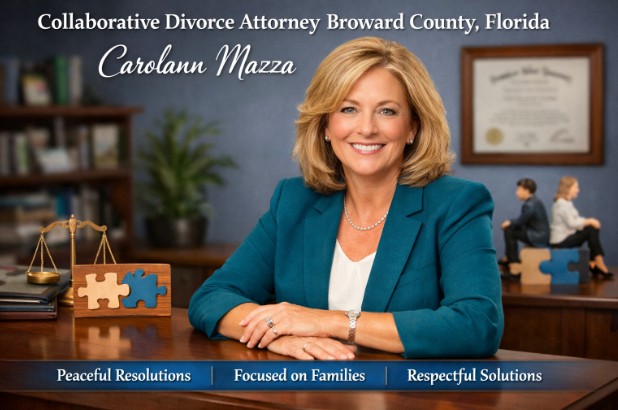
Carolann Mazza, P.A., is a Fort Lauderdale-based non-litigation family law firm. Broward County’s home-practice collaborative divorce firm since 2001, Carolann Mazza, P.A., is located at 12 SE 7th St, Fort Lauderdale, FL 33301. Carolann Mazza is a Florida Supreme Court Certified Family Mediator licensed since 2001.
Carolann Mazza, P.A., resolves collaborative divorce, mediation, and out-of-court settlement cases for all Broward County families under Florida’s Collaborative Law Process Act, Section 61.56, Florida Statutes.
Uncontested agreements are filed at the Broward County Central Courthouse, 201 SE 6th Street, Fort Lauderdale, FL 33301, without contested proceedings before Broward County’s 17th Judicial Circuit.
Call (954) 527-4604 for a confidential consultation.
Key Takeaways
- Broward County’s 17th Judicial Circuit uses a general assignment system — contested divorce cases go to whichever judge is available, giving families no advance knowledge of judicial philosophy, timeline, or approach.
- The Broward County Central Courthouse filing fee for a dissolution of marriage is $409, with an additional $10 for summons issuance and $40 for service of process through the Broward Sheriff’s Office.
- Florida Academy of Collaborative Professionals data shows 78% of Florida collaborative divorce cases conclude within six months — compared to 12 months or more for contested proceedings on Broward County’s 17th Judicial Circuit dockets.t
- Carolann Mazza, P., A. serves all 31 Broward County municipalities — from Fort Lauderdale and Hollywood to Weston, Parkland, Coral Springs, Pembroke Pines, Davie, and surrounding communities.s
Carolann Mazza, P.A., is Fort Lauderdale’s non-litigation family law firm — serving all Broward County families from the home county base since 2001. Schedule a confidential consultation today or call (954) 527-4604.
If you’re ready to get started, call us now!
How Does Collaborative Divorce Work Differently in Broward County?
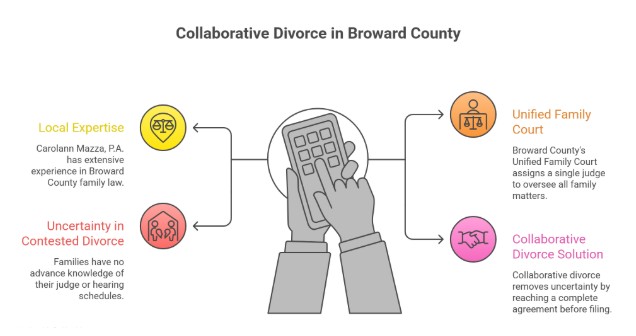
Carolann Mazza, P.A., has practiced family law in Broward County from the firm’s Fort Lauderdale office since 2001. That home-county depth gives Broward County families an advantage no out-of-county referral can replicate — a collaborative attorney whose entire non-litigation practice is built around the 17th Judicial Circuit’s specific family court environment.
Broward County is the second most populous county in Florida, with a 2026 projected population of approximately 1,998,037 residents across 31 municipalities, according to the US Census Bureau QuickFacts for Broward County.
The county’s Unified Family Court operates within the 17th Judicial Circuit of Florida, assigning a single judge to oversee all matters involving a single family. Contested divorce cases enter through a general assignment process.
Families have no advance knowledge of which judge handles their case, what that judge’s timeline preferences are, or how long the docket takes to schedule hearings.
Collaborative divorce removes that uncertainty entirely. Both spouses reach a complete written agreement before a single contested motion is filed at the Broward County Clerk of Courts.
For a full step-by-step guide to Broward County filing practicalities — including courthouse locations, cover sheet requirements, and eFiling procedures — see that resource. It covers every procedural detail for families entering the Broward family court system.
Does Broward County’s General Assignment System Affect Divorce Outcomes?
Broward County’s 17th Judicial Circuit uses a general assignment system for contested divorce cases — meaning a case is assigned to whichever judge is available rather than to a judge who encourages alternative dispute resolution. Palm Beach County’s 15th Judicial Circuit, by contrast, has judges who actively encourage collaborative divorce before contested hearings proceed.
In Broward County’s general assignment system, contested families have no predictability over judicial philosophy, timeline, or approach to disputed issues.
Collaborative divorce bypasses that system entirely — both spouses resolve every issue privately before any judge is assigned. For a detailed comparison of Broward, Miami-Dade, and Palm Beach County divorce fees and procedural differences, the county comparison covers each circuit’s specific characteristics.
How Does Broward County’s Unified Family Court Work?
Broward County’s Unified Family Court is a comprehensive approach to handling all cases involving children and families under the 17th Judicial Circuit’s Unified Family Court framework.
One judge oversees all delinquency, dependency, and domestic relations matters — including divorce, child custody, child support, alimony, and domestic violence — for each family.
That unified structure is designed to improve consistency and reduce delays. In practice, it also means every contested motion, financial disclosure, and hearing becomes part of a permanent public record maintained by the Broward County Clerk of Courts under the Florida Public Records Act.
Collaborative divorce keeps every disclosure, proposal, and financial detail privileged and inadmissible under Section 61.57, Florida Statutes — entirely out of the public record.
If you’re ready to get started, call us now!
What Is the Broward County Collaborative Divorce Professional Community?
Broward County has an established collaborative divorce professional community that Carolann Mazza, P.A., operates within directly.
The Collaborative Family Professionals of South Florida — of which Carolann Mazza is an active member — serves Broward County families through a network of trained collaborative attorneys, Certified Divorce Financial Analysts, licensed mental health neutrals, and child specialists who work collaboratively within the county’s specific family law environment.
That existing professional network means Broward County collaborative cases move efficiently through team assembly — rather than requiring attorneys to build a team from scratch for each case.
The International Academy of Collaborative Professionals sets the global training and ethical standards that govern all members of the network.
What Does Collaborative Divorce Cost for Broward County Families?
Collaborative divorce costs for Broward County families follow the same shared professional fee structure that applies across South Florida — producing per-spouse costs significantly lower than contested litigation on Broward County’s 17th Judicial Circuit docket.
What Is the Divorce Filing Fee in Broward County?
Every dissolution of marriage filed in Broward County carries a clerk’s filing fee of $409 at the Broward County Central Courthouse, 201 SE 6th Street, Fort Lauderdale, FL 33301, as confirmed by the Broward County Clerk of Courts’ fee schedule.
Summons issuance adds $10. Service of process through the Broward Sheriff’s Office adds $40. These base costs apply to every Broward County divorce filing — collaborative or contested.
How Much Does Collaborative Divorce Cost in Broward County?
Most Florida collaborative divorce cases resolve for $5,000 to $8,000 per spouse when both parties cooperate fully.
Broward County cases involving Fort Lauderdale waterfront real estate, Weston and Parkland executive residential properties, Coral Springs and Pembroke Pines family homes with accumulated equity, and closely held business interests across Broward County’s professional services, healthcare, and technology sectors benefit directly from the shared CDFA model.
One neutral Certified Divorce Financial Analyst credentialed by the Institute for Divorce Financial Analysts values all asset categories jointly — replacing competing appraisers and business valuators whose dueling expert fees drive contested litigation costs toward $15,000 to $30,000 or more per spouse in Broward County’s 17th Judicial Circuit.
How Do Broward County Collaborative Divorce Costs Compare to Contested Litigation?
Contested litigation on Broward County’s 17th Judicial Circuit docket averages $15,000 to $30,000 per spouse, or more, when attorney retainers, hourly billing throughout discovery, and multiple hearings, competing expert witnesses, and mandatory mediation fees of $200 to $400 per hour across two to four court-ordered sessions are included.
Collaborative divorce eliminates mandatory mediation costs, competing expert witness fees, discovery expenses, and contested motion practice entirely.
For a full Florida-wide cost comparison, the collaborative divorce cost breakdown documents each process across all three South Florida counties.
What Legal Issues Does Collaborative Divorce Resolve for Broward County Families?
Collaborative divorce in Broward County resolves every substantive family law issue under Florida Statutes Chapter 61 through negotiated agreement rather than contested motions or judicial hearings at the Broward County Central Courthouse.
Equitable distribution under Section 61.075, Florida Statutes, divides marital property equitably — not equally. Broward County cases frequently address Fort Lauderdale waterfront condominiums, Weston and Parkland executive properties, Davie equestrian holdings, and Port Everglades-adjacent business interests.
A neutral Certified Divorce Financial Analyst builds shared distribution scenarios for both spouses — replacing competing appraisers arguing values before a general-assignment 17th Judicial Circuit judge.
Alimony is governed by the 2023 Alimony Reform Act, which eliminated permanent alimony and capped durational alimony at 50% of the marriage length for marriages under 20 years. Collaborative divorce gives both spouses direct control over the amount, duration, and structure.
The tax treatment of alimony under the Tax Cuts and Jobs Act of 2017 eliminates deductibility for the paying spouse on all post-2018 agreements. IRS Publication 504 confirms the current federal treatment.
Child time-sharing and parental responsibility fall under Section 61.13, Florida Statutes. Broward County families frequently navigate time-sharing across Fort Lauderdale, Hollywood, Coral Springs, Weston, Miramar, and Hallandale Beach — each with distinct Broward County Public Schools enrollment zones and commute profiles.
A child specialist builds parenting plans that reflect those realities. Carolann Mazza, P.A., handles children’s issues as a core component of every collaborative case involving minor children.
Child support is calculated under Section 61.30, Florida Statutes, using Florida’s income shares guidelines. The financial neutral models multiple scenarios — including the effect of different time-sharing splits on the monthly obligation — so both parents understand the financial implications before committing to final figures.
| Issue | Florida Statute | How Collaborative Addresses It |
| Property division | §61.075 | Neutral CDFA builds shared distribution scenarios |
| Alimony | §61.08, 2023 Reform Act | Spouses control the amount, duration, and structure |
| Child time-sharing | §61.13 | Child specialist designs Broward-specific parenting plan |
| Child support | §61.30 | Financial neutral models multiple time-sharing scenarios |
| Parental responsibility | §61.13 | The agreement specifies sole or shared decision-making |
Carolann Mazza, P.A., handles divorce services across all five resolution areas entirely through out-of-court processes. Florida’s full statutory framework is documented in the Collaborative Law Process Act.
For a month-by-month breakdown, the collaborative divorce process covers each stage in detail.
Which Broward County Communities Does Carolann Mazza, P.A., serve?
Carolann Mazza, P.A. serves all 31 Broward County municipalities from the Fort Lauderdale office — including Fort Lauderdale, Hollywood, Pembroke Pines, Coral Springs, Weston, Plantation, Davie, Sunrise, Deerfield Beach, Pompano Beach, Parkland, Coconut Creek, Hallandale Beach, Miramar, Lauderhill, Margate, Tamarac, Oakland Park, Wilton Manors, Dania Beach, Cooper City, and Lighthouse Point.
Broward County’s residential profile spans from young professional families in downtown Fort Lauderdale and Wilton Manors to established households in Weston, Parkland, and Coral Springs, with long marriages, real estate equity, retirement portfolios, and business interests.
The collaborative model serves all of these profiles without the adversarial cost structure of contested litigation.
For families comparing all available options, collaborative divorce vs. mediation outlines both pathways in terms of cost, timeline, and legal representation.
A peaceful divorce in Florida is achievable through multiple routes — the right process depends on each family’s specific circumstances.
Broward County families navigating divorce keep control of financial outcomes and parenting arrangements with Carolann Mazza, P.A. Contact us today or call (954) 527-4604 to discuss your specific situation.
Carolann Mazza conducts structured intake screening before any Participation Agreement is signed under Section 61.55, Florida Statutes.
Broward County clients who are not suited for collaborative representation are redirected to mediation services or unbundled legal services after the consultation establishes which process fits their circumstances.
Contact Us Today For An Appointment
Frequently Asked Questions
Does Carolann Mazza serve all Broward County communities?
Carolann Mazza, P.A., serves all 31 Broward County municipalities from the firm’s Fort Lauderdale office at 12 SE 7th St, Fort Lauderdale, FL 33301 — including Fort Lauderdale, Hollywood, Coral Springs, Weston, Pembroke Pines, Plantation, Davie, Parkland, and surrounding communities. Call (954) 527-4604 to confirm service for your specific location.
Where are collaborative divorce cases filed for Broward County residents?
Collaborative divorce cases for Broward County residents are filed at the Broward County Central Courthouse, 201 SE 6th Street, Fort Lauderdale, FL 33301, Unified Family Court, West Building, 4th Floor, Room 04130 — as an uncontested dissolution of marriage only after both spouses reach full written agreement on all issues entirely outside of court.
What is Broward County’s 17th Judicial Circuit general assignment system?
Broward County’s 17th Judicial Circuit assigns contested divorce cases to whichever judge is available — rather than to a designated judge who encourages alternative dispute resolution. Families entering contested proceedings have no advance knowledge of their assigned judge’s timeline or approach. Collaborative divorce bypasses the general assignment system entirely — no judge is involved until the uncontested final filing.
How long does collaborative divorce take for Broward County families?
Collaborative divorce for Broward County families typically takes four to eight months. Florida Academy of Collaborative Professionals data shows 78% of Florida collaborative cases reach full agreement within six months of the Participation Agreement signing — compared to 12 months or more for contested proceedings on Broward County’s 17th Judicial Circuit general assignment docket.
What does collaborative divorce cost for Broward County families?
Collaborative divorce for Broward County families typically costs $5,000 to $8,000 per spouse. Contested litigation on Broward County’s 17th Judicial Circuit averages $15,000 to $30,000 or more per person when attorney fees, expert witnesses, mandatory mediation fees of $200 to $400 per hour, and court costs are included. The Broward County clerk’s filing fee is $409 for a dissolution of marriage petition.
Can collaborative divorce handle Broward County cases involving Fort Lauderdale waterfront property or Weston executive homes?
Collaborative divorce handles complex Broward County asset cases by assigning a neutral Certified Divorce Financial Analyst — credentialed by the Institute for Divorce Financial Analysts — to value Fort Lauderdale waterfront real estate, Weston and Parkland executive residential properties, Davie equestrian holdings, and business interests jointly for both spouses — without competing expert witnesses arguing valuations before a 17th Judicial Circuit general-assignment judge.
Is Carolann Mazza, P.A, based in Broward County?
Carolann Mazza, P.A., is based in Fort Lauderdale, Broward County, at 12 SE 7th St, Fort Lauderdale, FL 33301. Carolann Mazza has practiced family law in Broward County since 2001 — making Broward County the firm’s home practice county and the origin point of a South Florida collaborative divorce practice spanning Broward, Palm Beach, and Miami-Dade counties.
Does Carolann Mazza offer mediation for Broward County clients?
Carolann Mazza offers divorce mediation to Broward County clients as a Florida Supreme Court Certified Family Mediator. Mediation uses a single neutral professional to facilitate negotiation, rather than a full multidisciplinary team with dedicated legal representation for each spouse — a cost-effective option for Broward County couples who can negotiate without individual legal counsel throughout the process.
Broward County families with real estate, retirement assets, or business interests in Fort Lauderdale, Weston, Coral Springs, and surrounding communities privately resolve equitable distribution, support, and parenting terms with Carolann Mazza, P.A., without a 17th Judicial Circuit general-assignment judge making those decisions. Schedule a confidential consultation today or call (954) 527-4604.
About the Author
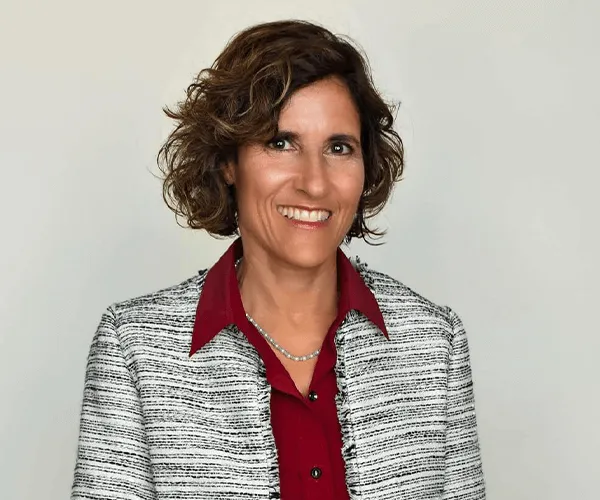
Carolann Mazza
Florida Family Law Attorney (The Florida Bar, admitted 2001) · Florida Supreme Court Certified Family Mediator (certified 2011, No. 25475F) · Super Lawyers, Family Law, 2022–2026
Carolann Mazza is the founder of Carolann Mazza, P.A., a non-litigation family law firm she opened in Fort Lauderdale in 2003. Practicing family law in Florida since 2001 and admitted to the State Bar of Texas in 1997, she resolves divorce and family conflicts exclusively through Collaborative Divorce, mediation, and out-of-court settlement — keeping families out of court while preserving relationships, dignity, and children’s wellbeing. She serves Broward, Palm Beach, and Miami-Dade counties.