
How to File for Divorce in Broward County: Courthouse, Fees, and Filing Packet
Filing for divorce in Broward County starts with opening a case. The spouse filing submits a dissolution of marriage petition, a Form 12.928 cover sheet, and the $409 filing fee to the Broward County Clerk of Courts Family Division or the Florida Courts E-Filing Portal.
Additional documents vary depending on the children, property, and filing route. Carolann Mazza, P.A. (Collaborative Solutions), a Fort Lauderdale, Florida non-litigation family law firm, prepares divorce filing packets for spouses who settle outside the courtroom.
A carefully assembled packet reduces avoidable clerk rejections and the need for correction filings.
Key Takeaways
- The Broward County Clerk of Courts lists a $409 fee to file a dissolution of marriage petition and $10 to issue each summons.
- The Family Division accepts paper filings at 201 SE 6th Street, 4th Floor, Room 04130, Fort Lauderdale, weekdays from 8:00 a.m. to 3:30 p.m.
- Section 61.052(2), Florida Statutes, requires corroboration of the 6-month Florida residency set by section 61.021.
- Florida Family Law Rule of Procedure 12.285 governs the exchange of financial affidavits in covered cases.
Filing errors can mean correction filings and added service costs. Carolann Mazza, P.A. reviews Broward packets, so spouses can schedule an early filing review.
Where Do Broward County Residents File a Divorce Petition?
Broward County residents file a divorce petition with the Family Division of the Broward County Clerk of Courts. The Family Division is in the West Building of the Central Courthouse Judicial Complex at 201 SE 6th Street, Fort Lauderdale, FL 33301. Its counter sits on the 4th Floor, Room 04130, and answers calls at (954) 831-6565.
The Clerk’s hours and locations directory lists the Family Division only at the Central Courthouse. The North Regional Courthouse in Deerfield Beach, the South Regional Courthouse in Hollywood, and the West Regional Courthouse in Plantation house county civil counters.
A spouse living in Coral Springs or Pembroke Pines therefore files a family case in downtown Fort Lauderdale or online.
The Pro Se Self Help Unit on the 2nd Floor, Room 02140, sells approved family law forms from 8:30 a.m. to 3:30 p.m. Its staff cannot give legal advice or choose forms.
Spouses who want an attorney to review only the paperwork can use unbundled legal services and keep control of the remaining steps in the case.
How Much Does It Cost to File for Divorce in Broward County?
The Broward County Clerk of Courts fee schedule lists $409 to file a dissolution of marriage petition and $10 to issue each summons as of October 2026. Service is a separate charge. Section 30.231, Florida Statutes, sets the sheriff’s fee at $40 per summons, and private process servers set their own rates.
| Filing event | Broward fee (October 2026) | Paid to |
| Dissolution of marriage or annulment petition | $409.00 | Broward County Clerk of Courts |
| Counter petition in a domestic relations case | $392.50 | Broward County Clerk of Courts |
| Modification of a final judgment of dissolution | $50.00 | Broward County Clerk of Courts |
| Issuance of each summons | $10.00 | Broward County Clerk of Courts |
| Sheriff service of each summons | $40.00 | Broward Sheriff’s Office |
The Clerk accepts cash, cashier’s checks, money orders, attorney’s checks, and American Express, Discover, MasterCard, or Visa cards. The Clerk’s fee schedule states that the Clerk refuses personal checks.
A filer approved as civil indigent under section 57.082, Florida Statutes, has the filing and summons fees waived, although other case costs may still apply.
Court costs stay fixed, while total South Florida divorce costs rise with each issue that both spouses leave unresolved.
Which Documents Open a Broward Divorce Case, and Which Come Later?
Three documents open a Broward divorce case: the correct petition, the Form 12.928 Cover Sheet for Family Court Cases, and a Notice of Social Security Number. Documents related to children, property, service, and financial disclosure are added at later stages.
The Florida Supreme Court posts the forms below free of charge on its family law forms page.
| Stage | Document | Florida form | Required when |
| Opening the case | Petition (one version) | 12.901(b)(1), (b)(2), or (b)(3) | Always; the version depends on minor children and shared property |
| Opening the case | Joint Petition for Simplified Dissolution | 12.901(a) | Replaces the regular petition only when both spouses qualify for simplified dissolution |
| Opening the case | Cover Sheet for Family Court Cases | 12.928 | Every new family case, filed with the first pleading |
| Opening the case | Notice of Social Security Number | 12.902(j) | Every dissolution petition, as a separate attachment |
| Opening the case | UCCJEA Affidavit | 12.902(d) | The spouses share minor children |
| Service | Summons: Personal Service | 12.910(a) | The other spouse is served by the sheriff or a certified process server |
| Within 45 days of service | Financial Affidavit | 12.902(b) or (c) | Cases covered by Rule 12.285 |
| Within 45 days of service | Certificate of Compliance with Mandatory Disclosure | 12.932 | Cases covered by Rule 12.285, unless the spouses agree not to exchange those documents |
| Before final judgment | Affidavit of Corroborating Witness | 12.902(i) | Residency proof comes from a third party |
| Before final judgment | Marital Settlement Agreement | 12.902(f)(1), (f)(2), or (f)(3) | The spouses resolve their issues by agreement |
Section 61.021, Florida Statutes, requires one spouse to live in Florida for 6 months before filing the petition. Section 61.052(2), Florida Statutes, requires that residency be corroborated.
Acceptable corroboration is a valid Florida driver’s license, a Florida ID card, a voter registration card, or third-party testimony or affidavit.
A spouse’s statement alone does not satisfy the statute, and corroborating proof should cover the full 6 months before filing.
If you’re ready to get started, call us now!
Should a Broward Filer Use E-Filing or File in Person?
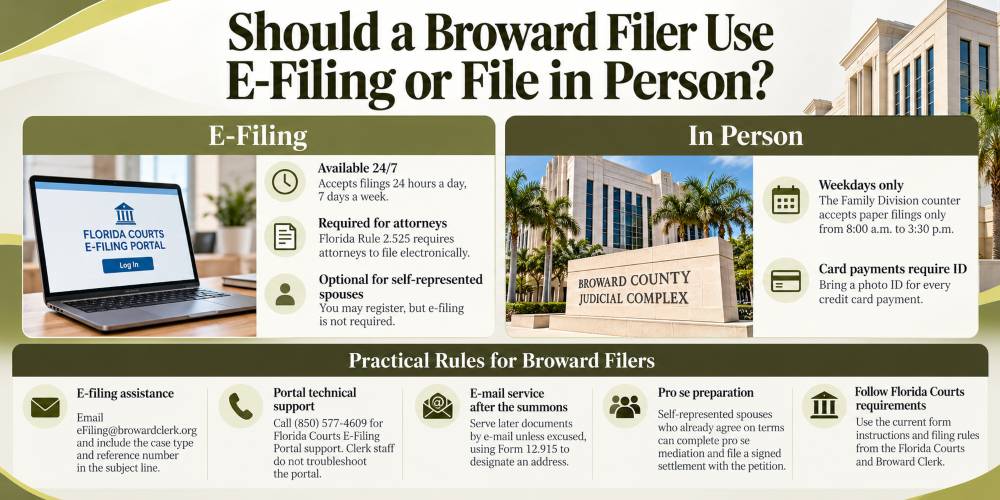
Most Broward filers benefit from the Florida Courts E-Filing Portal, which accepts filings 24 hours a day, 7 days a week.
The Family Division counter accepts paper filings only on weekdays from 8:00 a.m. to 3:30 p.m. The Florida Rules of General Practice and Judicial Administration require attorneys to file electronically.
Self-represented spouses may register on the Florida Courts E-Filing Portal but are not required to.
E-filing and in-person filing each follow practical rules that the Broward Clerk and the Florida Courts enforce:
- E-filing assistance: Filers email eFiling@browardclerk.org and include the case type and reference number in the subject line.
- Portal technical support: The Florida Courts E-Filing Portal support desk answers technical questions at (850) 577-4609, because Clerk staff do not troubleshoot the portal.
- Card payments in person: The Family Division counter requires photo identification for every credit card payment.
- E-mail service after the summons: Florida Courts form instructions require self-represented spouses to serve later documents by e-mail unless excused, using Form 12.915 to designate an address.
- Pro se preparation: Self-represented spouses who already agree on terms can complete pro se mediation and file a signed settlement with the petition.
What Happens After a Broward Divorce Petition Is Filed?
After filing, the Clerk assigns a case number. The case then moves through service, financial disclosure, and, for parents, a parenting course before the court enters a final judgment.
Section 61.19, Florida Statutes, sets a 20-day minimum before final judgment, which is a floor, not a forecast.
Serving the Other Spouse
Initial service means delivering the summons and petition to the other spouse through the Broward Sheriff’s Office or a certified process server. Broward’s AO-2019-15-UFC also recognizes a waiver and acceptance of service as an alternative event that triggers its status quo order. A Florida family attorney should confirm whether a written waiver fits a given case.
Form 12.903(a), the Answer, Waiver, and Request for Copy of Final Judgment, is a different document.
Florida Courts’ instructions limit it to a spouse who has already been served, admits the petition, and waives notice of the final hearing.
Mandatory Financial Disclosure
Florida Family Law Rule of Procedure 12.285 requires mandatory financial disclosure within 45 days of service of the petition in most dissolution cases. Rule 12.285 excludes simplified dissolution, and spouses cannot waive the exchange of financial affidavits where the rule applies.
Spouses who have exchanged complete affidavits may file Form 12.902(k), a Joint Verified Waiver, to keep both affidavits out of the court file.
Other disclosure items may be modified by agreement or court order. Spouses earning under $50,000 a year use the short-form affidavit, Form 12.902(b).
Parenting Course and the Status Quo Order
Section 61.21, Florida Statutes, requires parents in a dissolution with minor children to complete a Parent Education and Family Stabilization Course of at least 4 hours before the final judgment.
The petitioner must finish within 45 days of filing, and the other spouse within 45 days of service, unless the court excuses a parent for good cause.
Broward’s Administrative Order 2019-15-UFC lets each family judge decide whether to use a Status Quo Temporary Order. Where a division uses that order, the petitioner serves it with the petition.
The order holds routines steady so both spouses can draft a parenting plan without disrupting the children’s schedules.
Which Filing Mistakes Delay a Broward Divorce Case?
Common Broward filing delays come in two forms. Some are administrative problems the Clerk flags at intake, such as a refused personal check. Others are substantive gaps a judge identifies before the final hearing.
Each problem can require a corrected filing, a second service attempt, or an added hearing date.
- Wrong petition version: A filer uses Form 12.901(b)(2) even though the spouses share a minor child, so the judge requires an amended petition.
- Incomplete or inaccurately completed forms.
- Missing UCCJEA affidavit: A case with children reaches the judge without Form 12.902(d), and the court cannot address the parenting plan.
- No residency corroboration: A filer relies only on a personal statement, and the judge requires proof under section 61.052(2) before entering the final judgment.
- Late disclosure: A spouse misses the Rule 12.285 deadline of 45 days, which can invite a motion to compel.
Which Filing Route Fits a Broward Divorce?
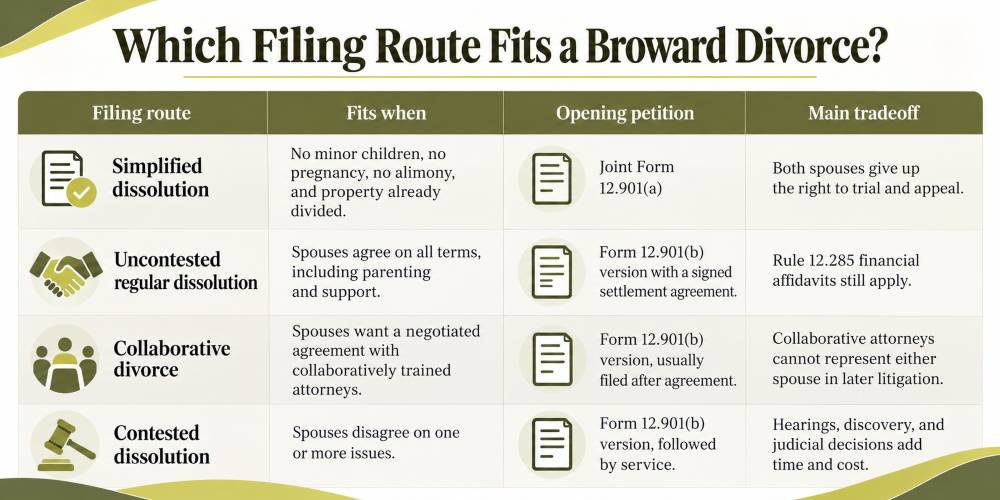
The right filing route may be simplified, uncontested, collaborative divorce, or contested. The choice depends on whether the spouses share minor children, seek alimony, and agree on terms before filing.
| Filing route | Fits when | Opening petition | Main tradeoff |
| Simplified dissolution | No minor children, no pregnancy, no alimony, and property already divided | Joint Form 12.901(a) | Both spouses give up the right to trial and appeal |
| Uncontested regular dissolution | Spouses agree on all terms, including parenting and support | Form 12.901(b) version with a signed settlement agreement | Rule 12.285 financial affidavits still apply |
| Collaborative divorce | Spouses want a negotiated agreement with Collaboratively trained attorneys | Form 12.901(b) version, usually filed after agreement | Collaborative attorneys cannot represent either spouse in later litigation |
| Contested dissolution | Spouses disagree on one or more issues | Form 12.901(b) version, followed by service | Hearings, discovery, and judicial decisions add time and cost |
Section 61.57(1), Florida Statutes, starts the Collaborative process when both spouses sign a participation agreement, whether or not a case is already pending. Section 61.57(8) keeps the process intact when both spouses ask the court to approve their written agreement, so the judge reviews an uncontested divorce file.
Carolann Mazza, Esq., a Florida Supreme Court Certified Family Mediator, has practiced Florida family law since 2001 and is a member of the International Academy of Collaborative Professionals.
Mazza’s practice drafts the marital settlement agreement, parenting plan, and required Florida forms before filing, treating the petition as the final administrative step. The Collaborative process does not guarantee an agreement.
Under Rule 4-1.19 of the Rules Regulating The Florida Bar, Collaborative attorneys withdraw if the process ends, and each spouse then retains new counsel for court.
Contact Us Today For An Appointment
Frequently Asked Questions
Can a Broward divorce be filed at the Hollywood or Plantation courthouse?
No. The Clerk’s location directory lists the Family Division only at the Central Courthouse, 201 SE 6th Street, Fort Lauderdale. The South Regional Courthouse in Hollywood and the West Regional Courthouse in Plantation house county civil counters, so family filers use Fort Lauderdale or e-filing.
How much is the divorce filing fee in Broward County?
The Broward County Clerk of Courts lists the filing fee for a dissolution of marriage petition at $409. Each summons costs $10 to issue, and sheriff service costs $40 per summons under section 30.231. A counter petition costs $392.50, and modifying a final judgment costs $50.
Can someone file for divorce in Broward County without a lawyer?
Yes. Self-represented spouses may file paper forms at the Family Division counter or register on the Florida Courts E-Filing Portal. The Pro Se Self Help Unit sells approved forms but cannot give legal advice, so many filers hire an attorney only to review documents.
How long does a Broward divorce take after filing?
Section 61.19, Florida Statutes, sets a 20-day minimum between filing and final judgment, but that minimum is a floor, not a typical timeline. Actual length depends on service, the 45-day financial disclosure window, the parenting course, and whether both spouses agree on terms.
Does the other spouse have to be served in a Broward divorce?
Generally yes, through the sheriff or a certified process server, unless counsel confirms a valid waiver and acceptance of service. Form 12.903(a) does not replace service; Florida Courts instructions limit that form to a spouse who has already been served and admits the petition.
What proof of Florida residency does a Broward divorce require?
Section 61.052(2), Florida Statutes, requires corroboration through a valid Florida driver’s license, a Florida identification card, a voter registration card, or third-party testimony or affidavit. The proof should show that one spouse lived in Florida for the full 6 months before filing.
Does Broward County require a parenting class for divorce?
Yes, when the spouses share minor children. Section 61.21, Florida Statutes, requires each parent to complete a course of at least 4 hours before final judgment. The petitioner finishes within 45 days of filing; the other parent within 45 days of service, absent good-cause excusal.
Can spouses skip financial disclosure in a Broward divorce?
No, not in cases covered by Rule 12.285, because spouses cannot waive the financial affidavit exchange, though spouses who exchanged complete affidavits may file Form 12.902(k) to keep both affidavits out of the court file. Simplified dissolution falls outside the rule.
Can the Broward divorce filing fee be waived?
Yes. A filer approved as civil indigent under section 57.082, Florida Statutes, has the Broward filing and summons fees waived after the Clerk reviews an Application for Determination of Civil Indigent Status. Other costs, such as process server charges, may still apply after approval.
Bottom Line
Opening a Broward divorce case takes a petition, a Form 12.928 cover sheet, a Notice of Social Security Number, and the Clerk’s filing fee, filed at the Central Courthouse or online.
Service, financial disclosure, residency corroboration, and the parenting course follow, and the filing route shapes which documents each case needs.
A Broward divorce filing goes more smoothly with the right route chosen early. Carolann Mazza, P.A. offers a confidential consultation to review the filing route, required forms, and settlement options before filing anything.

About the Author
Carolann Mazza
Florida Family Law Attorney (The Florida Bar, admitted 2001) · Florida Supreme Court Certified Family Mediator (certified 2011, No. 25475F) · Super Lawyers, Family Law, 2022–2026
Carolann Mazza is the founder of Carolann Mazza, P.A., a non-litigation family law firm she opened in Fort Lauderdale in 2003. Practicing family law in Florida since 2001 and admitted to the State Bar of Texas in 1997, she resolves divorce and family conflicts exclusively through Collaborative Divorce, mediation, and out-of-court settlement — keeping families out of court while preserving relationships, dignity, and children’s wellbeing. She serves Broward, Palm Beach, and Miami-Dade counties.