
Florida Alimony Reform: What the 2023 Law Changed and Who It Affects
Florida alimony reform refers to the 2023 amendments to sections 61.08 and 61.14 of the Florida Statutes.
Those amendments removed permanent alimony, capped durational alimony by marriage length and income, and set written standards for retirement and supportive-relationship modifications.
The amended rules took effect July 1, 2023. Carolann Mazza, P.A. (Collaborative Solutions), a Fort Lauderdale, Florida non-litigation family law firm, helps spouses negotiate support terms through out-of-court settlement.
Key Takeaways
- Section 61.08, Florida Statutes, lists only temporary, bridge-the-gap, rehabilitative, and durational alimony for petitions pending or filed on or after July 1, 2023.
- Durational alimony is unavailable for a marriage shorter than 3 years and cannot exceed 50%, 60%, or 75% of the marriage length.
- Durational alimony cannot exceed the lesser of the recipient’s reasonable need or 35% of the difference between the spouses’ net incomes.
- Section 61.14, Florida Statutes, lets a payor petition for retirement-based modification.
Support terms shape both spouses’ finances for years. Carolann Mazza, P.A., explains the reformed rules so spouses can negotiate alimony terms clearly.
What Did Florida’s 2023 Alimony Reform Change?
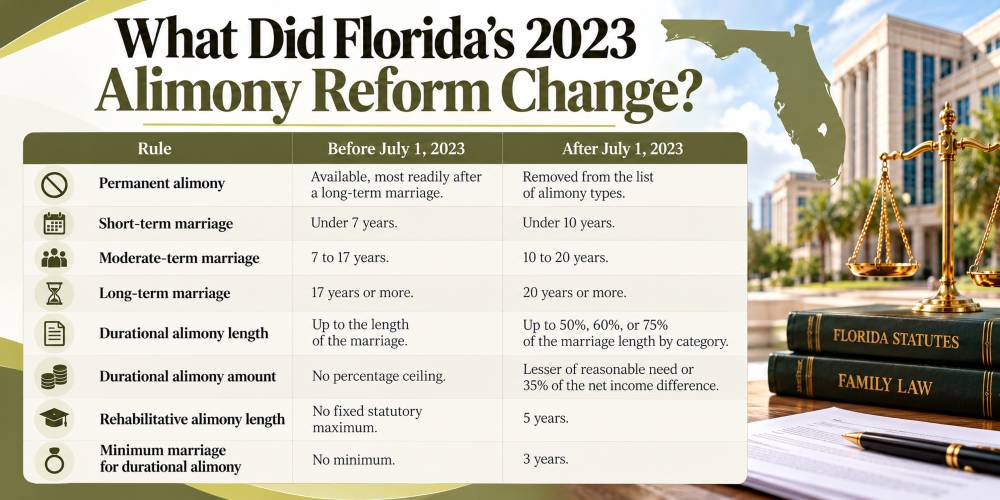
Florida’s 2023 reform replaced open-ended support with defined types, shorter maximum terms, and an income-based ceiling. A 2021 Florida Senate bill analysis describes the earlier system. That system sorted marriages into short, moderate, and long categories and allowed permanent alimony in each under different proof standards.
| Rule | Before July 1, 2023 | After July 1, 2023 |
| Permanent alimony | Available, most readily after a long-term marriage | Removed from the list of alimony types |
| Short-term marriage | Under 7 years | Under 10 years |
| Moderate-term marriage | 7 to 17 years | 10 to 20 years |
| Long-term marriage | 17 years or more | 20 years or more |
| Durational alimony length | Up to the length of the marriage | Up to 50%, 60%, or 75% of the marriage length by category |
| Durational alimony amount | No percentage ceiling | Lesser of reasonable need or 35% of the net income difference |
| Rehabilitative alimony length | No fixed statutory maximum | 5 years |
| Minimum marriage for durational alimony | No minimum | 3 years |
Bridge-the-gap alimony kept its 2-year limit and still cannot be modified in amount or length.
The Senate summary of SB 1416 also notes that a court must make specific written findings before ordering a payor to buy life insurance to secure an award. That term often surfaces in spousal support settlements negotiated outside court.
Which Cases Does the 2023 Alimony Law Apply To?
Section 61.08(11), Florida Statutes, applies the amended rules to two kinds of petitions that were pending or filed on or after July 1, 2023: initial dissolution petitions and support petitions unconnected with a dissolution. Florida’s district courts of appeal disagree on when a case ceases being labeled as ‘pending’, and the Sixth District certified that conflict in 2026.
| District | Decisions | When a petition stops being pending |
| First | Stockdale v. Stockdale, 409 So. 3d 163 (Fla. 1st DCA 2025) | When the trial court renders final judgment |
| Second | Woodward v. Woodward, 400 So. 3d 861 (Fla. 2d DCA 2025); Morgan v. Morgan, 427 So. 3d 599 (Fla. 2d DCA 2026) | Only after final disposition of any appeal |
| Fourth | Alfonso v. Alfonso, 426 So. 3d 478 (Fla. 4th DCA 2025) | When the trial court renders final judgment |
| Fifth | Secrist v. Secrist, 421 So. 3d 781 (Fla. 5th DCA 2025); Hawryluk v. Hawryluk (Fla. 5th DCA Feb. 27, 2026) | When the trial court renders final judgment |
| Sixth | Gaul v. Gaul, No. 6D2023-0935 (Fla. 6th DCA June 5, 2026) | When the trial court renders final judgment; conflict certified with Woodward and Morgan |
Appeals from Broward and Palm Beach County family cases go to the Fourth District, which follows the majority view. Miami-Dade appeals go to the Third District. The practical sorting works in three steps:
- A petition still awaiting final judgment on July 1, 2023, falls under the amended statute in every district.
- A judgment entered before that date keeps its original terms, including permanent alimony, outside the Second District’s broader reading.
- An existing award of any type changes only through a modification petition under section 61.14, Florida Statutes.
The broader Florida divorce law framework treats that award as one piece of a settlement that also divides property and sets time-sharing.
If you’re ready to get started, call us now!
How Is Durational Alimony Calculated Under the Reformed Law?
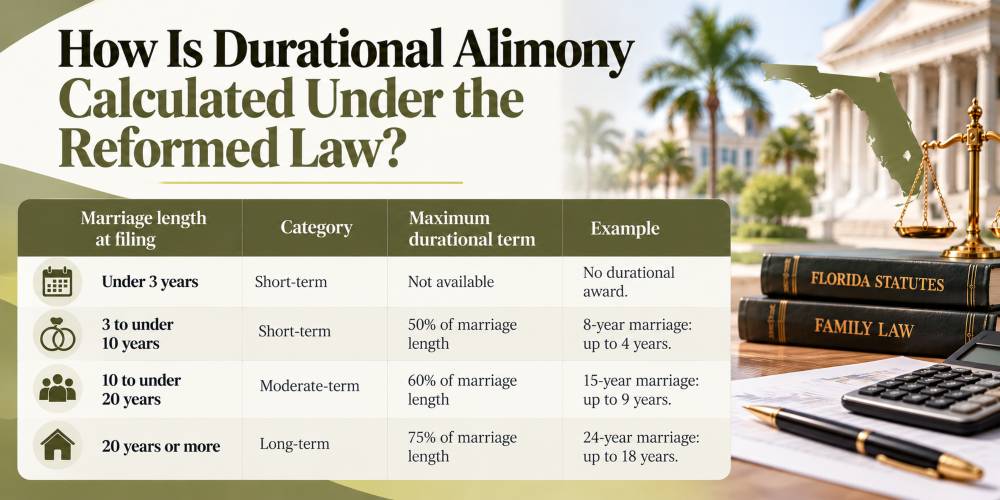
Durational alimony now has two separate ceilings: a length cap tied to marriage category and an amount cap tied to income. Section 61.08, Florida Statutes, measures marriage length from the wedding date to the filing date. The requesting spouse must first prove need and the other spouse’s ability to pay.
| Marriage length at filing | Category | Maximum durational term | Example |
| Under 3 years | Short-term | Not available | No durational award |
| 3 to under 10 years | Short-term | 50% of marriage length | 8-year marriage: up to 4 years |
| 10 to under 20 years | Moderate-term | 60% of marriage length | 15-year marriage: up to 9 years |
| 20 years or more | Long-term | 75% of marriage length | 24-year marriage: up to 18 years |
The amount cap works separately. In a hypothetical case where one spouse nets $9,000 a month and the other nets $4,000, the $5,000 difference produces a 35% ceiling of $1,750 a month, even if the recipient’s documented need is higher.
A judge may extend beyond these caps only with clear and convincing evidence of exceptional circumstances, such as a disability that limits self-support.
Absent written findings of exceptional circumstances, an award also should not leave the payor with significantly less net income than the recipient. These figures are ceilings, not entitlements: a judge may award less, or nothing, when need or ability to pay is not proven.
How Does Retirement Affect Alimony After the Reform?
Section 61.14(1)(c), Florida Statutes, allows a court to reduce or terminate alimony after a payor retires, but the outcome remains discretionary and depends on written findings at each stage.
A payor may file a modification of alimony in reasonable anticipation of retirement. Pension income or retirement accounts divided in the original divorce often are pertinent to the analysis.
The statute separates the decision into distinct steps:
- Eligibility: The court must find that the payor has reached Social Security normal retirement age or the customary retirement age for the profession and has retired or taken measurable steps toward retiring.
- Payor’s burden: The payor must prove by a preponderance of the evidence that retirement reduces the ability to pay.
- Burden shift: If the court finds a reduced ability to pay, the recipient must then prove the award should not be reduced or terminated.
- Court’s discretion: The judge weighs factors such as age, health, motive for retiring, both spouses’ assets and benefits, and the recipient’s needs before deciding whether any change is warranted.
- Effective date: A modification takes effect upon a reasonable, voluntary retirement as the court determines, or on the filing date or a later date as equity requires.
Two hypothetical payors, both 67, can receive different outcomes. A payor retiring from physically demanding work with modest savings presents a different picture than a payor with a large pension whose former spouse has limited income.
That is why divorce financial planning that maps retirement dates during the original settlement reduces later disputes.
What Is a Supportive Relationship Under Florida Alimony Law?
A supportive relationship is a relationship between the alimony recipient and an unrelated person that provides economic support similar to a marriage. Living together alone does not prove one.
Section 61.14(1)(b), Florida Statutes, first requires the payor to prove such a relationship by a preponderance of the evidence. The relationship must exist now or have existed within the 365 days before the petition was filed.
Once the payor meets that burden, the recipient must show why the award should not be reduced or terminated.
The court then makes written findings on both the relationship and the extent of any reduction, weighing the section 61.08 factors and relationship-specific evidence:
- Public presentation: Whether the couple has held themselves out as married
- Living arrangements: How long they have lived together at a shared residence
- Finances: Whether they have pooled assets, shared accounts, or supported each other or each other’s children
- Contributions: Whether they have exchanged property or services or reached an implied financial agreement
The statute does not require a romantic relationship and does not create a common-law marriage. The court also considers whether the payor has kept current on the existing award.
Spouses settling through Collaborative Divorce can address in writing how a future shared household would affect support.
Does Adultery or Federal Tax Treatment Change an Alimony Award?
Adultery can affect alimony, but only as one factor. Section 61.08 lets a judge consider either spouse’s adultery and its economic impact, such as marital funds spent on an affair, when deciding whether to award alimony and how much.
Federal tax treatment changed separately from the Florida reform. Under the IRS alimony rules, alimony paid under a divorce or separation instrument executed after December 31, 2018, is neither deductible by the payor nor taxable income to the recipient.
Pre-2019 final judgments or agreements are honored and the older treatment unless a later modification expressly adopts the new rule. That distinction shapes tax and alimony planning for South Florida couples.
How Can Spouses Negotiate Alimony Outside Court After the Reform?
Spouses can set alimony terms in a written settlement agreement instead of leaving the amount and length to a judge.
The Section 61.08 caps define what a judge can award, and that may be a useful guide during the negotiation. Once the court approves the agreement, however, the agreement’s own wording controls how the negotiated terms operate.
Wording matters most at the modification stage. Section 61.14(7) applies the same proof standard to modifying a settlement agreement as to modifying a court order.
In Rosenthal v. Rosenthal, No. 1D16-1035 (Fla. 1st DCA 2016), the court held that agreed alimony stays modifiable unless the agreement clearly and unambiguously waives modification, and silence does not create that waiver.
Bridge-the-gap and lump-sum terms also resist later change, so review each clause on amount, duration, retirement, and a future shared household with an attorney before signing.
Carolann Mazza, Esq., Florida Supreme Court Certified Family Mediator, has practiced Florida family law since 2001 and resolves support questions through Collaborative Divorce and family mediation.
In the firm’s Collaborative cases, each spouse describes their goals and interests for resolution. The team then works with the couple to build a joint financial snapshot of income, expenses, assets, and debts with the goal of reaching an agreement on support.
When finances are complex, a financial neutral collects documentation from the spouses and creates a shared cash flow summary. Using this information, the couple can discuss various scenarios and trade-offs, such as a higher monthly payment for a shorter term.
The firm’s initial consultation assesses which process fits and which records to gather first. Useful records include recent tax returns, pay records, account statements, and any existing alimony order. The court still needs to approve negotiated terms and enter the final judgment.
Contact Us Today For An Appointment
Frequently Asked Questions
Is permanent alimony gone in Florida?
Yes, for initial petitions pending or filed on or after July 1, 2023. Section 61.08, Florida Statutes, now lists only temporary, bridge-the-gap, rehabilitative, and durational alimony, and Florida’s appellate districts disagree on whether a case on appeal that day counts as pending.
Does the 2023 alimony reform change an existing divorce judgment?
Generally no. Judgments entered before July 1, 2023, keep their original alimony terms, although the Second District treats a case still on appeal that day as pending. Existing awards change only through a modification petition under section 61.14, Florida Statutes.
What is the minimum marriage length for alimony in Florida?
Durational alimony requires a marriage lasting at least 3 years under section 61.08, Florida Statutes, measured to the filing date. Bridge-the-gap and rehabilitative alimony carry no minimum marriage length, but every request still requires proof of need and the other spouse’s ability to pay.
Can alimony be reduced when the payor retires in Florida?
Possibly. Under section 61.14(1)(c), Florida Statutes, a payor at retirement age must prove retirement reduces the ability to pay, and the recipient may then oppose any change. The judge decides whether to reduce or end the award after weighing the statutory factors.
Does living with a new partner end alimony in Florida?
Not automatically. Cohabitation alone does not prove a supportive relationship under section 61.14(1)(b), Florida Statutes. The payor must prove economic support similar to a marriage; the recipient may respond, and the court decides in written findings how much, if any, reduction applies.
Is alimony taxable income in Florida?
Not for divorce instruments executed after December 31, 2018. Under federal rules, the recipient does not report that alimony as income, and the payor cannot deduct it. Florida has no state personal income tax, so state tax does not apply.
Can a husband receive alimony in Florida?
Yes. Section 61.08, Florida Statutes, allows the court to award alimony to either spouse based on need, ability to pay, and the statutory factors. Gender plays no role in eligibility, and both spouses face the same caps on duration and amount.
How long can durational alimony last after a 20-year marriage?
A marriage of 20 years or more counts as long-term, so durational alimony generally cannot exceed 75% of its length, or 15 years for a 20-year marriage. A judge may extend that term only on clear and convincing evidence of exceptional circumstances.
Bottom Line
Florida alimony reform removed permanent alimony for petitions pending or filed on or after July 1, 2023, and redrew the marriage-length categories. It also capped durational awards at 50%, 60%, or 75% of the marriage, and at the lesser of reasonable need or 35% of the net income difference.
Older judgments keep their terms outside the Second District’s broader reading, and section 61.14 governs any later modification.
Spouses who negotiate support in mediation or Collaborative Divorce use these limits as the legal backdrop for their own agreement.
Shared financial numbers keep alimony talks focused. Carolann Mazza, P.A. keeps families out of court, so spouses can schedule a confidential consultation on support terms.

About the Author
Carolann Mazza
Florida Family Law Attorney (The Florida Bar, admitted 2001) · Florida Supreme Court Certified Family Mediator (certified 2011, No. 25475F) · Super Lawyers, Family Law, 2022–2026
Carolann Mazza is the founder of Carolann Mazza, P.A., a non-litigation family law firm she opened in Fort Lauderdale in 2003. Practicing family law in Florida since 2001 and admitted to the State Bar of Texas in 1997, she resolves divorce and family conflicts exclusively through Collaborative Divorce, mediation, and out-of-court settlement — keeping families out of court while preserving relationships, dignity, and children’s wellbeing. She serves Broward, Palm Beach, and Miami-Dade counties.