
Trusted Collaborative Divorce Attorney in Hollywood, FL
Carolann Mazza, P.A. represents Hollywood, FL spouses in collaborative divorce, a structured, non-litigation process governed by Florida’s Collaborative Law Process Act, sections 61.55–61.58, Florida Statutes, effective July 1, 2017.
Collaborative divorce keeps both spouses out of courtroom litigation through a signed participation agreement, a shared team of trained professionals, and negotiation sessions that produce a written settlement.
Spouses in Broward County’s 17th Judicial Circuit choose this process to control the outcome, protect their children’s well-being, and avoid a judge deciding the terms of the marriage’s dissolution.
Key Takeaways
- Collaborative divorce operates under Florida’s Collaborative Law Process Act, sections 61.55–61.58, Florida Statutes, effective July 1, 2017.
- Both spouses retain separate collaborative attorneys and sign a written participation agreement committing to resolve the dissolution of marriage without filing contested litigation.
- A collaborative team can include one neutral financial professional and one communication facilitator, reducing the need for each spouse to retain separate competing experts.
- Under Rule Regulating the Florida Bar 4-1.19, both collaborative attorneys are barred from representing either spouse in contested litigation against the other spouse if the collaborative process terminates.
Contested divorce litigation places every decision before a Broward County judge. Carolann Mazza, P.A. gives Hollywood, FL spouses a structured, non-litigation path to a signed settlement — schedule a confidential consultation.
What Is a Collaborative Divorce Attorney in Hollywood, FL?
A collaborative divorce attorney is a Florida-licensed family lawyer trained under the Collaborative Law Process Act who represents one spouse exclusively in the collaborative process—negotiating a marital settlement agreement outside of court rather than preparing for trial.
Carolann Mazza, P.A. is a non-litigation family law firm based in Fort Lauderdale, Florida, serving Broward, Palm Beach, and Miami-Dade counties exclusively through collaborative divorce, mediation, and out-of-court settlement.
Every collaborative attorney signs the same participation agreement as the spouses, as required by Fla. Fam. L. R. P. 12.745. That agreement gives the attorney a direct professional stake in reaching agreement rather than preparing for a hearing.
If you’re ready to get started, call us now!
How Does the Collaborative Divorce Process Work in Broward County?
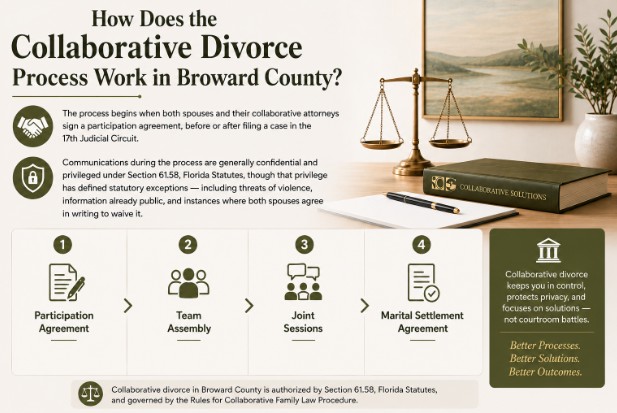
The process begins when both spouses and their collaborative attorneys sign a participation agreement, before or after filing a case in the 17th Judicial Circuit.
Communications during the process are generally confidential and privileged under Section 61.58, Florida Statutes, though that privilege has defined statutory exceptions — including threats of violence, information already public, and instances where both spouses agree in writing to waive it.
Step 1: Participation Agreement
Both spouses and their collaborative attorneys sign, committing to settle without litigation. The case proceeds outside the courtroom.
Step 2: Team Assembly
Spouses add a neutral financial professional and, where needed, a communication facilitator. One shared team replaces separate, competing experts.
Step 3: Joint Sessions
Structured meetings address assets, parenting, and support on a defined agenda. Issues are resolved incrementally rather than all at once.
Step 4: Marital Settlement Agreement
Spouses sign a written agreement covering every disputed issue. The agreement is filed with the court for final judgment.
Carolann Mazza, P.A. coordinates this process for Hollywood clients directly, using the same collaborative professional team structure used across Broward, Palm Beach, and Miami-Dade counties.
If you’re ready to get started, call us now!
What Are the Benefits of Collaborative Divorce Over Litigation?
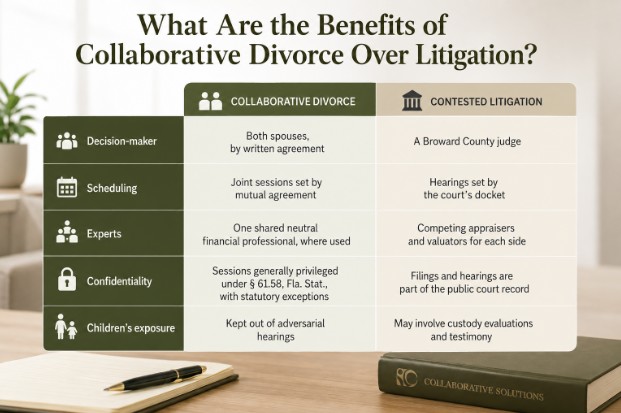
Collaborative divorce and contested litigation differ structurally in who controls the outcome and how information is handled — not in a fixed, predictable timeline or dollar amount, which vary by case.
| Factor | Collaborative Divorce | Contested Litigation |
| Decision-maker | Both spouses, by written agreement | A Broward County judge |
| Scheduling | Joint sessions set by mutual agreement | Hearings set by the court’s docket |
| Experts | One shared neutral financial professional, where used | Competing appraisers and valuators for each side |
| Confidentiality | Sessions generally privileged under § 61.58, Fla. Stat., with statutory exceptions | Filings and hearings are part of the public court record |
| Children’s exposure | Kept out of adversarial hearings | May involve custody evaluations and testimony |
Both spouses retain authority over the final marital settlement agreement in collaborative divorce, rather than accepting terms set after a contested hearing.
How Much Does a Collaborative Divorce Cost in Hollywood, FL?
Collaborative divorce can reduce certain categories of expense — most notably by having spouses share one neutral financial professional instead of each retaining separate, competing experts. Litigation costs, by contrast, accumulate with every motion filed, every deposition scheduled, and every hearing held.
Whether the total cost of a collaborative case is lower than litigation depends on case complexity, the number of joint sessions required, and how quickly the spouses reach agreement — it is not a fixed or guaranteed outcome.
Hollywood spouses can review a detailed breakdown of typical fee structures across South Florida for more specifics, or ask about expected costs directly during a confidential consultation.
How Does Collaborative Divorce Protect Children in a Divorce?
Collaborative divorce resolves parenting plans and time-sharing schedules through joint sessions rather than contested custody hearings. Florida Statute § 61.13 establishes a rebuttable presumption of equal time-sharing effective July 1, 2023, and requires every Florida parenting plan to address decision-making authority, the time-sharing schedule, and each parent’s contact information.
Parents working through collaborative divorce build a parenting plan with input from a child specialist when the case calls for one, rather than leaving those decisions to a judge after a custody evaluation.
Carolann Mazza, P.A. also handles standalone parenting plan and children’s issues matters outside a full divorce filing.
What Happens If Collaborative Divorce Fails in Florida?
If either spouse decides to pursue litigation, the collaborative process terminates, and under Rule Regulating the Florida Bar 4-1.19, both collaborative attorneys are barred from representing either spouse in contested litigation against the other spouse arising from that matter.
This disqualification clause is what gives both attorneys a direct incentive to reach settlement rather than position the case for trial.
Spouses who terminate the collaborative process must retain new litigation counsel. Carolann Mazza, P.A. reviews this disqualification clause with clients before they sign the participation agreement, so both spouses understand the commitment before starting.
Who Is Collaborative Divorce Not Right for in Hollywood, FL?
Collaborative divorce depends on both spouses voluntarily disclosing financial information and negotiating in good faith.
It may not be the right fit for every situation, including cases involving domestic violence, undisclosed assets, or a spouse unwilling to participate voluntarily.
Whether collaborative divorce, mediation, or litigation best fits a specific situation depends on the facts of that case.
Carolann Mazza, P.A. discusses the appropriate process during a confidential consultation, including options such as Florida Supreme Court certified mediation where relevant.
Contact Us Today For An Appointment
Frequently Asked Questions
Is collaborative divorce legal in Florida?
Yes. Florida’s Collaborative Law Process Act, sections 61.55–61.58, Florida Statutes, took effect July 1, 2017, and governs collaborative divorce cases statewide, including cases filed in Broward County’s 17th Judicial Circuit covering Hollywood.
Do both spouses need separate attorneys for collaborative divorce?
Yes. Each spouse retains a separate collaborative attorney who signs the participation agreement. Neither attorney represents both spouses, and both are barred from representing either spouse in litigation against the other if the process later terminates.
How long does a collaborative divorce take?
Timeline varies by case complexity and how many joint sessions the spouses need to reach agreement. Because spouses schedule sessions by mutual agreement rather than a court docket, they have more control over pacing than in contested litigation.
Can collaborative divorce handle high-conflict cases?
Collaborative divorce requires both spouses to commit voluntarily and negotiate in good faith. High-conflict cases can still qualify if both spouses sign the participation agreement, though a mental health neutral or communication facilitator is often added to manage disputes.
What happens to children’s issues in a collaborative divorce?
Parenting plans and time-sharing schedules are negotiated in joint sessions, sometimes with a child specialist involved. Florida Statute § 61.13 governs the required content of every parenting plan, whether reached collaboratively or through litigation.
Is collaborative divorce cheaper than litigation?
It can reduce certain costs, such as paying for one shared financial professional instead of competing experts. Total cost still depends on case complexity and the number of sessions required, so it is not a guaranteed savings in every case.
What is the disqualification clause in collaborative divorce?
Under Bar Rule 4-1.19, both collaborative attorneys are barred from representing either spouse in litigation against the other spouse if the collaborative process terminates. This structural rule gives both attorneys an incentive to help reach a signed settlement.
Is collaborative divorce confidential?
Communications made during the process are generally privileged under Section 61.58, Florida Statutes, meaning they typically cannot be used as evidence later. That privilege has statutory exceptions, including threats of violence and information already part of the public record.
Does Carolann Mazza, P.A. handle mediation as well as collaborative divorce?
Yes. Carolann Mazza, P.A. offers both collaborative divorce and Florida Supreme Court certified mediation for spouses who want a non-litigation path but prefer a single neutral mediator instead of a full collaborative team.
What areas does Carolann Mazza, P.A. serve?
Carolann Mazza, P.A. serves Broward County, Palm Beach County, and Miami-Dade County, resolving collaborative divorce, mediation, and out-of-court settlement matters throughout South Florida, including Hollywood.
Bottom Line
Collaborative divorce lets spouses resolve a dissolution of marriage under Florida’s Collaborative Law Process Act without contested litigation in Broward County’s 17th Judicial Circuit.
Both spouses retain separate attorneys, share a neutral financial professional where needed, and reach a signed settlement through sessions that are generally privileged, subject to statutory exceptions.
If either spouse chooses litigation instead, both collaborative attorneys are barred from representing either spouse against the other under Bar Rule 4-1.19.
Carolann Mazza has practiced Florida family law since 2001 and has been a Florida Supreme Court Certified Family Mediator since 2011, guiding Hollywood-area clients through this process.
A courtroom shouldn’t be the only path through a divorce. Carolann Mazza, P.A. structures a private, non-litigation resolution built around both spouses’ priorities — contact Carolann Mazza, P.A. today.
About the Author
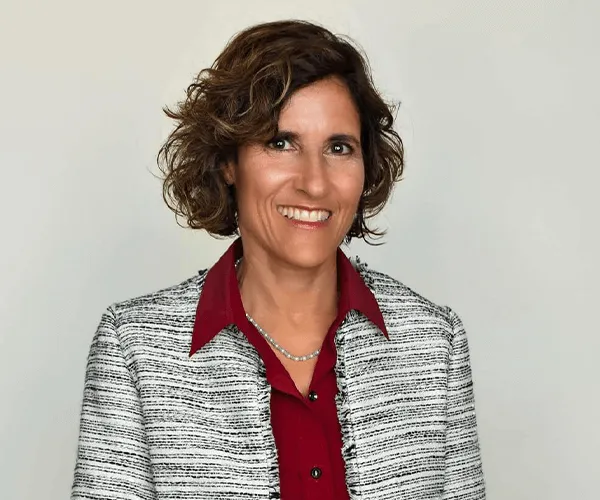
Carolann Mazza
Florida Family Law Attorney (The Florida Bar, admitted 2001) · Florida Supreme Court Certified Family Mediator (certified 2011, No. 25475F) · Super Lawyers, Family Law, 2022–2026
Carolann Mazza is the founder of Carolann Mazza, P.A., a non-litigation family law firm she opened in Fort Lauderdale in 2003. Practicing family law in Florida since 2001 and admitted to the State Bar of Texas in 1997, she resolves divorce and family conflicts exclusively through Collaborative Divorce, mediation, and out-of-court settlement — keeping families out of court while preserving relationships, dignity, and children’s wellbeing. She serves Broward, Palm Beach, and Miami-Dade counties.