
What Children Learn From Their Parents’ Divorce — And How the Divorce Process Shapes Those Lessons
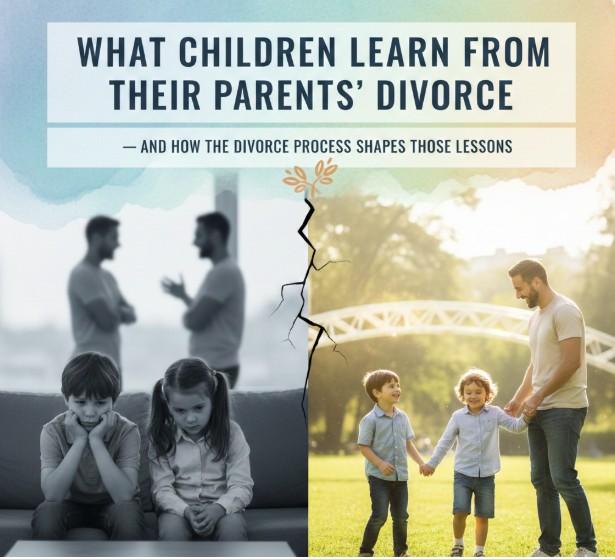
Children learn from their parents’ divorce primarily by observing parental behavior, not by processing what they are told.
When parents manage conflict respectfully, communicate clearly, and maintain household stability for their children, children develop measurable skills in emotional regulation, conflict resolution, adaptability, and interpersonal resilience.
When parents litigate, escalate conflict, or recruit children as emotional intermediaries, children internalize patterns of hostility and instability that a 2020 meta-analysis in Clinical Psychology Review links to elevated long-term mental health risk across 24,854 children in 115 post-divorce family samples.
Inter-parental conflict — not the divorce event itself — is the primary driver of negative child developmental outcomes after parental separation, as confirmed by that same 2020 meta-analysis. The divorce is not the lesson. The divorce process is the lesson.
Key Takeaways
Conflict, not the separation itself, drives child outcomes. The 2020 meta-analysis of 24,854 children across 115 post-divorce samples identifies inter-parental conflict — not the divorce event — as the primary predictor of long-term mental health risk.
Children learn by observation, not by instruction. What parents say about the divorce matters far less than what children watch their parents do during it.
Florida law sets a floor, not a standard. Florida requires a parenting plan and a parenting course in every dissolution involving minor children — but no statute governs how parents behave in front of those children.
The process choice is the variable parents control. Litigation structurally rewards adversarial conduct. The Collaborative process structurally requires the interest-based negotiation behavior parents want their children to absorb.
What Child Development Research Says Children Actually Learn From Divorce
Key Research Finding: A peer-reviewed review published in Pediatrics & Child Health (Canadian Pediatric Society) concluded that children are sensitive to all forms of inter-parental conflict — including suppressed or polite hostility — and that children who witness the resolution of parental conflict, not merely its absence, develop measurable problem-solving skills. Children learn from what they observe, not from what they are shielded from.
The Association for Behavioral and Cognitive Therapies identifies three parental behaviors that consistently protect children against negative divorce outcomes: reducing inter-parental conflict, maintaining effective and consistent parenting practices, and preserving the quality of the parent-child relationship.
All three behaviors are within a parent’s direct control. All three are directly shaped by the divorce process that the parents select.
Research published in Frontiers in Psychology found that low-conflict, cooperative co-parenting after divorce promotes child resilience not only through direct conflict reduction, but also by modeling the emotional maturity and self-regulation that children internalize as their own behavioral templates.
The central finding across three decades of peer-reviewed divorce research is consistent: children learn how to handle difficulty, conflict, and change by observing their parents navigate those same challenges. The divorce is the context. Parental conduct during the divorce is the curriculum.
If you’re ready to get started, call us now!
6 Lessons Children Learn From How Their Parents Handle Divorce
The following six lessons document developmental outcomes of post-divorce parental behavior, drawn from peer-reviewed research in child development psychology and family law.
Lesson 1: How to Regulate Emotions Under Pressure
Children mirror their parents’ emotional responses during periods of family stress. A 2024 study by the REACH Institute at Arizona State University, supported by the National Institute of Mental Health, found that children of divorced parents who observed parental emotional self-regulation scored measurably higher on standardized emotion-regulation assessments than children in high-dysregulation parenting environments.
Parents who process grief privately and present stability during parenting time teach their children that difficult emotions are manageable — not overwhelming.
Parents who express anger toward each other at custody exchanges, recruit children as emotional confidants, or display sustained distress during parenting sessions teach the opposite lesson: that emotional distress is uncontrollable and contagious.
The MGH Clay Center for Young Healthy Minds at Massachusetts General Hospital identifies parental emotional burden-sharing with children as one of the most damaging divorce behaviors, independent of the custody arrangement in place.
Lesson 2: How Adults Resolve Conflict Without Ending Relationships
A peer-reviewed study in Pediatrics & Child Health (Canadian Pediatric Society) found that children who observe their parents resolve disagreements — even imperfectly — develop conflict-resolution skills they apply across their peer relationships, friendships, and adult romantic partnerships.
Children in high-conflict divorces, by contrast, frequently internalize a template that equates conflict with relationship termination — a pattern the Institute for Family Studies documents as persisting into adult relationships and contributing to higher divorce rates in the next generation.
Lesson 3: That Adults Take Ownership of Difficult Decisions
Children in litigated divorces witness a process in which neither parent takes ownership of the outcomes: both defer to their attorneys, assign blame to the other party, and present court-issued decisions as external impositions rather than as chosen commitments.
Children in Collaborative Divorces observe a different process: two adults jointly negotiate difficult decisions, accept responsibility for those decisions, and honor agreements they authored themselves.
The Institute for Advanced Legal Studies (IAALS) at the University of Denver identifies co-authored parenting plans as a key protective factor in post-divorce child adjustment.
Children who observe co-authored parenting plans internalize the message that their family’s future was shaped by their parents’ deliberate choices — not by a stranger adjudicating from a courtroom bench.
Lesson 4: How to Adapt to Change Without Losing Stability
Divorce requires children to adapt to new household configurations, school schedules, and social environments simultaneously.
Research reviewed by the Child Encyclopedia on Early Childhood Development identifies parental routine-maintenance as the single most effective buffer against transition-related anxiety in children of divorce.
Children whose parents maintain predictable routines in both homes learn that change is navigable — that personal stability is an internal resource, not a fixed external condition.
Children whose parents allow household structure to collapse during divorce — irregular schedules, inconsistent behavioral expectations, unpredictable custody exchanges — learn that change is destabilizing and that adults cannot sustain a reliable environment under pressure.
Lesson 5: That Seeking Professional Help Is Competent Adult Behavior
Children observe whether their parents seek professional support — family therapists, financial neutrals, child specialists, Collaborative attorneys — or attempt to manage a complex legal and emotional process without expert guidance.
Parents who engage professional support model a specific and learnable lesson: that seeking expert guidance when facing challenges outside one’s area of competence is intelligent adult behavior, not evidence of weakness.
Lesson 6: That Family Is a Commitment, Not a Living Arrangement
Children of divorce who watch their parents remain committed co-parents — attending school events, communicating respectfully about the child’s needs, and honoring the parenting plan without court enforcement — learn that family is a sustained behavioral commitment, independent of shared residence.
Children whose parents treat each other with contempt after separation learn the opposite lesson: that adult relationships are conditional on convenience and that proximity, not commitment, defines family membership.
Child empathy, self-sufficiency, and cross-household relationship capacity are not automatic consequences of low-conflict divorce — each skill emerges from deliberate, sustained parental behavior during and after the legal process.
Summary: What Children Learn Depends on How Parents Divorce
| What Children Observe | Lesson Absorbed — Low-Conflict Divorce | Lesson Absorbed — High-Conflict Divorce |
| Parental emotional behavior during stress | Difficult emotions are manageable; adults self-regulate under pressure | Emotional distress is contagious; adults cannot control their responses |
| Parental conflict handling | Conflict can be resolved without ending the relationship | Conflict = relationship termination; disagreement is dangerous |
| Decision-making process | Adults take ownership of difficult choices and honor self-made commitments | Outcomes are imposed by external authorities; blame is the default response |
| Household routine maintenance | Change is navigable; personal stability is an internal resource | Change is destabilizing; adults cannot maintain reliable environments |
| Professional help-seeking | Seeking expert guidance is intelligent, competent adult behavior | Adults must manage complex problems alone or signal weakness |
| Post-divorce co-parenting conduct | Family is a sustained behavioral commitment, not a living arrangement | Adult relationships are conditional; proximity defines family, not commitment |
If you’re ready to get started, call us now!
Why the Collaborative Divorce Process Teaches Better Lessons Than Florida Litigation
Florida’s contested divorce litigation is structured to produce adversarial parental behavior. Both attorneys advocate for their respective clients’ parenting positions.
Both parents build evidentiary cases to show that the other parent is less capable, less present, or less fit.
Children absorb this adversarial process directly through overheard conversations and the language parents use about each other, and indirectly through the sustained emotional atmosphere of the household during proceedings.
The Florida Collaborative Law Process Act, Florida Statutes §§ 61.55–61.58, governs Collaborative Divorce in Florida and establishes a structure in which both parents commit in writing to resolving all family law issues — including timesharing, asset division, and support — without court adjudication.
The Participation Agreement each parent signs disqualifies both attorneys from representing their clients in subsequent litigation, structurally aligning every professional’s financial incentive toward resolution rather than escalation.
Collaborative Divorce adds three structural components that mediation alone does not provide:
(1) independent legal representation for each parent, ensuring informed consent at every decision point;
(2) a neutral financial professional who eliminates information asymmetry on asset and support issues
(3) a licensed child specialist who translates the child’s developmental needs directly into the parenting plan structure.
A 12-year randomized follow-up trial cited in a PMC review of divorce interventions and child mental health demonstrated that mediation — a structurally related but less comprehensive process — produced lower inter-parental conflict, improved parenting quality, and greater non-residential parent involvement compared to litigation, and sustained these effects across the full 12-year observation window.
What Florida Law Requires of Divorcing Parents — and What Children Observe
Florida imposes three concrete obligations on divorcing parents with minor children. Each obligation creates a moment children observe directly, and how parents meet it becomes part of the curriculum.
What Does Florida Statutes § 61.13 Require in a Parenting Plan?
Florida Statutes § 61.13 requires a parenting plan in every dissolution involving minor children, and requires that plan to specify the time-sharing schedule, which parent holds decision-making authority over education and health care, and the methods the parents will use to communicate with each other about the child.
A court-imposed plan and a parent-authored plan satisfy the same statute. Children can tell the difference. A plan two parents negotiated and signed is one children watch their parents honor voluntarily. A plan a judge imposed is one children watch their parents comply with — and compliance and commitment teach different lessons.
Does Florida Require Divorcing Parents to Take a Parenting Course?
Florida Statutes § 61.21 requires both parents in a dissolution involving minor children to complete a Supreme Court-approved parenting education and family stabilization course before the court will schedule a final hearing.
The approved curriculum covers the developmental impact of divorce on children, co-parent communication, and conflict-resolution techniques — the same behaviors this article identifies as the curriculum children absorb.
Parents who complete the course early, rather than treating it as a procedural box to check off before the final hearing, receive the material while decisions are still being made.
How Does the Florida Collaborative Law Process Act Change Parental Behavior?
The Collaborative Law Process Act, Florida Statutes §§ 61.55–61.58, effective July 1, 2017, requires both spouses to commit in writing to full financial disclosure and to resolving all disputes without court intervention.
Because the Participation Agreement disqualifies both attorneys from any subsequent litigation, every professional in the room carries a financial incentive aligned with settlement rather than escalation. Parents negotiate differently when escalation costs them their own counsel — and children register that difference in the household atmosphere long before any agreement is signed.
Florida Courts publishes the approved Participation Agreement template and all required family law forms on its official family law forms page.
5 Actions Florida Parents Can Take Right Now to Shape What Their Children Learn
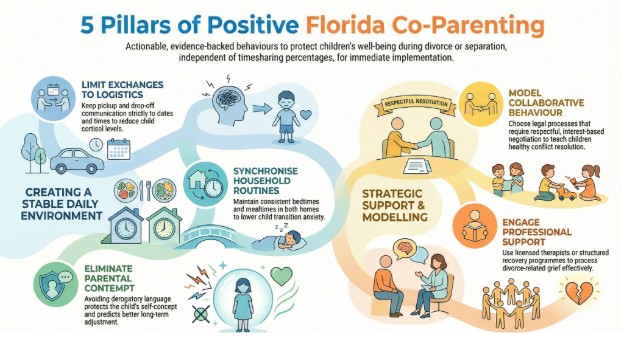
Florida parents do not need to wait for a divorce to be finalized to begin modeling the right developmental lessons. The following five parental behaviors are evidence-backed, immediately actionable, and independent of timesharing percentage.
1. Limit custody exchange communication to logistics only. Keeping pickup and drop-off communication to date, time, and schedule — nothing more — reduces children’s cortisol exposure at transitions, so children associate custody exchanges with a calm routine rather than parental conflict.
2. Maintain consistent household routines in both parenting homes. Predictable bedtimes, mealtimes, and homework schedules across both households reduce child transition anxiety and communicate that both environments are stable, so children can relax into each home rather than recalibrate at every exchange.
3. Eliminate contemptuous language about the co-parent in the child’s presence. Children identify psychologically with both parents. Derogatory language directed at one parent damages the child’s self-concept, not only the co-parenting relationship. The MGH Clay Center for Young Healthy Minds identifies parental contempt language as one of the strongest predictors of long-term child adjustment problems, independent of custody arrangement.
4. Engage a licensed therapist or structured support program to process divorce-related grief. Florida-based family therapists, licensed clinical social workers, and structured divorce recovery programs.
5. Select a divorce process that models the conflict-resolution behavior you want your children to internalize. Florida parents who want their children to learn that conflict is resolvable without relationship destruction should choose a process that structurally requires respectful, interest-based conflict resolution. The Collaborative Process keeps timesharing decisions in the parents’ hands and requires both parents to engage in constructive negotiation throughout each session.
Contact Us Today For An Appointment
Frequently Asked Questions
At What Age Do Children Handle Parental Divorce Best?
No age “handles divorce best.” Children at every developmental stage can experience separation stress, especially when conflict remains high. The strongest protective factors are low conflict, stable routines, and age-appropriate explanations that match the child’s maturity.
Does Collaborative Divorce In Florida Cost More Than Contested Litigation?
Usually, no, when total costs are compared. Collaborative Divorce often reduces court-driven delays and repeated motion practice, thereby lowering overall spending on attorney and expert time and reducing case drag.
Can Children Participate In The Florida Collaborative Divorce Process?
Children do not attend Collaborative Divorce sessions. A child specialist or licensed therapist can gather developmentally appropriate input and incorporate the child’s perspective into the design of the parenting plan without putting the child in adult negotiations.
What Is The Most Harmful Behavior Parents Use During Divorce?
Turning a child into a messenger, spy, or emotional confidant is one of the most harmful patterns. Research on parentification links this role reversal to higher anxiety, guilt, and loyalty conflicts that can persist long after the divorce.
How Does The Collaborative Divorce Process Protect Children In Practice?
A collaborative structure reduces a child’s exposure to courtroom conflict and keeps parents focused on interest-based problem-solving. Parents also develop a parenting plan together, which can reduce recurring conflict because both parents understand and accept the routines they have created.
What Predicts The Best Child Outcomes After Divorce?
Low inter-parental conflict and consistent, engaged parenting predict stronger child adjustment after divorce. Clear routines, reliable exchanges, and stable communication rules usually matter more than the exact timesharing percentage.
What If Parents Need A Lower-Structure Option Than Collaborative Divorce?
Mediation can fit when parents want an out-of-court agreement without a full collaborative team. A neutral mediator can structure the conversation and document the terms, while parents retain decision-making authority.
Do Children Adjust Better After Collaborative Divorce Than After Litigation?
Direct head-to-head research comparing Collaborative Divorce with litigation on child outcomes is limited. The strongest available evidence is the 12-year randomized mediation trial, which found sustained reductions in inter-parental conflict and improved parenting quality relative to litigation. Because Collaborative Divorce adds independent counsel, a financial neutral, and a child specialist to that same out-of-court structure, the conflict-reduction mechanism applies — but parents should understand the evidence as extrapolated from mediation research rather than directly measured on Collaborative cases.
What Should Parents Tell Their Children About the Divorce?
Both parents should agree on what will be said before either speaks to the child, deliver the message together where possible, state plainly that the divorce is not the child’s fault and that the child will not be asked to choose sides, and answer only the questions the child actually asks. Children take their emotional cue from how the message is delivered far more than from its content.
The Divorce Process You Choose Becomes the Education Your Children Receive
Florida parents who enter contested timesharing litigation risk producing a court-ordered parenting plan misaligned with their child’s developmental needs and their family’s actual schedule.
Carolann Mazza, a Florida-licensed Collaborative Divorce Attorney serving Broward, Palm Beach, and Miami-Dade Counties, structures the divorce process so parents design their own parenting plan — one calibrated to their child, accepted by both parties, and enforceable without court re-entry.
Schedule a Confidential Consultation Carolann Mazza | Florida-Licensed Collaborative Divorce Attorney Serving Broward County • Palm Beach County • Miami-Dade County Phone: (954) 527-4604 | Email: carolann@cmazzalaw.com Contact Carolann Mazza →

About the Author
Carolann Mazza
Florida Family Law Attorney (The Florida Bar, admitted 2001) · Florida Supreme Court Certified Family Mediator (certified 2011, No. 25475F) · Super Lawyers, Family Law, 2022–2026
Carolann Mazza is the founder of Carolann Mazza, P.A., a non-litigation family law firm she opened in Fort Lauderdale in 2003. Practicing family law in Florida since 2001 and admitted to the State Bar of Texas in 1997, she resolves divorce and family conflicts exclusively through Collaborative Divorce, mediation, and out-of-court settlement — keeping families out of court while preserving relationships, dignity, and children’s wellbeing. She serves Broward, Palm Beach, and Miami-Dade counties.