
Collaborative Divorce vs. Litigation in Florida: The Full Comparison
Collaborative divorce and litigation are the two primary dissolution paths in Florida — and choosing between them determines your total cost, your timeline, your privacy, and your family’s ability to co-parent after the process ends.
Collaborative divorce resolves every issue — property division, alimony, parenting plans, and child support — through structured private meetings governed by the Florida Collaborative Law Process Act, Florida Statutes §§ 61.55–61.58, effective July 1, 2017.
Litigation places every unresolved issue before a Florida circuit court judge who issues binding rulings that neither spouse controls.
Key Takeaways
- Collaborative divorce keeps decision-making authority with both spouses; litigation transfers final authority to a circuit court judge.
- Contested litigation in Florida costs $15,000–$100,000+ per person; Collaborative divorce costs $7,500–$25,000 per person in most cases (per the most recent Florida Academy of Collaborative Professionals survey).
- Collaborative divorce communications are privileged and confidential under Florida Statutes § 61.58; contested divorce filings are public records under Florida Statutes Chapter 119.
- Contested litigation is the appropriate path when domestic violence, hidden assets, or emergency court orders are required.
Not sure which path protects your interests? A Collaborative divorce attorney in Fort Lauderdale can assess your specific situation and give you a direct answer before you file anything.
What Is the Core Difference Between Collaborative Divorce and Litigation in Florida?
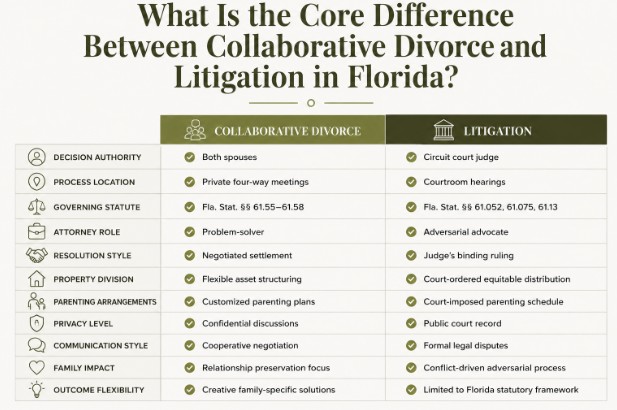
The core difference between collaborative divorce and litigation in Florida is who makes the final decisions — in collaborative divorce, both spouses retain decision-making authority; in litigation, a Florida circuit court judge makes binding rulings on every unresolved issue.
Both processes end with a final dissolution judgment under Florida Statutes § 61.052. The path to that judgment is entirely different.
Collaborative divorce is a voluntary, statute-governed process under Florida Statutes §§ 61.55–61.58 in which both spouses retain separately trained Collaborative attorneys, sign a participation agreement, and resolve every issue — property division under Florida Statutes § 61.075, alimony under Florida Statutes § 61.08, parenting plans under Florida Statutes § 61.13, and child support under Florida Statutes § 61.30 — through structured four-way meetings outside the courtroom.
Contested litigation is a court-supervised adversarial process in which a Florida circuit court judge reviews evidence, hears arguments from opposing attorneys, and issues rulings on each unresolved issue.
Spouses who cannot agree on their financial future and parenting arrangements can go to a third party who has no knowledge of their family’s specific circumstances.
| Factor | Collaborative Divorce | Contested Litigation |
| Decision authority | Both spouses | Circuit court judge |
| Process location | Private four-way meetings | Courtroom hearings |
| Governing statute | Fla. Stat. §§ 61.55–61.58 | Fla. Stat. §§ 61.052, 61.075, 61.13 |
| Attorney role | Problem-solver | Adversarial advocate |
| Outcome | Negotiated settlement | Judge’s binding ruling |
The Collaborative divorce process preserves both spouses’ ability to craft solutions a judge could not order — flexible parenting arrangements, creative asset divisions, and agreements tailored to the family’s specific needs. Litigation produces a judgment that fits within the rigid framework of Florida statutory law, regardless of what either spouse actually wants.
If you’re ready to get started, call us now!
How Do the Costs Compare Between Collaborative Divorce and Litigation in Florida?
Collaborative divorce costs significantly less than contested litigation in Florida for the majority of cases — not because Collaborative attorneys charge lower rates, but because the Collaborative process eliminates the most expensive phases of litigation entirely.
The Florida Academy of Collaborative Professionals reports that 55% of Florida Collaborative cases cost $25,000 or less per person (most recent Florida Academy of Collaborative Professionals survey data).
Contested litigation in Florida typically costs $15,000–$100,000+ per person, depending on complexity and whether the case goes to trial.
The cost difference comes from what litigation requires that Collaborative divorce does not. Formal discovery — depositions, interrogatories, subpoenas, and document production — consumes dozens of attorney hours at rates that drive total costs upward rapidly.
Pre-trial motions, hearings on temporary relief, and trial preparation add further. The Florida filing fee under Florida Statutes § 28.241 is $408 for either path, but the attorney hours that follow differ by an order of magnitude.
| Cost Category | Collaborative Divorce | Contested Litigation |
| Attorney fees per person | $7,500–$25,000 | $15,000–$100,000+ |
| Financial neutral/expert | $150–$300/hr (shared) | $300–$600/hr (competing experts) |
| Divorce coach/mental health | $150–$250/hr (optional) | Not applicable |
| Court filing fee | $408 (Fla. Stat. § 28.241) | $408 (Fla. Stat. § 28.241) |
| Discovery costs | None | Depositions, subpoenas, production |
| Trial preparation | None | Significant — adds thousands |
| Expert witnesses | Shared neutral | Competing — each party pays separately |
The professional team model in Collaborative divorce — where both spouses share a single neutral financial professional and, where appropriate, a divorce coach — eliminates the competing expert cost that drives litigation bills upward.
In contested litigation, each spouse pays separately for their own financial analyst, vocational expert, or child custody evaluator.
Understanding the full economics of collaboration clarifies why 24% of Florida Collaborative cases cost $15,000 or less per person in total — a figure the Academy reports based on surveys of Florida Collaborative professionals — and why in contested litigation rarely occurs, even in the simplest disputes.
How Do the Timelines Compare Between Collaborative Divorce and Litigation in Florida?
Collaborative divorce resolves faster than contested litigation in Florida for most families — the Florida Academy of Collaborative Professionals reports 60% of Florida Collaborative cases complete within six months, and 90.7% within twelve months.
Contested litigation in Florida takes six months to eighteen months for straightforward cases and one to three years for complex disputes involving business valuations, high-conflict custody, or contested alimony.
The timeline difference is structural, not incidental. Collaborative divorce eliminates court scheduling delays entirely. Four-way meetings are scheduled at the convenience of both spouses and their attorneys — no waiting for hearing dates assigned by a circuit court docket.
Contested litigation moves at the court’s pace, and the Broward and Miami-Dade County family divisions have significant docket backlogs that extend timelines regardless of how efficiently either attorney works.
Florida imposes a mandatory 20-day waiting period under Florida Statutes § 61.19 from filing to final judgment for any dissolution.
Each additional month of contested litigation adds substantially to total attorney fees. A case that takes eighteen months instead of six incurs significantly higher legal costs due to that timeline difference alone — before expert witnesses, depositions, or trial preparation are factored in.
The Collaborative divorce timeline for Florida is controlled by both spouses, not by a court calendar.
How Does Privacy Differ Between Collaborative Divorce and Litigation in Florida?
Collaborative divorce is private by statute; contested litigation is a public record under Florida law — and for business owners, professionals, and parents, that distinction carries significant financial and reputational exposure.
All Collaborative law communications — financial disclosures, settlement proposals, parenting discussions, and asset valuations exchanged in four-way meetings — are privileged and not subject to discovery under Florida Statutes § 61.58. Neither spouse may introduce Collaborative communications as evidence in any subsequent court proceeding.
Contested divorce filings are public records under Florida Statutes Chapter 119. Every financial affidavit, asset schedule, income disclosure, and parenting dispute submitted to a Florida circuit court becomes accessible to any member of the public through the clerk of court’s portal.
Business owners whose revenue figures appear in a dissolution filing risk those records reaching competitors, clients, or employees. Professionals whose income documentation is filed in open court cannot retract that exposure after the fact.
The privacy protection in Collaborative divorce is comprehensive — it covers not only the final settlement terms but the entire negotiation process.
Proposals made and rejected, financial positions taken, and discussions about parenting arrangements never enter the public record under any circumstances, provided the Collaborative process concludes with an agreement.
The confidentiality protections built into Collaborative divorce represent one of the most significant structural advantages for high-asset Florida families, professionals, and anyone whose financial or personal information carries reputational risk.
If you’re ready to get started, call us now!
How Does Collaborative Divorce vs. Litigation Handle Property Division, Alimony, and Parenting in Florida?
Both Collaborative divorce and contested litigation resolve the same legal issues — equitable distribution, alimony, parenting plans, and child support — but the mechanism, flexibility, and outcome quality differ substantially between the two paths.
Florida’s equitable distribution standard under Florida Statutes § 61.075 governs how a judge must divide marital assets in litigated cases. In a Collaborative divorce, the spouses, with the help of their team, decide how their assets and debt will be divided.
Property division under Florida Statutes § 61.075 begins with a presumption of equal distribution of marital assets. In Collaborative divorce, a shared neutral financial professional helps both spouses value and divide assets in a tax-efficient, practical manner without competing appraisers driving up cost. In litigation, each spouse retains separate experts, valuation conflicts arise, and a judge resolves the dispute based on the evidence — often producing an outcome neither spouse finds optimal.
Alimony under Florida Statutes § 61.08 is calculated using a statutory framework the judge must apply in a litigated case. In a Collaborative process, the team assists the spouses determine what works for both of them. A shared neutral financial professional guides both spouses through the alimony discussion, replacing a judge’s ruling.
Florida’s 2023 alimony reform eliminated permanent alimony and capped durational alimony, making the statutory framework more predictable — but contested alimony disputes remain among the most expensive phases of litigation in Florida. In a Collaborative law process, the decision on how much alimony and for how long it will be paid remains with the participants.
Parenting plans under Florida Statutes § 61.13 require both parents to complete a Supreme Court-approved parenting education course under Florida Statutes § 61.21 before a final hearing, regardless of the path.
In a Collaborative divorce, a neutral facilitator with a mental health background helps parents craft time-sharing arrangements tailored to their children’s specific needs.
In litigation, a judge applies statutory factors without knowledge of the family’s daily reality — and contested parenting disputes can trigger custody evaluations, which are a significant added expense in contested Florida dissolution proceedings.
The out-of-court divorce settlement model in Collaborative divorce allows creative solutions — graduated time-sharing schedules, business buyout structures, deferred asset transfers — that a circuit court judge has neither the time nor the statutory authority to craft independently.
What Are the Co-Parenting Outcomes After Collaborative Divorce vs. Litigation in Florida?
Collaborative divorce produces better post-divorce co-parenting outcomes than contested litigation because the process requires respectful communication throughout — and the habits built during Collaboration often carry forward into post-divorce family life.
Contested litigation is adversarial by design. Each attorney advocates for their client’s position against the other spouse’s position. That adversarial dynamic — repeated across months or years of hearings — damages the working relationship both parents need after the dissolution is final.
Parents who divorce through Collaborative divorce create parenting arrangements together, with professional guidance.
Both parents understand the reasoning behind every time-sharing decision because they made it jointly. Contested litigation produces a court-ordered parenting plan that one or both parents may resent — and that resentment surfaces in post-divorce conflicts, modification proceedings, and the children’s daily experience of their parents’ relationship.
Florida requires all parents in a dissolution involving minor children to complete the parenting education and family stabilization course under Florida Statutes § 61.21. Collaborative divorce extends that educational approach throughout the entire process, not just in a single mandated course.
The child-centered divorce approach supported by Collaborative practice gives children parents who can communicate, a post-divorce outcome that benefits children’s adjustment, which no court-ordered parenting plan replicates on its own.
When Is Litigation the Right Choice Over Collaborative Divorce?
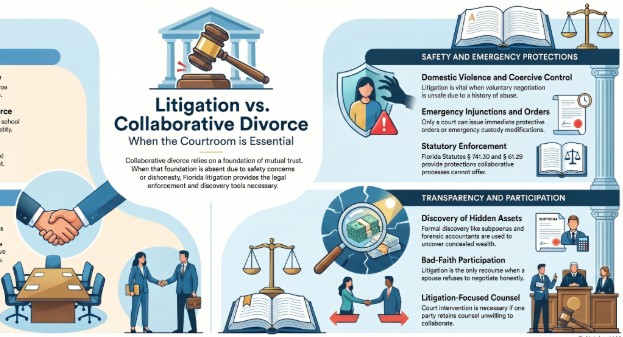
Contested litigation is the appropriate path in Florida when domestic violence, hidden assets, bad-faith participation, or the need for emergency court orders makes voluntary negotiation structurally unsafe or inadequate.
The Collaborative process depends entirely on both spouses committing to full transparency and good-faith negotiation. When that foundation is absent, litigation provides the enforcement tools that Collaborative divorce cannot.
Litigation is the correct path when:
- A history of domestic violence or coercive control makes voluntary negotiation unsafe — Florida Statutes § 741.30 governs injunctions, which only a court can issue
- One spouse is concealing marital assets, and formal discovery — depositions, subpoenas, forensic accountants — is required to uncover them.
- Emergency protective orders, temporary child support, or emergency custody modifications under Florida Statutes § 61.29 are needed immediately.
- One spouse refuses to participate in the Collaborative process or retains litigation-focused counsel.
Understanding when Collaborative divorce is not the right choice is as important as understanding when it is. Choosing Collaborative divorce in a case that requires the enforcement tools of litigation exposes the filing spouse to the disqualification clause under Florida Statutes § 61.57 — forcing both attorneys to withdraw and requiring both spouses to start over with new litigation counsel at full cost.
How Do You Choose Between Collaborative Divorce and Litigation in Florida?
The right path between Collaborative divorce and litigation in Florida depends on five factors: the level of trust between spouses, the complexity of assets, the presence of domestic violence or hidden assets, whether emergency orders are needed, and both spouses’ ability to negotiate in good faith.
When all five factors point toward safety and honesty, Collaborative divorce is the stronger choice in terms of cost, timeline, privacy, and co-parenting outcomes. When any one of them is in doubt, litigation provides the mechanisms for enforcement that Collaborative divorce cannot.
| Decision Factor | Points to Collaborative | Points to Litigation |
| Trust between spouses | Both spouses communicate honestly | History of deception or bad faith |
| Asset complexity | Standard assets, shared financial neutral, adequate | Business valuations, hidden assets suspected |
| Domestic violence | No history of abuse or control | Any history of abuse, coercion, or threats |
| Emergency orders | No immediate safety or support needs | Immediate protective, support, or custody orders are needed |
| Spouse’s legal counsel | Both retain collaborative-trained attorneys | Spouse retains litigation-focused attorney |
The Collaborative divorce vs. mediation comparison provides a further breakdown for couples who fall between these two paths. The out-of-court divorce settlement framework at collaborativenow.com covers the full range of non-litigation options available to Florida families.
Ready to understand which path fits your situation? Contact our Fort Lauderdale office for a direct, no-pressure assessment of your options before you file.
Contact Us Today For An Appointment
Frequently Asked Questions
What is the main difference between Collaborative divorce and litigation in Florida?
Collaborative divorce in Florida keeps all decisions with both spouses through private meetings governed by Florida Statutes §§ 61.55–61.58. Contested litigation transfers final decision-making to a Florida circuit court judge. The difference determines your cost, timeline, privacy, and co-parenting relationship after dissolution.
Is Collaborative divorce cheaper than litigation in Florida?
Collaborative divorce costs $7,500–$25,000 per person in most Florida cases, according to data from the Florida Academy of Collaborative Professionals. Contested litigation typically costs $15,000–$100,000+ per person. Collaborative divorce eliminates formal discovery, depositions, expert witness competition, pre-trial motions, and trial preparation entirely.
How long does Collaborative divorce take compared to litigation in Florida?
The Florida Academy of Collaborative Professionals reports 60% of Florida Collaborative divorces are completed within six months and 90.7% within twelve months. Contested litigation in Florida takes six months to three years for complex cases. Each additional month of litigation adds substantially to total attorney fees at Florida’s prevailing hourly rates.
Is Collaborative divorce confidential in Florida? Collaborative divorce communications are privileged and not subject to discovery under Florida Statutes § 61.58. No statement, proposal, or financial disclosure made during the Collaborative process may be introduced as evidence in subsequent litigation. Contested divorce filings are public records under Florida Statutes Chapter 119.
Can a judge override a Collaborative divorce agreement in Florida?
A Florida circuit court judge reviews and enters the Collaborative settlement as a final dissolution judgment under Florida Statutes § 61.052. Judges confirm agreements that comply with Florida statutory requirements rather than override them. A judge retains authority to reject agreements not in the best interests of minor children under Florida Statutes § 61.13.
What happens if a Collaborative divorce case terminates in Florida?
When a Collaborative divorce case terminates in Florida, Florida Statutes § 61.57 requires both Collaborative attorneys to withdraw immediately. Both spouses must retain new litigation counsel who starts the case from scratch. Communications in the Collaborative process remain confidential under Florida Statutes § 61.58 and cannot be used as evidence.
Does Collaborative divorce work when children are involved?
Collaborative divorce is particularly effective when minor children are involved because a neutral divorce coach builds parenting plans tailored to children’s specific needs. Both parents complete the mandatory parenting education course under Florida Statutes § 61.21. The co-parenting relationship built during collaboration produces better post-divorce outcomes than court-ordered parenting plans.
Can you negotiate alimony and property division in Collaborative divorce?
In a Collaborative divorce, both spouses discuss alimony and equitable distribution directly in a team setting and create options from the information gathered. A shared neutral financial professional, along with the other team members, guides both spouses through every valuation and distribution decision. A Fort Lauderdale Collaborative divorce attorney drafts the Collaborative Marital Settlement Agreement and ensures that it is legally sound.

About the Author
Carolann Mazza
Florida Family Law Attorney (The Florida Bar, admitted 2001) · Florida Supreme Court Certified Family Mediator (certified 2011, No. 25475F) · Super Lawyers, Family Law, 2022–2026
Carolann Mazza is the founder of Carolann Mazza, P.A., a non-litigation family law firm she opened in Fort Lauderdale in 2003. Practicing family law in Florida since 2001 and admitted to the State Bar of Texas in 1997, she resolves divorce and family conflicts exclusively through Collaborative Divorce, mediation, and out-of-court settlement — keeping families out of court while preserving relationships, dignity, and children’s wellbeing. She serves Broward, Palm Beach, and Miami-Dade counties.