
The Collaborative Divorce Team in Florida: Who Does What and Why
Data last verified: March 2026
A Florida collaborative divorce team includes four roles: one collaborative attorney per spouse, a mental health neutral, a financial neutral (CDFA), and — when children are involved — an optional child specialist.
Every team member signs the Participation Agreement under the Florida Collaborative Law Process Act, Sections 61.55 to 61.58, Florida Statutes.
No team member may represent either spouse in litigation if the collaborative process terminates.
The team structure replaces the adversarial model with a multidisciplinary problem-solving framework that addresses legal, financial, and emotional issues simultaneously.
Carol Ann Mazza is a Florida-licensed Collaborative Divorce Attorney and Florida Supreme Court Certified Family Mediator serving Broward County, Palm Beach County, and Miami-Dade County.
Understanding each team member’s role, authority, and limitations helps Florida spouses enter the process with accurate expectations and choose the right collaborative attorney from the outset.
Key Takeaways
- A Florida collaborative divorce team consists of two collaborative attorneys, a mental health neutral, a financial neutral, and an optional child specialist.
- No team member is a therapist or financial advisor for either spouse individually — every neutral professional serves the process, not a party.
- The Participation Agreement binds every team member to the collaborative process and triggers mandatory withdrawal if litigation begins.
- Section 61.57, Florida Statutes, classifies all collaborative team communications as privileged and inadmissible in any subsequent court proceeding.
- The Florida Academy of Collaborative Professionals (FACP) reports that over 85% of Florida collaborative cases reach full agreement when both spouses are correctly screened at intake.
Carol Ann Mazza serves as a collaborative attorney for Florida spouses in Broward, Palm Beach, and Miami-Dade counties. Schedule a confidential consultation today.
If you’re ready to get started, call us now!
The Florida Collaborative Divorce Team at a Glance
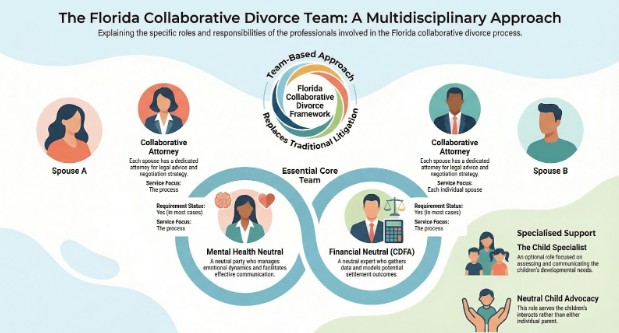
Every Florida collaborative divorce team includes two attorneys and at least one neutral professional. The table below identifies each role, its function, and the professional who serves in that role in the process.
| Team Member | Role | Who They Serve | Required? |
| Collaborative Attorney (x2) | Advises each spouse on legal rights and negotiation strategy | Each spouse has their own attorney | Yes — one per spouse |
| Mental Health Neutral | Facilitates communication; manages emotional dynamics during sessions | The process — not either spouse individually | Yes, in most Florida cases |
| Financial Neutral (CDFA) | Gathers financial data, builds settlement options, and models outcomes | The process is neutral to both spouses | Yes, in most Florida cases |
| Child Specialist | Assesses children’s developmental needs; communicates them to the team | The children’s interests — not either parent | Optional — recommended when children are involved |
Role 1: The Collaborative Attorneys
Each spouse in a Florida collaborative divorce retains one collaborative attorney trained in the Florida Collaborative Law Process Act.
The collaborative attorney advises their client on Florida family law, negotiation strategy, and legal rights — but is permanently barred from representing that client in litigation if the collaborative process terminates under the disqualification clause.
| What They DO | What They DON’T Do |
| Advise each spouse on Florida family law, asset rights, and parenting plan options | Build litigation strategies or prepare for trial |
| Draft and review all agreements reached during team sessions | Communicate with the other spouse’s attorney outside sessions without consent |
| Prepare the final uncontested divorce filing with the court | Represent either spouse in court if the collaborative process terminates |
| Screen clients for the five collaborative divorce disqualifiers before signing the Participation Agreement |
The disqualification clause is the structural mechanism that makes this role fundamentally different from a traditional divorce attorney.
Both collaborative attorneys lose the case if either spouse files in court — thereby aligning their professional incentives entirely with reaching a negotiated agreement.
Role 2: The Mental Health Neutral
The mental health neutral in a Florida collaborative divorce is a licensed mental health professional who facilitates communication between the spouses during team sessions.
The mental health neutral is not a therapist for either spouse, does not provide individual counseling, and does not advocate for either party.
The mental health neutral serves the process — managing emotional dynamics so legal and financial discussions can proceed productively.
Florida divorces involve decisions about children, property, and financial futures — all made under significant emotional stress. Without a trained communication facilitator, sessions frequently derail when emotion escalates.
The mental health neutral identifies when a session needs to pause, reframes destructive communication patterns, and keeps both spouses focused on interest-based problem-solving rather than positional argument.
The mental health neutral does not hold a confidential therapeutic relationship with either spouse.
All communications in team sessions are covered by the collaborative privilege under Section 61.57, Florida Statutes, but the mental health neutral’s obligation runs to the process, not to a client.
Carol Ann Mazza works with Florida’s most experienced collaborative mental health and financial neutrals. Contact Carol Ann Mazza to discuss your situation.
If you’re ready to get started, call us now!
Role 3: The Financial Neutral (CDFA)
The financial neutral in a Florida collaborative divorce is typically a Certified Divorce Financial Analyst (CDFA) who gathers comprehensive financial data from both spouses, develops multiple settlement options, and models the long-term financial outcomes of each.
Both spouses share one financial neutral, whose job is to give both parties accurate data so they can make informed decisions together.
In contested litigation, each spouse typically retains a separate financial expert — driving cost and creating competing analyses designed to favor each party’s position. The collaborative financial neutral eliminates that dynamic.
One professional gathers all data, both spouses review the same numbers, and settlement options are built on shared financial reality rather than competing expert opinions.
The financial neutral’s work covers asset valuation, debt allocation, income analysis, tax implications of proposed divisions, treatment of retirement accounts under QDROs, and long-term cash flow modeling.
A full explanation of how the financial neutral role works in practice is available at the benefit of a financial neutral in collaborative divorce.
Optional Role: The Child Specialist
A child specialist is a licensed mental health professional with child development expertise who joins the collaborative team when children are involved in the divorce.
The child specialist meets with the children independently, assesses their developmental needs and expressed preferences, and presents those findings to both parents and their attorneys — giving the children’s perspective formal influence over the design of the parenting plan without requiring the children to participate in adult legal proceedings.
The child specialist does not represent the children legally or function as a Guardian Ad Litem.
The child specialist’s findings inform the design of the parenting plan — they do not bind either parent or the attorney. Both parents retain full decision-making authority over the final parenting plan.
Research published in the BMJ Canadian Medical Association Journal confirms that children are sensitive to all forms of inter-parental conflict, including suppressed hostility.
The child specialist role gives children a structured voice in the process at the developmental stage when that input is most protective of their long-term wellbeing.
The Participation Agreement: What Every Team Member Signs
The Florida Collaborative Participation Agreement is a binding contract signed by both spouses and every team member before the first joint session begins.
The agreement establishes the no-litigation commitment, defines confidentiality protections, specifies mandatory withdrawal obligations, and sets the disclosure standards every party must meet throughout the process.
| Agreement Element | What It Means in Practice |
| No-litigation commitment | Neither spouse may file in court while the collaborative process is active |
| Disqualification clause | All collaborative attorneys withdraw permanently if either spouse initiates litigation |
| Full disclosure obligation | Both spouses must voluntarily disclose all assets, income, debts, and financial interests |
| Confidentiality protection | All communications are privileged under Section 61.57, Florida Statutes |
| Respectful conduct standard | Both spouses commit to good-faith engagement throughout all sessions |
| Neutral professional commitment | All neutrals commit to serving the process, not advocating for either party |
Florida spouses should review the Participation Agreement carefully with Carol Ann Mazza before signing, as its obligations — particularly the disqualification clause — have significant consequences if the process does not reach a resolution.
Confidentiality: What Is and Is Not Protected
Section 61.57, Florida Statutes, classifies all Florida collaborative law communications as privileged and inadmissible in any subsequent proceeding.
That protection covers every document exchanged, every session discussion, and every financial disclosure made during the collaborative process — by any team member, including the neutrals.
| Protected (Privileged) | Not Protected |
| All session communications between team members | The final divorce agreement was filed with the court |
| Financial disclosures made under the Participation Agreement | Information that existed independently before the process began |
| Child specialist’s findings and reports | Public financial records (tax filings, business registrations) |
| Settlement proposals and counterproposals | Evidence of fraud or criminal conduct |
What Triggers Dissolution of the Team and What Happens Next
The Florida collaborative team dissolves when either spouse gives written notice of intent to terminate the process, when a party files a court pleading, or when a collaborative attorney determines that continued participation is no longer appropriate under the Florida Collaborative Law Process Act.
Upon dissolution, all collaborative attorneys and neutral professionals withdraw from the case immediately.
After team dissolution, both spouses retain new litigation counsel from scratch. The disqualification clause under Florida Family Law Rule 12.745 bars all collaborative attorneys — and all attorneys in their firms — from representing either spouse in court on any matter related to the collaborative case.
All financial disclosures, session communications, and settlement proposals made during the collaborative process remain privileged under Section 61.57, Florida Statutes.
Both spouses effectively restart the legal process, which is why accurate eligibility screening before signing the Participation Agreement is critical.
How to Choose Your Collaborative Attorney in Florida
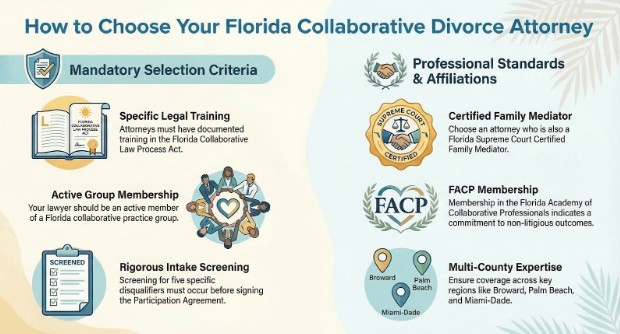
Florida spouses should select a collaborative attorney with specific training in the Florida Collaborative Law Process Act, active membership in a Florida collaborative practice group, and a documented intake screening process that identifies the five disqualifiers before the Participation Agreement is signed.
Carol Ann Mazza is a Florida Bar member, Florida Supreme Court Certified Family Mediator, and trained collaborative divorce attorney serving Broward County, Palm Beach County, and Miami-Dade County.
Carol Ann Mazza is a member of the Florida Academy of Collaborative Professionals, the statewide organization of attorneys, financial professionals, and mental health practitioners whose mission is to guide Florida families to peaceful divorce without litigation.
Florida spouses evaluating whether the collaborative process fits their situation can review when collaborative divorce is not the right choice in Florida before scheduling a consultation.
Contact Us Today For An Appointment
Frequently Asked Questions
How many attorneys are in a Florida collaborative divorce?
A Florida collaborative divorce requires one collaborative attorney per spouse — two attorneys total. Each attorney advises their own client on legal rights and negotiation strategy. Both attorneys sign the Participation Agreement and are barred from representing either spouse in litigation if the process terminates.
Is the mental health neutral to my therapist in a collaborative divorce?
The mental health neutral in a Florida collaborative divorce is not a therapist for either spouse. The mental health neutral facilitates communication between both parties during team sessions and serves the collaborative process as a whole. Florida spouses who need individual therapeutic support retain a separate personal therapist outside the collaborative team.
What does the financial neutral do in a Florida collaborative divorce?
The financial neutral gathers comprehensive financial data from both spouses, develops multiple settlement options, and models the long-term outcomes of each. Both spouses share one financial neutral who serves neither party individually and gives both parties the same financial data for decision-making.
Does every Florida collaborative divorce require a child specialist?
A child specialist is optional in Florida collaborative divorce, not mandatory. Carol Ann Mazza recommends a child specialist when the couple has minor children and parenting plan design would benefit from an independent assessment of each child’s developmental needs and expressed preferences.
What happens to the collaborative team if one spouse wants to go to court? Each member of the collaborative team withdraws immediately upon one spouse initiating litigation. The disqualification clause under Florida Family Law Rule 12.745 permanently bars all collaborative attorneys from representing either spouse in court. Both parties must retain entirely new litigation counsel before any court proceedings can begin.
Are collaborative divorce team communications confidential in Florida?
All Florida collaborative team communications are privileged under Section 61.57, Florida Statutes. That protection covers session discussions, financial disclosures, settlement proposals, and the child specialist’s findings. The privilege survives process termination — new litigation counsel cannot use collaborative communications as evidence in subsequent court proceedings.
How is a collaborative attorney different from a traditional divorce attorney in Florida?
A collaborative attorney in Florida is contractually barred from representing their client in litigation. A traditional divorce attorney may negotiate and litigate the same case. The disqualification clause removes the litigation fallback option, aligning the attorney’s professional interest entirely toward reaching a negotiated settlement.
Can I use my regular family attorney as my collaborative attorney in Florida?
A Florida family attorney may serve as a collaborative attorney only if trained in the Florida Collaborative Law Process Act and willing to sign the Participation Agreement, including the disqualification clause. Many experienced family law litigators decline collaborative cases because the disqualification clause prevents them from continuing if negotiations fail.
Schedule a confidential consultation with Carol Ann Mazza to discuss your collaborative divorce team and whether the process is a good fit for your situation. Contact Carol Ann Mazza today.
Related reading: The Collaborative Divorce Process in Florida | The Benefit of a Financial Neutral | How the Disqualification Clause Works | Collaborative Divorce vs. Litigation in Florida | When Collaborative Divorce Is Not the Right Choice
Originally published: March 2026 | Reviewed by Carol Ann Mazza, Florida Bar Member, Collaborative Divorce Attorney
About the Author
Carolann Mazza
Florida Family Law Attorney (The Florida Bar, admitted 2001) · Florida Supreme Court Certified Family Mediator (certified 2011, No. 25475F) · Super Lawyers, Family Law, 2022–2026
Carolann Mazza is the founder of Carolann Mazza, P.A., a non-litigation family law firm she opened in Fort Lauderdale in 2003. Practicing family law in Florida since 2001 and admitted to the State Bar of Texas in 1997, she resolves divorce and family conflicts exclusively through Collaborative Divorce, mediation, and out-of-court settlement — keeping families out of court while preserving relationships, dignity, and children’s wellbeing. She serves Broward, Palm Beach, and Miami-Dade counties.