
Florida Divorce Law: What Couples Should Know Before Filing
Florida divorce law is the body of rules in Chapter 61, Florida Statutes, that controls a dissolution of marriage.
It covers who may file, no-fault grounds, how property is divided, when alimony applies, and how parents share time with children. A Florida court grants a divorce once the marriage is irretrievably broken, without either spouse proving fault.
Carolann Mazza, P.A. (Collaborative Solutions), a non-litigation family law firm in Fort Lauderdale, Florida, helps couples apply these rules through Collaborative divorce and mediation.
Key Takeaways
- Section 61.052, Florida Statutes, recognizes only two grounds for dissolution: an irretrievably broken marriage or a spouse’s adjudicated mental incapacity lasting at least 3 years.
- Section 61.075, Florida Statutes, directs judges to start from an equal division of marital assets and debts.
- Section 61.08, Florida Statutes, no longer lists permanent alimony and caps durational alimony at 50%, 60%, or 75% of the marriage length for petitions pending or filed on or after July 1, 2023.
- Section 61.13(2)(c)1, Florida Statutes, presumes that equal time-sharing serves a child’s best interests unless a parent proves otherwise.
Each divorce applies the same statutes to a different family. Carolann Mazza, P.A. explains each rule, so couples can plan a settlement that works for their unique family with confidence.
What Are the Legal Grounds for Divorce in Florida?
Florida is a no-fault state, so a spouse needs only to show the marriage is irretrievably broken. Section 61.052, Florida Statutes, also allows dissolution when one spouse has been adjudicated mentally incapacitated for at least 3 years before the petition.
Fault still matters in narrow ways. Section 61.08 lets a judge weigh either spouse’s adultery and its economic effect when deciding alimony. Section 61.075 lets a judge consider intentional waste of marital assets when dividing property. And, of course, fault plays an indirect role when each spouse blames the other for the situation.
When a spouse denies the breakdown or the couple shares a minor child or children, section 61.052 allows the court to order counseling or continue the case for up to 3 months.
Section 61.021, Florida Statutes, requires one spouse to live in Florida for 6 months before filing. Section 61.052(2) requires corroborating residency through a Florida driver’s license, ID card, voter registration card, or a third-party witness.
Local steps such as the $409 Broward Clerk fee and the Broward filing location sit on top of these statewide requirements.
How Does Florida Divide Property and Debt in a Divorce?
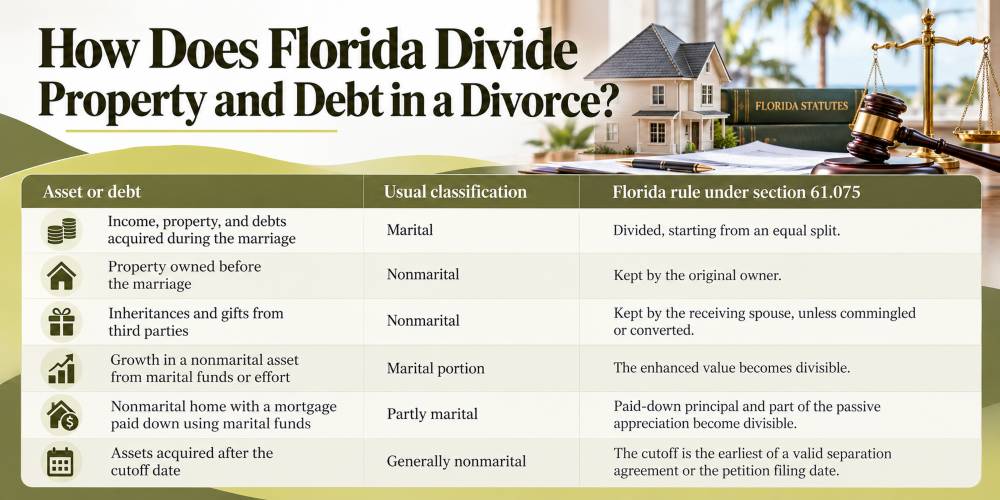
Florida uses equitable distribution, not community property. Section 61.075, Florida Statutes, directs the judge to set aside each spouse’s nonmarital property first, then begin with an equal split of marital assets and debts.
A judge has the authority to depart from that equal starting point if there is justification, taking into account career sacrifices, contributions to the other spouse’s education, or intentional waste of marital assets.
| Asset or debt | Usual classification | Florida rule under section 61.075 |
| Income, property, and debts acquired during the marriage | Marital | Divided, starting from an equal split |
| Property owned before the marriage | Nonmarital | Kept by the original owner, unless commingled or converted to marital |
| Inheritances and gifts from third parties | Nonmarital | Kept by the receiving spouse, unless commingled or converted |
| Growth in a nonmarital asset from marital funds or effort | Marital portion | The enhanced value becomes divisible |
| Nonmarital home with a mortgage paid down using marital funds | Partly marital | Paid-down principal and part of the passive appreciation become divisible |
| Assets acquired after the cutoff date | Generally nonmarital | The cutoff is the earliest of a valid separation agreement or the petition filing date |
Consider a hypothetical spouse who bought a condo before the wedding and then paid its mortgage from joint paychecks for 10 years.
The equity owned on the wedding day stays nonmarital, while the principal paid with marital income becomes divisible. Any marital share of the condo’s market appreciation comes from a coverture-fraction formula in section 61.075(6).
That formula depends on the mortgage balance, the payments made, and appraised values, so no single percentage applies to every home.
The final numbers depend on tracing records and the valuation dates the judge sets for each asset. Dividing retirement accounts adds another step, because the plan administrator generally needs a separate court order.
If you’re ready to get started, call us now!
What Changed in Florida Alimony Law in 2023?
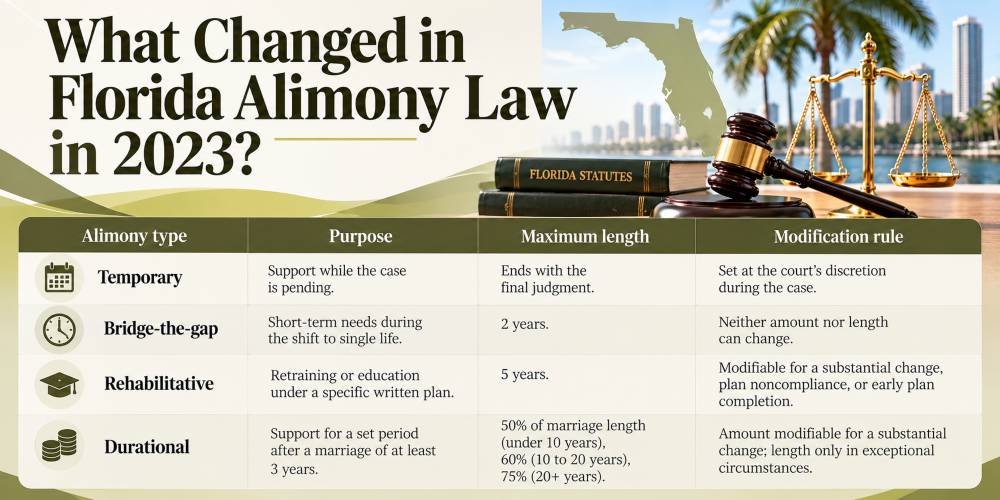
Florida removed permanent alimony from section 61.08 in 2023. Under section 61.08(11), Florida Statutes, the amended rules govern initial petitions pending or filed on or after July 1, 2023. Florida’s district courts of appeal read “pending” differently:
- In Woodward v. Woodward, 400 So. 3d 861 (Fla. 2d DCA 2025), the Second District treated a case still on appeal that day as pending.
- The First District in Stockdale v. Stockdale (Fla. 1st DCA 2025) and the Fifth District in Secrist v. Secrist, 421 So. 3d 781 (Fla. 5th DCA 2025), treat a petition as pending only until the trial court renders final judgment.
Courts may now award temporary, bridge-the-gap, rehabilitative, or durational alimony, paid periodically, in a lump sum, or both.
| Alimony type | Purpose | Maximum length | Modification rule |
| Temporary | Support while the case is pending | Ends with the final judgment | Set at the court’s discretion during the case |
| Bridge-the-gap | Short-term needs during the shift to single life | 2 years | Neither amount nor length can change |
| Rehabilitative | Retraining or education under a specific written plan | 5 years | Modifiable for a substantial change, plan noncompliance, or early plan completion |
| Durational | Support for a set period after a marriage of at least 3 years | 50% of marriage length (under 10 years), 60% (10 to 20 years), 75% (20+ years) | Amount modifiable for a substantial change; length only in exceptional circumstances |
The spouse requesting alimony must prove both a need and the other spouse’s ability to pay. Durational alimony cannot exceed the lesser of the recipient’s reasonable need or 35% of the difference between the spouses’ net incomes.
A judge may exceed the duration caps only when clear and convincing evidence shows exceptional circumstances.
Section 61.08 measures marriage length from the wedding date to the filing date. For example, a 12-year marriage falls in the moderate-term category, so durational alimony generally cannot run longer than 7.2 years under Florida alimony reform.
The table simplifies these rules, and courts base each award on written findings under the statutory factors.
How Do Parenting Plans and Time-Sharing Work Under Florida Law?
Florida law frames parenting decisions through parental responsibility, parenting plans, and time-sharing schedules. Section 61.13(2)(c)1., Florida Statutes, presumes that equal time-sharing is in a child’s best interests.
A parent who wants a different arrangement must rebut that presumption by a preponderance of the evidence, unless both parents agree to another schedule.
Section 61.13(2)(b) lists five items that every court-approved parenting plan must include at a minimum. Parents may opt out of only the exchange-location item, and only by written agreement:
- Daily responsibilities: How the parents share and divide the child’s routine upbringing tasks
- Time-sharing schedule: The specific days and overnights the child spends with each parent
- Decision areas: Which parent handles health care, school matters, and other activities, including the school-boundary address
- Communication methods: The technology and methods each parent uses to stay in contact with the child
- Exchange locations: Authorized handoff locations, which the court may move to a neutral safe exchange site when it finds a risk of harm during exchanges
Equal time-sharing is a starting point, not a requirement in unsafe situations or if the judge finds it is not in the child’s best interest.
Section 61.13 directs the court to treat evidence of domestic violence or child abuse as evidence of detriment to the child. Certain convictions create a rebuttable presumption against shared parental responsibility.
Judges weigh 20 best-interest factors in section 61.13(3), including factor (m) on domestic violence, abuse, and neglect. However, a judge approving an agreed schedule need not make findings on every factor.
How Does Florida Calculate Child Support?
Florida calculates child support with an income-shares formula under section 61.30, Florida Statutes.
The formula combines both parents’ net monthly incomes, sets a basic obligation from the statutory schedule, and assigns each parent a share in proportion to income.
Time-sharing directly changes the result. A parent with at least 20% of the year’s overnights, which equals 73 nights, qualifies for the substantial time-sharing adjustment, which can reduce the amount of child support paid by one parent to the other.
Work-related child care costs, the child’s health insurance premiums, and uncovered medical, dental, and prescription costs are added to the basic obligation.
A judge may move up to 5% away from the guideline amount after considering the statutory factors, and a larger deviation requires a written finding.
Parents resolving children’s issues by agreement still submit a Child Support Guidelines Worksheet so the court can confirm the figure.
What Financial Disclosure Does Florida Require in a Divorce?
Florida Family Law Rule of Procedure 12.285 requires both spouses to exchange a financial affidavit and supporting records within 45 days of service of the petition in most dissolution cases.
The rule excludes simplified dissolution, and the financial affidavit exchange cannot be waived in cases the rule covers.
Mandatory financial disclosure gives both spouses the same financial picture before anyone negotiates, so property, alimony, and child support decisions rest on documented numbers. The package covers several record categories:
- Income records: Federal and state tax returns for the prior 3 years, plus W-2s, 1099s, and pay stubs
- Account statements: Bank, brokerage, and retirement account statements
- Property records: Deeds, titles, and records for real estate and vehicles
- Debt records: Credit card, loan, and mortgage statements
The Form 12.902(b) instructions direct a spouse with individual gross income under $50,000 a year to the short form, while a spouse at $50,000 or more uses Form 12.902(c). Those instructions list three situations where no affidavit is needed:
- a simplified dissolution in which both spouses waive it;
- a case with no minor children, no support issues, and a filed written settlement disposing of all financial issues;
- a case where the court lacks jurisdiction over financial issues.
Form 12.902(k), the Notice of Joint Verified Waiver of Filing Financial Affidavits, waives only the court filing, not the exchange.
Both spouses must first exchange complete affidavits and sign the notice before any dispositive agreement. Other mandatory financial disclosure items may be modified by agreement or court order.
Which Divorce Process Fits a Florida Couple?
The right process depends on how much the spouses agree, whether both will participate in good faith, and whether safety or a power imbalance is present.
| Process | Who participates | Attorney role | Best suited when |
| Uncontested filing | Both spouses sign a complete settlement | Optional review or full drafting | Spouses already agree on every issue |
| Mediation | Both spouses and a neutral certified mediator, in joint sessions or separate caucuses | Each spouse may bring or consult an attorney; the mediator advises neither | Spouses can negotiate with a neutral’s assistance, together or apart |
| Collaborative divorce | Both spouses, each with a Collaboratively trained attorney, plus optional neutrals | Attorneys negotiate but cannot later litigate the case | Spouses want legal advocacy without court |
| Litigation | Both spouses, attorneys, and a judge | Full courtroom representation | One spouse will not cooperate or safety requires court orders |
Mediation communications stay confidential under section 44.405, Florida Statutes. Section 44.102(2)(c) bars court-ordered family mediation, on a party’s request, when a history of domestic violence would compromise the process.
Generally, divorces require at least 20 days between filing and final judgment under section 61.19.
Carolann Mazza, Esq., Florida Supreme Court Certified Family Mediator, offers Collaborative Divorce and family mediation across South Florida under the Collaborative Law Process Act, sections 61.55 through 61.58.
Rule 4-1.19 of the Rules Regulating The Florida Bar requires a Collaborative attorney to screen for any history of coercive or violent conduct; in cases involving domestic violence, extra precautions must be taken.
The process requires voluntary disclosure on the part of each spouse. If immediate court orders are required or if there is a severe lack of trust between the spouses, a Collaborative Divorce might not be the right fit. If the process ends without agreement, the Collaborative attorneys withdraw, and each spouse hires new counsel to litigate their case.
The firm’s initial consultation assesses which process suits the couple, pinpoints which records to collect first, and outlines a path toward settlement.
Contact Us Today For An Appointment
Frequently Asked Questions
Is Florida a no-fault divorce state?
Yes. Section 61.052, Florida Statutes, grants a divorce when the marriage is irretrievably broken, without proof of wrongdoing. Mental incapacity is the only other ground. A judge may still weigh adultery and its economic effect when deciding alimony under section 61.08.
How long must someone live in Florida before filing for divorce?
One spouse must live in Florida for 6 months before filing under section 61.021, Florida Statutes. Section 61.052(2) requires corroboration through a Florida driver’s license, ID card, voter registration card, or a third-party witness, not just the spouse’s own statement.
Is permanent alimony still available in Florida?
No, for petitions pending or filed on or after July 1, 2023, under section 61.08(11), Florida Statutes. Courts may award temporary, bridge-the-gap, rehabilitative, or durational alimony, and durational awards are capped at 50%, 60%, or 75% of the marriage length.
Does Florida split marital property 50/50?
Florida starts from an equal split but does not guarantee one. Section 61.075, Florida Statutes, lets a judge divide marital assets and debts unequally when factors such as career sacrifices or intentional waste justify it. Nonmarital property generally stays with its original owner.
Does Florida presume equal time-sharing for parents?
Yes. Section 61.13(2)(c)1., Florida Statutes, presumes equal time-sharing serves a child’s best interests. A parent seeking a different schedule must rebut that presumption by a preponderance of the evidence, and evidence of domestic violence or abuse counts as evidence of detriment.
Does adultery affect a Florida divorce?
Adultery does not change the no-fault ground, but it can matter financially. Section 61.08 lets a judge consider adultery and its economic impact when setting alimony, and spending marital money on an affair can support an unequal property division under section 61.075.
How long does a Florida divorce take?
Section 61.19, Florida Statutes, requires at least 20 days between filing and final judgment, but that is a floor, not a forecast. An uncontested divorce with a signed settlement agreement moves fastest, while contested cases take much longer.
Can couples divorce in Florida without going to court?
Most of the work can happen outside court. Collaborative Divorce and mediation are processes whereby spouses negotiate privately and sign a written settlement agreement. A Florida judge must still review the agreement and enter a final judgment before the dissolution becomes official.
Bottom Line
Florida divorce law grants dissolution on a no-fault basis once one spouse meets the 6-month residency rule.
Judges start with an equal split of marital property and limit alimony to four defined types.
They also presume equal time-sharing unless evidence shows a different schedule protects the child.
Couples who negotiate through mediation or Collaborative Divorce apply these same rules while keeping the decisions in their own hands.
Choosing the right process early shapes cost, privacy, and control. Carolann Mazza, P.A. offers a confidential consultation covering process options, disclosure, and parenting plans.

About the Author
Carolann Mazza
Florida Family Law Attorney (The Florida Bar, admitted 2001) · Florida Supreme Court Certified Family Mediator (certified 2011, No. 25475F) · Super Lawyers, Family Law, 2022–2026
Carolann Mazza is the founder of Carolann Mazza, P.A., a non-litigation family law firm she opened in Fort Lauderdale in 2003. Practicing family law in Florida since 2001 and admitted to the State Bar of Texas in 1997, she resolves divorce and family conflicts exclusively through Collaborative Divorce, mediation, and out-of-court settlement — keeping families out of court while preserving relationships, dignity, and children’s wellbeing. She serves Broward, Palm Beach, and Miami-Dade counties.