
Making the Most of Limited Parenting Time With Your Children: A Florida Parent’s Guide
Originally published: September 2015 | Updated: February 2026 | Reviewed by Carol Ann Mazza

Florida parents who receive a timesharing schedule with fewer days than expected face a specific, documented fear: reduced parenting time will permanently weaken the parent-child bond.
A 2020 meta-analysis of 115 divorced families, published in Clinical Psychology Review, identified inter-parental conflict — not timesharing frequency — as the primary driver of negative developmental outcomes in children of divorce.
Florida family law uses the term “timesharing” — not “visitation” — to signal a legal principle: both parents retain active roles in a child’s life after divorce.
Florida Statute §61.13 governs all timesharing decisions in Broward, Miami-Dade, and Palm Beach County family courts, and mandates a child-centered analysis rather than a parent-preference model.
In Florida, Collaborative Divorce gives parents the power to design their own timesharing arrangement — one calibrated to their child’s actual developmental needs, school schedule, and family geography, rather than left to a judge’s best guess from a witness stand.
How Florida Courts Calculate Timesharing Under Florida Statute §61.13
Florida family courts do not award timesharing based on parental preference or negotiating position. Florida Statute §61.13 requires judges in Broward, Miami-Dade, and Palm Beach County to evaluate 20 enumerated best-interest-of-the-child factors before approving any parenting plan.
The six most heavily weighted statutory factors include:
- Parental willingness to support the child’s relationship with the other parent: Courts penalize parents who obstruct contact or communication.
- Anticipated division of post-divorce parental responsibilities: Judges assess each parent’s capacity to fulfill day-to-day caregiving tasks.
- Geographic viability of the proposed parenting plan: The distance between the parental residences directly affects schedule feasibility.
- Each parent’s moral fitness and physical and mental health: Documented mental health history, substance use, or domestic violence records are reviewed.
- The child’s established school, community, and home routine: Courts avoid disrupting stable educational and social environments.
- The child’s own preference: Weighted by age and maturity; one factor of 20, not determinative.
On July 1, 2023, Florida Statute §61.13 was amended to create a rebuttable presumption that equal (50/50) timesharing is in the child’s best interest.
This presumption can be rebutted by a preponderance of the evidence if a party demonstrates that equal timesharing does not serve the child’s best interests.
Florida parents entering timesharing negotiations or litigation after July 1, 2023, should understand that equal timesharing is now the legal starting point — not a threshold that must be argued from scratch.
Florida law also mandates that both parents complete a Florida Supreme Court–approved 4-hour parenting education course within 45 days of filing a dissolution of marriage petition under Florida Statute §61.21. Completion is a prerequisite to case resolution, not an optional program.
Florida Timesharing: Key Legal Parameters (as of February 2026) Governing statute: Florida Statute §61.13 Decision standard: Best interest of the child — 20 enumerated statutory factors Default presumption (as of July 1, 2023): Rebuttable presumption of equal (50/50) timesharing Mandatory parenting education: 4-hour Florida Supreme Court–approved course within 45 days of filing (Fla. Stat. §61.21) Modification standard: Substantial and material change in circumstances Jurisdictions: Broward County, Miami-Dade County, Palm Beach County family courts
If you’re ready to get started, call us now!
What Child Development Research Says About Parenting Time Quality vs. Quantity
A 2020 meta-analysis of 24,854 children across 115 divorced-family samples, published in Clinical Psychology Review, found that inter-parental conflict — not timesharing frequency — is the primary predictor of internalizing and externalizing problems in children of divorce.
Parental hostility, intrusiveness, and role diffusion mediated child adjustment outcomes more strongly than any custody arrangement.
A 2023 analysis cited by the Institute for Family Studies found that on academic, cognitive, emotional, psychological, and physical health measures, children in shared parenting arrangements perform comparably to children in nuclear families when inter-parental conflict is low.
The determining variable is not the number of overnights — it is the emotional safety of the parenting environment on both sides.
A timesharing schedule defines access windows. A parent’s emotional consistency, conflict-free behavior, and routine maintenance within those windows determine a child’s developmental outcomes.
Florida parents with minority timesharing who eliminate conflict and maintain structured parenting environments build secure parent-child attachments that research shows persist into adolescence.
| Timesharing Scenario | Documented Impact on Child Wellbeing |
| High inter-parental conflict (any schedule) | Most damaging — primary driver of anxiety disorders, behavioral dysregulation, and academic underperformance |
| Low conflict + equal (50/50) timesharing | Strongest outcomes when both parents cooperate at exchanges and in co-parenting communication |
| Low conflict + 60/40 or 70/30 timesharing | Strong adjustment outcomes when a minority-time parent maintains consistent, structured parenting |
| High conflict + equal (50/50) timesharing | Exchange frequency increases conflict exposure — associated with elevated child stress markers |
| Consistent, emotionally present minority-time parent | Secure parent-child attachment forms regardless of schedule percentage when parenting quality is high |
7 Evidence-Informed Strategies for Maximizing Parenting Time Quality
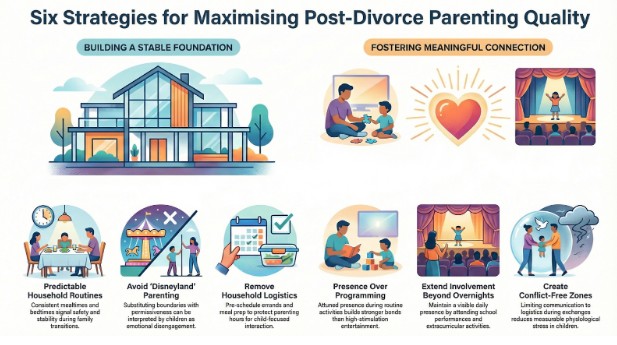
The following seven strategies apply to Florida parents with any timesharing arrangement. Each strategy targets a specific, documented driver of parent-child attachment quality.
1. Prioritize Presence Over Programming
Children of divorce do not require high-stimulation activities to form secure parental attachments. Attachment research originating with Dr. John Bowlby and Dr. Mary Ainsworth identified consistent, attuned parental presence — not event frequency — as the foundation of secure parent-child bonds.
Florida parents with limited timesharing build stronger relationships through homework sessions, shared meals, and routine conversations than through entertainment-heavy visits that substitute activity for attention.
2. Maintain Consistent Household Routines
Predictable household routines — consistent bedtimes, mealtimes, and homework schedules — reduce child anxiety during the post-divorce adjustment period.
The American Academy of Pediatrics identifies routine as a primary stress-reduction mechanism for children experiencing family transitions.
A parenting home that operates on a consistent schedule signals to the child that the environment is safe, stable, and permanent — not a temporary exception to normal life.
3. Avoid the ‘Disneyland Parent’ Dynamic
The ‘Disneyland Parent’ pattern is a parenting dynamic in which a non-custodial parent substitutes entertainment and permissiveness for routine and behavioral guidance.
Family therapists document the Disneyland Parent pattern as damaging to long-term parent-child attachment because children interpret the absence of boundaries as emotional disengagement rather than affection.
Florida parents with minority timesharing strengthen the parent-child relationship by maintaining age-appropriate expectations and consistent consequences during all parenting sessions.
4. Extend Parental Involvement Beyond Scheduled Timesharing
Florida parenting plans, governed by Florida Statute §61.13, can be structured to include school event attendance rights, extracurricular participation rights, and medical appointment notification requirements — independent of overnight timesharing percentages.
Florida parents who attend school performances, volunteer in classrooms, and participate in weekend activities maintain a visible presence in their child’s daily life.
Review Florida’s statutory parenting plan requirements to understand which participation rights can be codified into an existing plan.
If you’re ready to get started, call us now!
5. Remove Household Logistics From Parenting Hours
Every hour a Florida parent allocates to grocery shopping, household errands, or administrative tasks during scheduled timesharing is an hour subtracted from child-directed interaction.
Parents who pre-schedule grocery delivery, batch meal preparation on non-parenting days, and outsource time-intensive household tasks protect the full duration of their parenting window for child-focused activity.
This time-management discipline is a direct, measurable investment in the quality of the parent-child relationship.
6. Maintain Structured, Conflict-Free Co-Parent Communication
Children display measurable physiological stress responses — including elevated cortisol levels — when exposed to inter-parental tension during custody exchanges.
Florida co-parents who limit exchange communications to logistics, adopt parallel parenting frameworks when direct communication is contentious, and use structured co-parenting communication protocols reduce their children’s exposure to conflict-related stress.
For a broader post-divorce communication framework, see Managing Communication After Divorce in South Florida.
7. Engage Professional Emotional Support Outside of Parenting Sessions
Florida parents who process divorce-related grief or anxiety during parenting sessions inadvertently transfer that distress to their children. Florida-based family therapists, licensed clinical social workers, and structured divorce recovery programs.
Engaging professional support outside of parenting sessions ensures that scheduled timesharing remains child-focused rather than grief-driven.
How the Divorce Process — Collaborative vs. Litigated — Determines Parenting Plan Quality
The divorce process a Florida family chooses determines not only the speed and cost of resolution — it determines the structural quality of the parenting plan produced and the durability of the co-parenting relationship that executes it.
Florida family court judges apply the 20-factor analysis under Florida Statute §61.13 to a one-day evidentiary snapshot of each family.
A judge does not have access to a child’s specific school transition schedule, a parent’s seasonal work travel patterns, the proximity of extended family caregivers, or the developmental particularities of the child.
A court-issued parenting plan is legally enforceable. A court-issued parenting plan is frequently misaligned with the family’s actual daily life.
Florida parents who negotiate their own timesharing arrangement through the Collaborative Divorce process design a parenting plan calibrated to their specific family circumstances.
Shared authorship of the parenting plan increases long-term compliance and reduces post-divorce modification litigation.
Why Collaborative Divorce Produces Structurally Superior Florida Parenting Plans. In a Florida Collaborative Divorce, both parents work with their respective attorneys, a neutral financial professional, and — where children are involved — a licensed child specialist or family therapist. The child specialist directly assesses the child’s developmental stage, temperament, and school schedule to inform the structure of the parenting plan. The resulting plan is co-authored, developmentally calibrated, and accepted by both parents — reducing the likelihood of future modification proceedings. A Florida family court judge cannot replicate this level of family-specific analysis within the constraints of a contested hearing.
Florida contested timesharing litigation creates a structural problem: both attorneys are retained to advocate for their respective clients’ parenting position.
This adversarial dynamic generates documented resentment, hardens parenting positions, and produces co-parenting relationships that require ongoing court intervention to manage.
Children caught in high-conflict post-divorce co-parenting arrangements sustain measurable long-term psychological harm, as confirmed by the 2020 meta-analysis in Clinical Psychology Review.
The Collaborative Divorce process requires both parents to practice interest-based negotiation throughout each session — building the co-parenting communication skills needed to resolve scheduling conflicts without returning to court.
Florida parents operating under an existing court-issued parenting plan benefit from the same principle: structured post-divorce co-parenting communication reduces conflict more effectively than modification hearings and protects children from ongoing inter-parental tension.
Frequently Asked Questions
Does Florida Law Presume 50/50 Timesharing As The Starting Point?
Yes. Florida Statute § 61.13 creates a rebuttable presumption that equal timesharing is in a child’s best interests, effective July 1, 2023. A parent who opposes equal timesharing must rebut the presumption by a preponderance of the evidence with child-specific facts showing equal timesharing is not in that child’s best interests.
What Does “Quality Parenting Time” Mean In A Florida Custody Context?
Quality parenting time means reliable, child-centered timesharing that protects routines, school stability, and the child’s emotional and social development, as outlined in a parenting plan. Quality parenting time is measured by consistency and parenting behavior, not by spending money on entertainment or creating high-activity experiences.
Can A Florida Child Legally Choose Which Parent To Live With?
No. Florida Statute § 61.13 treats a child’s preference as one factor in the best-interest analysis, not a deciding right. Judges weigh the preference based on the child’s age and maturity, then evaluate it alongside the full set of statutory factors before setting timesharing.
What Evidence Can Rebut The 50/50 Timesharing Presumption In Florida?
Evidence can rebut the presumption when it shows equal timesharing does not serve the specific child’s best interests under the statutory factors in Florida Statute § 61.13. Courts look for concrete, child-specific facts, not generalized claims about fairness, parental conflict, or convenience.
What Enforcement Tools Does Florida Law Provide When A Co-Parent Violates A Timesharing Order?
Florida Statute § 61.13 authorizes remedies that can include make-up timesharing, awards of attorney’s fees and costs, and other court-ordered compliance measures when a parent fails to follow a timesharing schedule. Strong documentation matters because judges rely on dated, specific records of missed exchanges and communication when deciding enforcement relief.
Can A Parent Go To Jail For Violating A Florida Timesharing Order?
Sometimes. Repeated or willful violations can lead to contempt proceedings in Florida family court, and contempt sanctions can include serious consequences beyond make-up time and fee shifting. The court’s focus is on enforcing the order in a way that protects the child’s best interests and restores the nonoffending parent’s time.
Does Domestic Violence Affect Timesharing In Florida?
Yes. Florida’s timesharing analysis treats child safety as central, and certain criminal convictions can trigger statutory presumptions against granting timesharing in specific circumstances. A court can restrict or structure contact when the evidence shows that unrestricted timesharing is not in the child’s best interests.
Can Florida Parents Switch To Collaborative Divorce After Litigation Has Already Begun?
Yes, if both parties agree. Florida’s Collaborative Law Process Act is designed to encourage early resolution of pending litigation through a voluntary settlement process, and it requires the parties to sign a collaborative participation agreement to formally enter the collaborative process.