
Collaborative Divorce Attorney Boca Raton, Florida-Carolann Mazza
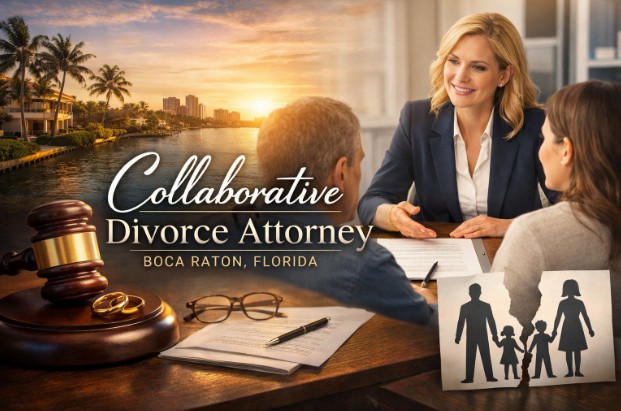
A collaborative divorce attorney in Boca Raton is a Florida-licensed family law attorney who guides spouses through out-of-court divorce resolution under Florida’s Collaborative Law Process Act, Section 61.56, Florida Statutes.
Carolann Mazza, a Florida Supreme Court Certified Family Mediator licensed since 2001, provides collaborative divorce representation to Boca Raton and Palm Beach County families — keeping financial decisions, parenting arrangements, and asset division with the family rather than a Palm Beach County circuit court judge.
Key Takeaways
- Carolann Mazza, P.A., serves Boca Raton residents under Florida’s Collaborative Law Process Act, Section 61.56, Florida Statutes, effective July 1, 2017
- Collaborative divorce cases for Boca Raton families are filed in Palm Beach County’s 15th Judicial Circuit Court — only after both spouses reach a full written agreement outside of court.
- Carolann Mazza, P.A., handles collaborative divorce, mediation, children’s issues, unbundled legal services, and out-of-court settlements across Broward, Palm Beach, and Miami-Dade counties.
- Florida Academy of Collaborative Professionals member data shows 78% of Florida collaborative divorce cases conclude within six months, compared to 12–18 months for contested litigation in Palm Beach County.
What Does a Collaborative Divorce Attorney in Boca Raton Actually Do?
A collaborative divorce attorney in Boca Raton advises one spouse on legal rights, equitable distribution strategy, and out-of-court negotiation under the Florida Collaborative Law Process Act.
Carolann Mazza coordinates with the opposing spouse’s attorney and a team of neutral professionals to reach a binding marital settlement agreement — without filing contested motions in Palm Beach County’s 15th Judicial Circuit Court.
The collaborative attorney role carries one structurally defining feature: the disqualification clause under Florida Family Law Rule 12.745. That clause bars the collaborative attorney — and every attorney in the same firm — from representing the same client in any subsequent court proceeding if the process terminates without agreement.
The disqualification clause eliminates the financial incentive to prolong conflict. It aligns the attorney’s professional interest entirely with reaching a durable out-of-court resolution — so Boca Raton clients receive advocacy aimed at settlement rather than billable courtroom appearances.
The difference between a collaborative divorce attorney and a divorce mediator is that a collaborative divorce attorney provides individual legal representation. A mediator serves as a neutral facilitator for both spouses and advocates for neither.
Carolann Mazza represents one spouse’s legal interests exclusively — while simultaneously holding Florida Supreme Court Certified Family Mediator credentials that deepen Carolann Mazza, P.A.’s capacity to evaluate, structure, and finalize complex Palm Beach County settlements.
Carolann Mazza has represented Boca Raton and Palm Beach County families in non-litigation family law proceedings since 2001.
Carolann Mazza, P.A., helps Boca Raton families resolve divorce privately and out of court. Schedule a confidential consultation today at (954) 527-4604.
If you’re ready to get started, call us now!
Why Do Boca Raton Couples Choose Collaborative Divorce Over Litigation?
Boca Raton couples choose collaborative divorce over contested litigation for three reasons: financial privacy, direct control over settlement outcomes, and preservation of co-parenting relationships.
Privacy and Public Record Risk in Palm Beach County
Palm Beach County’s contested court docket extends high-asset cases beyond eighteen months in many instances. Every court filing in Palm Beach County’s 15th Judicial Circuit enters the public record. For professionals, business owners, and executives in communities such as Broken Sound, St. Andrews Country Club, Boca West Country Club, and Royal Palm Yacht and Country Club — where financial details carry professional reputational weight — public exposure is a material liability.
Cost Differences Between Collaborative Divorce and Litigation
Contested litigation assigns competing expert witnesses to value real estate portfolios, closely held business interests, investment accounts, and retirement assets. That adversarial structure drives per-person legal costs toward $15,000 to $30,000 or more as of 2025. The economics of collaborative divorce work differently.
One neutral Certified Divorce Financial Analyst serves both parties. Shared professional costs replace dueling expert fees. Florida collaborative cases as of 2025 typically resolve for $5,000 to $8,000 per spouse.
Confidentiality Protections Under Florida Law
Collaborative proceedings operate under the confidentiality protections of Section 61.57, Florida Statutes. All financial disclosures, settlement proposals, and team communications remain privileged and inadmissible in any subsequent proceeding.
As a mediation alternative, collaborative divorce offers one protection that mediation alone does not: dedicated legal counsel for each spouse throughout the process.
Understanding why collaborative divorce fits Boca Raton’s asset and privacy profile is the first step.
Understanding how the process actually operates is what helps Boca Raton couples decide whether to begin, so here is exactly what happens from the first consultation through the final court filing.
How Does the Collaborative Divorce Process Work in Palm Beach County?
The collaborative divorce process in Palm Beach County begins when both spouses and both attorneys sign a Participation Agreement under Section 61.55, Florida Statutes. That agreement commits all parties to resolve every marital issue outside of court and triggers confidentiality protections under Section 61.57.
Carolann Mazza, P.A., represents one spouse through six stages — from intake screening through the final uncontested court filing — so Boca Raton families reach a signed settlement agreement without contested motions or judicial hearings.
Stage 1 — Intake screening.
Carolann Mazza meets separately with the prospective client to confirm the case qualifies. Screening identifies domestic violence, financial concealment risk, and good-faith negotiation capacity before a Participation Agreement is signed.
Cases that do not qualify are redirected to mediation or litigation immediately — so Boca Raton clients do not invest time and money in a process their circumstances will not support.
Stage 2 — Participation Agreement.
Both spouses and both attorneys execute the agreement. All disclosures and proposals made during the process become privileged under Section 61.57, Florida Statutes, and inadmissible in any subsequent court proceeding. The Florida Courts’ family law rules govern each attorney’s obligations under Rule 12.745.
Stage 3 — Team assembly.
Every Florida collaborative team includes one attorney per spouse. Boca Raton cases with significant assets add a Certified Divorce Financial Analyst credentialed by the Institute for Divorce Financial Analysts to evaluate real estate, investment portfolios, retirement accounts, and business interests.
A licensed mental health neutral facilitates joint sessions. Cases involving minor children may add a child specialist focused on time-sharing design. Each team member’s role and limitations are defined under Florida’s statutory framework.
Stage 4 — Joint sessions.
The spouses and attorneys meet in three to five structured sessions. Each session covers a defined agenda: asset inventory, equitable distribution options, support calculations, and parenting plan terms.
The mental health neutral manages communication dynamics to keep legal discussions productive. For a month-by-month breakdown, the collaborative divorce timeline in Florida details each stage.
Stage 5 — Marital settlement agreement.
Once both parties reach full agreement, the attorneys draft the marital settlement agreement covering equitable distribution, alimony, child time-sharing, parental responsibility, and child support. Both spouses review and sign before submission.
Stage 6 — Uncontested court filing.
The signed agreement is filed with Palm Beach County’s 15th Judicial Circuit as an uncontested dissolution of marriage. This is the only court interaction in a completed collaborative case.
For a full explanation of how the process unfolds from first consultation through final filing, the process guide covers each stage in detail.
With the process structure clear, the next question Boca Raton families ask is which specific legal issues the collaborative model resolves—and how it handles the asset complexity common in Palm Beach County marriages.
If you’re ready to get started, call us now!
What Legal Issues Does Collaborative Divorce Resolve for Boca Raton Families?
Collaborative divorce in Boca Raton resolves every substantive issue a contested divorce addresses — equitable distribution, alimony, child time-sharing, parental responsibility, and child support — through a negotiated agreement under Florida Statutes Chapter 61, without contested motions or judicial hearings in Palm Beach County’s 15th Judicial Circuit.
Equitable distribution is governed by Section 61.075, Florida Statutes. Florida divides marital property equitably — not equally — by weighing the duration of the marriage, each spouse’s economic circumstances, and contributions to the marital estate.
A neutral Certified Divorce Financial Analyst builds multiple distribution scenarios for both spouses to evaluate jointly — replacing the adversarial model of competing appraisers arguing asset values before a judge.
Alimony in Florida is governed by the 2023 Alimony Reform Act, which eliminated permanent alimony and established durational caps tied to the length of the marriage. Collaborative divorce gives both spouses direct control over alimony amount, duration, and payment structure — including lump-sum and step-down arrangements — rather than submitting those decisions to judicial discretion.
The tax treatment of alimony under the Tax Cuts and Jobs Act of 2017 eliminates deductibility for the paying spouse on all post-2018 agreements. IRS Publication 504 confirms the current federal tax treatment applicable to Florida divorce agreements finalized after December 31, 2018.
Child time-sharing and parental responsibility fall under Section 61.13, Florida Statutes. Florida’s best-interests-of-the-child standard gives parents significant design space to build time-sharing schedules and decision-making agreements suited to their specific family.
Carolann Mazza, P.A., handles children’s issues as a core component of every collaborative case involving minor children — including holiday schedules, school district decisions, healthcare authority, and modification procedures.
Child support is calculated under Section 61.30, Florida Statutes, using Florida’s income shares guidelines. The financial neutral models multiple child support scenarios — including the effect of different time-sharing splits on the support obligation — so both Boca Raton parents understand the financial implications of each parenting plan option before agreeing to final figures.
Boca Raton families with complex divorce service needs — high-asset property portfolios, multi-county real estate holdings, closely held business interests, or executive compensation structures — benefit from the collaborative model’s ability to engage credentialed neutral professionals without the adversarial costs and public exposure of contested litigation in Palm Beach County.
Florida’s full statutory framework governing collaborative proceedings is documented in the Collaborative Law Process Act.
Is Collaborative Divorce the Right Choice for Your Boca Raton Divorce?
Cooperative intent — not prior amicability — is the qualifying factor for collaborative divorce. Both Boca Raton spouses need only commit to working toward a resolution rather than toward a courtroom outcome. The process does not require agreement on any issue before it begins.
Couples with minor children derive particular value from the collaborative model. The process structure preserves the co-parenting relationship that contested litigation in Palm Beach County’s 15th Judicial Circuit frequently damages beyond repair.
Families who protect that relationship during the divorce process reduce post-divorce conflict — so children maintain stable relationships with both parents through the transition and beyond.
Collaborative divorce does not produce durable agreements in every Boca Raton case. The process is not appropriate when domestic violence is present, when one spouse has concealed or is likely to conceal financial assets, or when a party enters the Participation Agreement in bad faith.
Florida’s Collaborative Law Process Act, Section 61.56, requires both parties to voluntarily commit — and that commitment must be genuine for the process to function.
Carolann Mazza conducts structured intake screening before any Participation Agreement is signed. Boca Raton clients are redirected to divorce mediation or unbundled legal services when collaborative representation is not the right fit.
For couples comparing all available out-of-court options, collaborative divorce vs. mediation outlines both pathways across cost, timeline, and case complexity.
A peaceful divorce in Florida is achievable through multiple routes — the right process depends on each family’s specific circumstances.
Who Is Carolann Mazza and Why Does She Serve Boca Raton Families?
Carolann Mazza is a Florida-licensed collaborative divorce attorney and Florida Supreme Court Certified Family Mediator who has practiced family law in South Florida since 2001. Mazza holds licenses in both Florida and Texas.
Mazza maintains active membership in five professional organizations: the South Palm Beach County Collaborative Law Group, the International Academy of Collaborative Professionals, the Collaborative Family Law Institute, the Collaborative Family Professionals of South Florida, and the Florida Bar Family Law Section.
Carolann Mazza, P.A., is a non-litigation family law firm. Every service the firm provides — collaborative divorce, family mediation, out-of-court settlement negotiation, and unbundled legal services — resolves family law matters without courtroom proceedings.
Boca Raton clients retain a collaboratively trained attorney who holds both litigation-depth legal knowledge and Florida Supreme Court mediation certification — a dual credential that strengthens the practice’s capacity to evaluate, negotiate, and finalize complex Palm Beach County settlements.
The International Academy of Collaborative Professionals sets global training and ethical standards for collaborative practitioners. Membership confirms Mazza meets the professional benchmarks the organization requires for collaborative law practice.
Carolann Mazza, P.A., serves Boca Raton families as part of a South Florida practice spanning Broward, Palm Beach, and Miami-Dade counties — from the firm office at 12 SE 7th St, Fort Lauderdale, FL 33301.
Boca Raton couples choose Carolann Mazza, P.A., to protect financial privacy and preserve co-parenting relationships. Schedule a confidential consultation now.
Contact Us Today For An Appointment
Frequently Asked Questions
Does Carolann Mazza serve clients outside Boca Raton proper in Palm Beach County?
Carolann Mazza, P.A., serves all Palm Beach County residents — including families in Delray Beach, Boynton Beach, West Palm Beach, and surrounding communities — as part of the firm’s South Florida service area covering Broward, Palm Beach, and Miami-Dade counties. Call (954) 527-4604 to confirm service for your specific location.
Is collaborative divorce legally recognized by Palm Beach County courts?
Collaborative divorce is fully recognized by Palm Beach County’s 15th Judicial Circuit under Florida’s Collaborative Law Process Act, Section 61.56, Florida Statutes, effective July 1, 2017. Marital settlement agreements reached through the collaborative process carry the same legal force as court-ordered judgments once filed and approved.
What is the difference between a collaborative divorce attorney and a divorce mediator in Florida?
A collaborative divorce attorney in Florida represents one spouse exclusively and advocates for that spouse’s legal interests. A Florida divorce mediator serves as a neutral facilitator for both parties and advocates for neither. Mazza holds both credentials and helps clients select the right process.
How long does collaborative divorce take in Palm Beach County?
Collaborative divorce in Palm Beach County typically takes four to eight months, with FACP member data showing 78% of Florida collaborative cases reach full agreement within six months of signing the Participation Agreement.
What does collaborative divorce cost for Boca Raton couples?
Collaborative divorce for Boca Raton couples typically costs $5,000 to $8,000 per spouse as of 2025. Palm Beach County contested litigation averages $15,000 to $30,000 per person, or more, when attorney fees, expert witnesses, and court costs are included.
Can collaborative divorce handle a Boca Raton divorce involving business ownership?
Collaborative divorce handles business ownership by assigning a neutral Certified Divorce Financial Analyst — credentialed by the Institute for Divorce Financial Analysts — to jointly value the business interest. That shared valuation replaces competing appraisers arguing before a Palm Beach County judge, reducing both cost and conflict.
What happens if the collaborative process fails in Palm Beach County?
When the collaborative process terminates without agreement, Florida Family Law Rule 12.745 requires both collaborative attorneys to withdraw immediately. Both Boca Raton spouses must retain new attorneys before filing contested proceedings in Palm Beach County’s 15th Judicial Circuit Court.
Does Carolann Mazza offer mediation for Boca Raton clients?
The firm offers divorce mediation as a Florida Supreme Court Certified Family Mediator service. Mediation uses a single neutral professional to facilitate negotiation, rather than a full multidisciplinary team with individual legal representation, making it a cost-effective option for couples who can negotiate without dedicated counsel.
About the Author
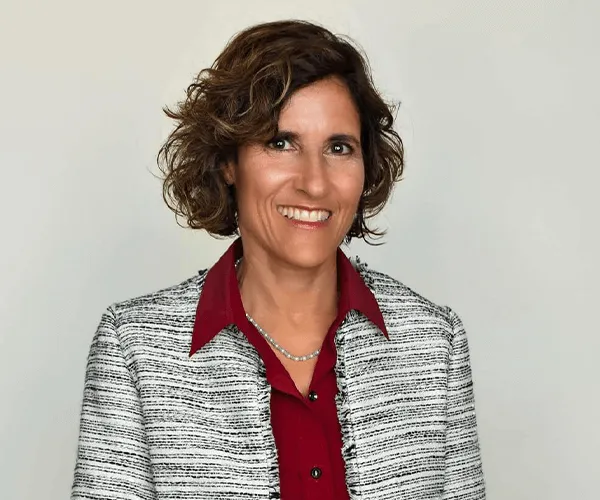
Carolann Mazza
Florida Family Law Attorney (The Florida Bar, admitted 2001) · Florida Supreme Court Certified Family Mediator (certified 2011, No. 25475F) · Super Lawyers, Family Law, 2022–2026
Carolann Mazza is the founder of Carolann Mazza, P.A., a non-litigation family law firm she opened in Fort Lauderdale in 2003. Practicing family law in Florida since 2001 and admitted to the State Bar of Texas in 1997, she resolves divorce and family conflicts exclusively through Collaborative Divorce, mediation, and out-of-court settlement — keeping families out of court while preserving relationships, dignity, and children’s wellbeing. She serves Broward, Palm Beach, and Miami-Dade counties.