
How to Prepare for Collaborative Divorce in Florida
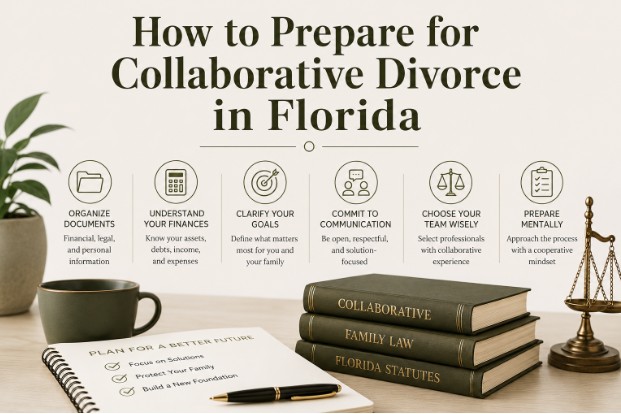
Preparing for Collaborative divorce in Florida means gathering your financial documents, selecting an experienced collaboratively trained attorney, clarifying your personal goals, and confirming your spouse’s genuine willingness to participate — before you sign the Participation Agreement.
The Florida Collaborative Law Process Act, Florida Statutes §§ 61.55–61.58, effective July 1, 2017, requires both spouses to commit in writing to full financial disclosure, honest communication, and to resolving disputes without court intervention.
Preparation, both before the first meeting and throughout the process, can be the difference between a long process and a shorter one and a less expensive process versus an expensive one.
Key Takeaways
- There are standard financial documents, such as tax returns, pay stubs, statements, and expense information, that are regularly used in the Collaborative process. Gathering these before the first meeting prevents delays.
- Selecting an attorney trained specifically in Collaborative law — not just a general family law attorney — is the single most important preparatory decision.
- Clarifying your goals and priorities before the first four-way meeting gives the team a foundation for building agreements, rather than spending time during the session establishing them.
- Both parents in a dissolution involving minor children must complete a parenting education course under Florida Statutes § 61.21 — completing it early removes a procedural delay at the final stage.
Step 1: Confirm the Process Is Right for Your Situation
Before preparing for a Collaborative divorce process, confirm that your situation meets the conditions the process requires — because entering Collaborative divorce in a case that will require a judge’s involvement and enforcement tools costs more than starting with litigation directly.
The Collaborative process depends entirely on both spouses committing to voluntary, transparent participation. When that foundation is absent, every dollar spent in preparation is wasted.
Collaborative divorce is appropriate when all of the following conditions are met:
- Both spouses can communicate without a history of domestic violence, coercion, or financial control
- Both spouses are willing to disclose marital assets fully and honestly
- Both spouses are willing to retain collaboratively trained attorneys — not litigation specialists
- No emergency court orders — temporary child support, domestic violence injunctions under Florida Statutes § 741.30, or emergency custody modifications — are needed immediately
If any of these conditions are in doubt, understanding when Collaborative divorce is not the right choice before committing protects your time, money, and legal position.
The disqualification clause under Florida Statutes § 61.57 requires that both Collaborative attorneys withdraw if the process fails — meaning a wrong choice at the start forces you to hire new counsel and begin again at full cost.
Note: Any documents that have been exchanged and/or budget or equitable distribution analyses completed in the Collaborative process are available to litigation counsel.
If you’re ready to get started, call us now!
Step 2: Select a Collaboratively Trained Attorney
Selecting an attorney with specific Collaborative law training — not a general family law attorney who occasionally handles cases collaboratively — is the most consequential preparatory decision in the entire process.
Florida Bar Rule 4-1.19 governs the professional conduct of Collaborative attorneys and requires them to complete specialized training before representing clients in the Collaborative process.
When interviewing Collaborative attorneys, ask:
- Have you completed formal Collaborative law training under Florida Bar Rule 4-1.19?
- Are you a member of the Florida Academy of Collaborative Professionals or a regional Collaborative practice group?
- How many Collaborative cases have you completed to full agreement?
- Can you also represent me in litigation if the Collaborative process terminates — and do you recommend doing so given my situation?
The last question matters because Florida Statutes § 61.57 requires your Collaborative attorney to withdraw if the process terminates. Some attorneys handle both Collaborative and litigation matters, which means you would need to find new counsel regardless. Understanding this up front prevents a costly surprise.
Your attorney should also assess whether your spouse’s likely attorney choice is genuinely Collaborative-trained or a litigation specialist who entered the process for tactical reasons.
A litigation-minded attorney on the other side is one of the clearest signals that Collaborative divorce will not succeed.
The Collaborative divorce process at collaborativenow.com details how both attorneys structure each phase, from the participation agreement through the final court submission.
Step 3: Gather Your Financial Documents
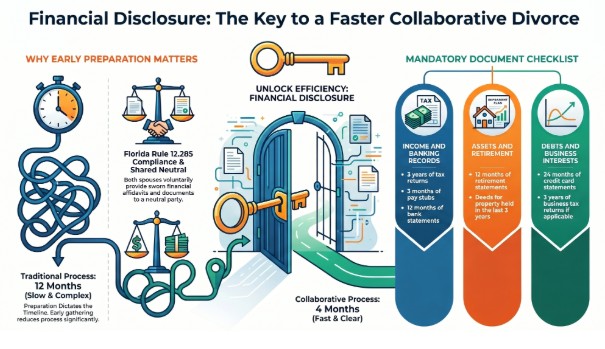
Gathering your financial documents before the first meeting is the preparation step that most directly determines whether your Collaborative divorce will be completed in four months or drag past twelve.
Florida Family Law Rule of Procedure 12.285 requires both spouses to exchange sworn financial affidavits and supporting documents.
In a Collaborative divorce, both spouses provide this information voluntarily to the shared financial neutral — but the required document categories are the same.
Documents to gather before your first Collaborative meeting:
- Income records: federal tax returns for the past 3 years (with all W-2s, 1099s, and K-1 attachments); pay stubs for the past 3 months; proof of any self-employment income, including profit and loss statements
- Bank and investment accounts: 12 months of statements for all checking, savings, money market, and certificate of deposit accounts; 12 months of brokerage account statements
- Retirement accounts: most recent statement plus 12 months of statements for all IRAs, 401(k)s, 403(b)s, pension plans, and deferred compensation accounts
- Real estate: deeds for all property owned or held in the past 3 years; current mortgage statements; most recent property tax notice
- Debts and liabilities: credit card statements for the past 24 months; all loan applications and financial statements prepared within the past 24 months
- Business interests: if you have an ownership interest in a business, include the past 3 years of business tax returns and core financial statements
The mandatory financial disclosure requirements under Florida Family Law Rule of Procedure 12.285 are detailed on collaborativenow.com.
Arriving at the first meeting with organized, complete documents allows the financial neutral to build the marital balance sheet immediately, rather than spending multiple sessions chasing missing records.
If you’re ready to get started, call us now!
Step 4: Clarify Your Goals Before the First Meeting
The most overlooked preparation step in Collaborative divorce is identifying your own priorities and goals before the first four-way meeting — because spouses who enter without a clear sense of what matters most to them spend expensive session time discovering it with the whole team present.
The Collaborative process is interest-based, not position-based. Knowing the difference before you walk in determines how productive every session is.
A position is what you want: “I want the house.” An interest is what you want: “I want the children to stay in the same school district.” Interests are workable — positions create deadlocks.
Your attorney and the neutral facilitator will help you develop interests throughout the process, but arriving with a working understanding of your own priorities will accelerate every conversation.
Before the first meeting, think through:
- Financial priorities: which assets matter most to your long-term financial stability, and which are less critical than they might appear
- Parenting priorities: what time-sharing arrangement genuinely serves your children’s daily life, not just your preferred outcome
- Housing priorities: whether keeping the marital home is financially realistic for your post-divorce income, or whether a clean sale and division serves both parties better
- Support priorities: what level of alimony or child support you need to maintain financial stability — with actual monthly budget figures, not estimates
Step 5: Have the Conversation With Your Spouse
Collaborative divorce requires both spouses to agree to participate, and how you introduce the idea to your spouse determines whether the process begins productively or with defensiveness that carries into every session.
Neither spouse can be ordered into the collaborative process under Florida Statutes § 61.57. Voluntary participation is not a formality — it is the structural foundation of the entire model.
When raising the issue of Collaborative divorce with your spouse:
- Frame the conversation around outcomes, not process — “I want us both to have enough information to make good decisions for the children and our finances” lands differently than “I want a Collaborative divorce.”
- Avoid presenting it as your preferred option that requires their agreement — present it as a path worth exploring together, with a direct comparison to what litigation costs and takes.
- Acknowledge their likely concerns — privacy, cost, whether the process is “real” legal representation — and be prepared to suggest they speak independently with a Collaborative attorney before committing.
- Give them time and resources — the Florida Academy of Collaborative Professionals website offers accessible information for spouses unfamiliar with the process.
If your spouse’s initial reaction is resistance, it’s worth understanding before proceeding.
A spouse who agrees reluctantly under pressure, or who retains a litigation-focused attorney while nominally agreeing to a Collaborative process, can create a bad-faith dynamic that may cause a Collaborative divorce to terminate, triggering disqualification under Florida Statutes § 61.57.
Step 6: Complete the Parenting Education Course Early
Both parents in a Florida dissolution involving minor children must complete a Supreme Court-approved parenting education and family stabilization course under Florida Statutes § 61.21 before the court schedules a final hearing — completing the course early removes a procedural bottleneck at that stage.
The requirement applies to every divorce process where minor children are involved. Waiting until the end of the process to complete it unnecessarily delays the final court submission.
The parenting education course covers:
- The developmental impact of divorce on children at different ages
- Communication strategies for co-parents after dissolution
- How to support children’s relationships with both parents
- Conflict resolution techniques for ongoing parenting decisions
Florida courts maintain a roster of approved providers under Florida Statutes § 61.21. Most providers offer the course online, and each spouse completes the course independently.
Completing the parenting education course early also reinforces the Collaborative mindset — the communication frameworks taught in the course align directly with the interest-based negotiation model the Collaborative team uses throughout the process.
The child-centered divorce approach at collaborativenow.com provides further context on how parenting decisions are handled within a Collaborative framework.
Step 7: Sign the Participation Agreement With Full Understanding
Signing the Florida Collaborative Law Participation Agreement is the formal act that begins the Collaborative law process under Florida Statutes § 61.57, and every spouse should understand exactly what that signature commits them to before signing.
The Participation Agreement is not a routine form. The obligations it creates are binding, and the consequences of termination are significant.
The Participation Agreement commits both spouses to:
- Full financial disclosure — no concealment of assets, income, or liabilities
- Honest, respectful communication in all team sessions
- Resolution of all dissolution issues without court intervention during the process
- Acceptance that both Collaborative attorneys must withdraw if either spouse files anything in court
The Florida Supreme Court approved standardized Collaborative divorce forms, including the Participation Agreement template as Florida Family Law Form 12.985(b)(2), available through the Florida Courts’ official forms page.
Your Collaborative attorney reviews every clause with you individually before the agreement is signed. The ” How the disqualification clause works resource at collaborativenow.com explains the specific obligations and consequences in plain language.
If you have questions about what the Participation Agreement requires, contact our Fort Lauderdale office before you sign — understanding every clause protects you from costly surprises.
Contact Us Today For An Appointment
Frequently Asked Questions
How long does it take to prepare for a Collaborative divorce in Florida?
Preparation time varies by case complexity. Gathering financial documents under Florida Family Law Rule of Procedure 12.285, selecting a collaboratively trained attorney, and clarifying personal goals take the most time. Starting document collection immediately after the initial attorney consultation prevents the most common delays.
What financial documents do I need to prepare for a Collaborative divorce in Florida?
Florida Family Law Rule of Procedure 12.285 requires federal tax returns for the past 3 years, 3 months of pay stubs, 12 months of bank and retirement statements, 24 months of credit card statements, real estate deeds, and business financials if you have an ownership interest.
Does my spouse have to agree to a Collaborative divorce in Florida?
Both spouses must voluntarily agree to participate — no court can compel either spouse under Florida Statutes § 61.57. If your spouse refuses or retains litigation-focused counsel, the process cannot proceed. Reluctant participation under pressure creates a bad-faith dynamic that can cause a Collaborative process to terminate.
What happens if I start preparing for a Collaborative divorce and then change my mind?
A Florida spouse can exit the process at any time under Florida Statutes § 61.57. Exiting after signing the Participation Agreement requires both Collaborative attorneys to immediately withdraw. You must retain new litigation counsel, and all Collaborative communications remain confidential under Florida Statutes § 61.58.
Do I need to complete the parenting course before Collaborative divorce starts?
Florida Statutes § 61.21 requires both parents to complete the parenting education course before the court schedules a final hearing — not before the Collaborative process begins. Completing the course early removes a procedural bottleneck at final submission and reinforces the Collaborative communication framework.
How do I find a Collaboratively trained attorney in Florida?
The Florida Academy of Collaborative Professionals maintains a statewide directory of trained Collaborative professionals. Florida Bar Rule 4-1.19 governs the training requirements attorneys must meet before practicing Collaborative law. Confirm that any attorney you interview has completed formal training and handled Florida Collaborative cases to full agreement. Many Collaborative attorneys in Florida are Accredited Collaborative Professionals, and extra accreditation is achieved by experience and additional training.
What should I prioritize when setting goals before the first Collaborative meeting?
Before the first meeting, identify financial stability needs, children’s daily schedule requirements, and housing feasibility based on actual post-divorce income. Translating each priority from a position — what you want — into an interest — why you want it — gives the team a workable foundation.
Can I prepare for a Collaborative divorce without telling my spouse first?
Consulting a Collaborative attorney independently before approaching your spouse is appropriate and advisable. The process cannot begin until both spouses agree to participate and retain their own attorneys. Preparing documents and clarifying goals before the conversation gives you a more informed foundation for raising it.

About the Author
Carolann Mazza
Florida Family Law Attorney (The Florida Bar, admitted 2001) · Florida Supreme Court Certified Family Mediator (certified 2011, No. 25475F) · Super Lawyers, Family Law, 2022–2026
Carolann Mazza is the founder of Carolann Mazza, P.A., a non-litigation family law firm she opened in Fort Lauderdale in 2003. Practicing family law in Florida since 2001 and admitted to the State Bar of Texas in 1997, she resolves divorce and family conflicts exclusively through Collaborative Divorce, mediation, and out-of-court settlement — keeping families out of court while preserving relationships, dignity, and children’s wellbeing. She serves Broward, Palm Beach, and Miami-Dade counties.