
When Collaborative Divorce Is NOT the Right Choice in Florida
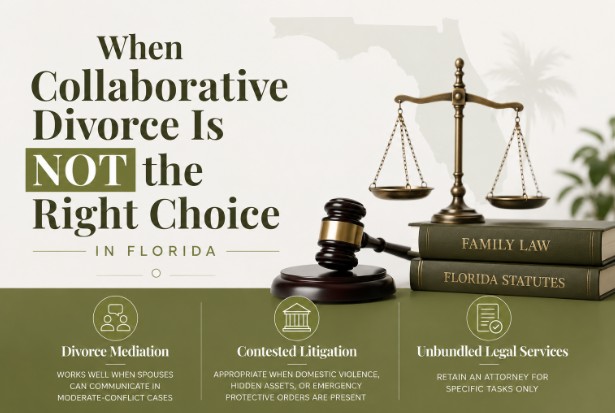
Collaborative divorce is the wrong choice in Florida when domestic violence, hidden assets, bad-faith participation, or the need for emergency court orders make voluntary negotiation structurally unsafe.
Under the Florida Collaborative Law Process Act (Florida Statutes §§ 61.55–61.58), effective July 1, 2017, the process depends entirely on both spouses committing to full transparency and good-faith negotiation — and when that foundation is absent, choosing Collaborative divorce can delay your case, cost tens of thousands of dollars more than litigation, and leave you without the legal protections you need.
A Collaborative divorce attorney in Fort Lauderdale can assess whether the process is structurally appropriate for your specific situation before you commit.
Key Takeaways
- Domestic violence, hidden assets, bad-faith participation, and emergency legal needs each disqualify Collaborative divorce under Florida law.
- Florida Statutes § 61.57 requires both Ccollaborative attorneys to withdraw if the process terminates — forcing you to hire new litigation counsel from scratch.
- The Florida Academy of Collaborative Professionals reports that 85.1% of Florida Collaborative cases reach full agreement, meaning approximately 15% — derived from that 85.1% success rate — fail, often in the exact circumstances described in this article.
- Mediation, contested litigation, and unbundled legal services are the primary alternatives when Collaborative divorce is not appropriate.
Unsure whether your situation qualifies? Don’t sign a participation agreement until you know. Schedule a consultation with a Fort Lauderdale Collaborative divorce attorney who will give you a direct, honest assessment.
Does Your Situation Involve Domestic Violence or a Power Imbalance?
Collaborative divorce cannot safely proceed when domestic violence or a significant power imbalance exists between spouses. Florida Statutes § 61.57 mandates that Collaborative attorneys screen for domestic violence before any participation agreement is signed.
When abuse is present — whether physical, financial, emotional, or coercive — the power dynamics that Collaborative divorce depends on are fundamentally compromised.
A survivor of domestic violence cannot negotiate as an equal partner across a conference table from their abuser, regardless of how skilled the attorneys are. The Collaborative model assumes that both spouses can freely advocate for their own interests.
Abuse destroys that assumption. Florida Statutes § 741.30 governs domestic violence injunctions — court-issued protections that the Collaborative process cannot provide.
| Situation | Collaborative Divorce | Contested Litigation |
| History of physical abuse | Not appropriate | Appropriate — the court enforces protective orders |
| Financial control by one spouse | High risk | Formal discovery tools are available |
| Emotional manipulation | High risk | Judge-supervised proceedings |
| Coercive control patterns | Not appropriate | Injunctions and restraining orders are available |
Extreme financial power imbalances — where one spouse controls all marital assets and financial records — carry similar risks. When one party has significantly more financial knowledge or legal sophistication, the negotiation table is not level.
Contested litigation provides formal discovery tools, including depositions, subpoenas, and forensic accounting, that Collaborative divorce does not.
If you have experienced any form of abuse in your marriage, contact the National Domestic Violence Hotline at 1-800-799-7233 before deciding on any dissolution process.
If you’re ready to get started, call us now!
Your Spouse Hiding Assets or Refusing Financial Disclosure
Collaborative divorce fails when one spouse conceals marital assets or refuses to comply with financial disclosure requirements because the process lacks an enforcement mechanism to compel transparency.
The entire Collaborative model is built on the voluntary exchange of financial information. A spouse who underreports income, transfers assets before filing, or withholds account records turns the Collaborative process into a tool for their own advantage — at your expense.
Florida Family Law Rule of Procedure 12.285 requires both parties in any dissolution to produce mandatory financial disclosures. In contested litigation, a judge can compel compliance through formal discovery — depositions, subpoenas to financial institutions, and court-ordered forensic accountants.
Collaborative divorce has none of those enforcement mechanisms. If your spouse refuses to disclose voluntarily, you have no legal leverage.
Warning signs that hidden assets may disqualify Collaborative divorce:
- Unexplained drops in reported income in the year before filing
- Sudden transfers of marital assets to family members or business partners
- Refusal to produce bank statements, tax returns, or retirement account records
- Business ownership that obscures personal income through complex distributions
- Recent creation of loans or debts that cannot be independently verified
When you suspect concealed assets, the contested litigation discovery process — including subpoenas and forensic accountants — gives you the enforcement tools to find them. The out-of-court divorce process may still be achievable later, but only after full financial transparency is established.
Will Your Spouse Participate in Good Faith?
Collaborative divorce requires both spouses to commit in writing to honest communication and voluntary settlement — and if either spouse approaches the process in bad faith, it will fail and cost both parties significantly more than proceeding directly to litigation.
Florida Statutes § 61.55 defines the Collaborative law process as a “unique nonadversarial process” predicated on a working relationship between the parties. A spouse who enters the process intending to delay, obstruct, or use Collaborative sessions to gather intelligence for later litigation defeats the statutory purpose entirely.
The good-faith test is practical. Ask yourself whether your spouse can genuinely commit to the following.
| Good-Faith Indicator | What It Looks Like |
| Full financial transparency | Produces all requested records without dispute |
| Willingness to compromise | Engages with settlement proposals rather than rejecting all offers |
| Respectful communication | Participates in sessions without hostility or threats |
| Consistent legal counsel | Retains a trained collaborative attorney, not a litigation specialist |
| Shared resolution goal | Prioritizes a workable outcome over “winning.” |
If your spouse has retained a litigation-focused attorney, publicly threatened court action, or has a documented pattern of financial deception in the marriage, that is your answer. The disqualification clause under Florida Statutes § 61.57 means that when the process breaks down, both Collaborative attorneys must immediately withdraw.
You start over — hiring new litigation counsel at full cost — and anything disclosed during Collaborative sessions is protected from use as evidence under Florida Statutes § 61.58 confidentiality provisions, including by you.
Don’t commit to a process designed to fail. If you’re unsure whether your spouse will participate honestly, speak with a collaborative attorney first before signing anything.
When You Need Emergency Court Orders
Collaborative divorce has significant limitations when emergency court orders are needed — and for certain urgent protections, contested litigation is the only path that gives you court-enforced relief.
Under Florida Family Law Rule of Procedure 12.745(e), a court may issue emergency orders to protect the health, safety, or welfare of a party during an active Collaborative process.
However, the Collaborative attorneys’ ability to participate in those emergency proceedings is immediately restricted under the same rule — and in practice, pursuing emergency relief requires stepping outside the Collaborative framework entirely.
Florida Statutes § 61.29 governs parental responsibility and time-sharing, and emergency modifications under that statute require direct judicial intervention. Florida Statutes § 741.30 governs domestic violence injunctions.
Both require a court proceeding that the Collaborative participation agreement is not designed to facilitate. When emergency relief is the priority, contested litigation provides immediate access.
Situations that require immediate court access include:
- A spouse threatening to relocate children out of Florida before a parenting plan is finalized
- An immediate need for temporary child support while dissolution proceedings are pending
- A spouse’s untreated substance abuse creates an urgent safety risk for minor children
- A domestic violence incident requiring a restraining order
- Rapid dissipation of marital assets — including emptying joint accounts — before dissolution is completed
In high-urgency circumstances, the out-of-court divorce settlement path closes immediately.
A Broward or Fort Lauderdale family court judge has the authority to issue temporary orders within days. A Collaborative participation agreement does not.
If you’re ready to get started, call us now!
What Is the Real Cost of Choosing Collaborative Divorce When It Isn’t Appropriate?
Choosing a Collaborative divorce in an unsuitable case typically costs Florida families more — not less — than proceeding directly to litigation, because process failure triggers the mandatory attorney disqualification rule and forces both spouses to start over.
When Collaborative divorce fails under Florida Statutes § 61.57, both Collaborative attorneys are required to withdraw.
You must then hire new litigation counsel who learns your entire case from scratch, prepares for contested proceedings, and navigates formal discovery — all charged on top of the Collaborative fees you already spent.
The Florida Academy of Collaborative Professionals reports that 55% of Florida Collaborative cases cost $25,000 or less per person (2025 data) when the process succeeds.
When Collaborative divorce fails — approximately 15%, derived from the 85.1% success rate reported by the Florida Academy of Collaborative Professionals — total costs can exceed what contested litigation alone would have cost, because you pay for both processes sequentially.
| Cost Scenario | Collaborative (Success) | Collaborative (Failure) | Contested Litigation Only |
| Attorney fees per person (2025) | $7,500–$25,000 | $7,500–$25,000 + new counsel | $15,000–$100,000+ |
| Timeline | 6–12 months | 12–36+ months | 12–36 months |
| Discovery costs | None | Full discovery is still required | Full discovery required |
| Restart penalty | None | Both attorneys withdraw | Not applicable |
If your case has even one disqualifying factor — domestic violence, hidden assets, or a spouse unwilling to negotiate honestly — entering Collaborative divorce exposes you to the worst-case cost column above.
Understanding the economics of collaboration means knowing when the math does not work in your favor.
What Are the Alternatives When Collaborative Divorce Is Not Right?
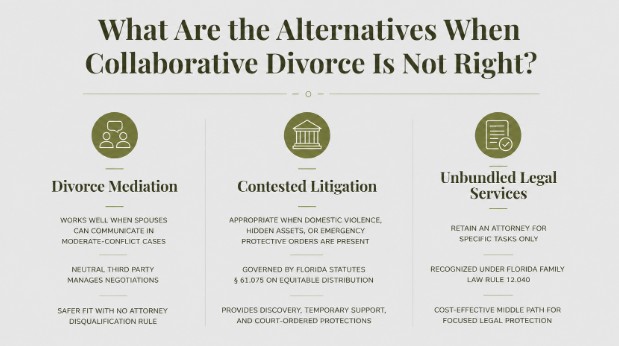
When Collaborative divorce is not appropriate, Florida families have three primary alternatives: divorce mediation, contested litigation, and unbundled legal services — and each serves a different level of conflict, complexity, and urgency.
Choosing correctly depends on how many disqualifying factors are present, whether emergency orders are needed, and the overall degree of trust remaining between spouses.
Divorce mediation works well when spouses can communicate in moderate-conflict cases but need a neutral third party to manage negotiations. Unlike Collaborative divorce, mediation does not trigger the attorney disqualification rule if the process fails, and a mediator can help reach partial agreements on some issues while leaving contested matters for the court.
The Florida Dispute Resolution Center maintains a roster of certified mediators statewide. The role of mediation in out-of-court divorce is distinct from the Collaborative model — and in moderate-conflict cases, it is the safer fit.
Contested litigation is the appropriate path when domestic violence, hidden assets, or emergency protective orders make voluntary negotiation unsafe or structurally impossible. Florida Statutes § 61.075 governs Florida’s equitable distribution standard — how a Broward or Miami-Dade judge divides marital assets when spouses cannot agree.
Litigation provides formal discovery, court-ordered temporary support, and judicially enforceable orders that no out-of-court process can replicate.
Unbundled legal services — also called limited scope representation — allow you to retain an attorney for specific tasks only, such as reviewing a proposed settlement agreement or appearing at a single hearing, without committing to full-service litigation. Florida courts recognize unbundled services under Florida Family Law Rule of Procedure 12.040 as a cost-effective middle path for cases that don’t require full litigation but do require legal protection.
Explore unbundled legal services in Florida to determine whether this option fits your situation.
| Alternative | Best For | Key Advantage |
| Divorce mediation | Moderate conflict, some communication | No attorney disqualification if it fails |
| Contested litigation | Domestic violence, hidden assets, and emergency orders | Full discovery and court enforcement |
| Unbundled legal services | Limited legal needs, budget-conscious | Pay only for what you need |
Your situation is specific. Stop guessing which path fits. Contact our Fort Lauderdale office for a straightforward assessment — no pressure, just clarity on your options.
How Do You Know Which Divorce Process Is Right for Your Florida Case?
The right divorce process for a Florida couple depends on four factors: the presence of domestic violence or power imbalance, whether financial disclosure will be voluntary, whether both spouses can negotiate in good faith, and whether emergency court orders may be needed.
When all four factors point toward safety and good faith, Collaborative divorce is often the right option. When any one of them is in doubt, a different path protects you better.
Use this framework before signing any participation agreement.
| Question | If YES | If NO |
| Is there any history of abuse or control? | Litigation or protective order first | Collaborative may be appropriate |
| Do you suspect hidden assets? | Litigation with formal discovery | Collaborative may be appropriate |
| Will your spouse negotiate honestly? | Collaborative may be appropriate | Litigation or mediation |
| Do you need emergency orders now? | Litigation immediately | Collaborative may be appropriate |
| Has your spouse hired a litigation attorney? | Litigation or mediation | Collaborative may be appropriate |
The Collaborative divorce process works exceptionally well for the couples it was designed for — those who can communicate openly, disclose honestly, and prioritize resolution.
For everyone else, knowing when to choose a different path is the most important decision in your entire dissolution. Read more on the full Collaborative divorce vs. mediation comparison to further clarify your options.
Contact Us Today For An Appointment
Frequently Asked Questions
Can Collaborative divorce be used if there has been minor conflict in the marriage?
Collaborative divorce in Florida can proceed when past conflict has been minor, and both spouses commit to transparent, good-faith negotiation. Florida Statutes § 61.55 requires that neither spouse have a history of abuse, financial deception, or coercive control that would compromise voluntary participation under the Act.
What happens to my Collaborative attorneys if the process fails in Florida?
When a Collaborative divorce terminates in Florida, Florida Statutes § 61.57 requires both Collaborative attorneys to withdraw immediately. You must then hire new litigation counsel who starts your case from scratch. The disqualification rule extends to all attorneys in the same firm as your Collaborative lawyer.
Is mediation a better option than Collaborative divorce when trust is low? Mediation is often a better fit in moderate-conflict cases where trust is limited, but a total communication breakdown has not occurred. A mediator manages communication between parties rather than facilitating direct negotiation. Mediation also does not carry the attorney disqualification clause that Collaborative divorce imposes under Florida Statutes § 61.57.
Can I switch from Collaborative divorce to litigation in Florida?
A Florida spouse can exit the Collaborative process at any time by notifying the other party in a written record under Florida Statutes § 61.57. Both Collaborative attorneys must immediately withdraw, and you will need new litigation counsel. Anything disclosed during collaborative sessions is protected from use in court under Florida Statutes § 61.58.
How does domestic violence screening work in a Florida Collaborative divorce?
Florida Statutes § 61.57 requires Collaborative attorneys to screen for domestic violence before any participation agreement is signed. Florida adopted these screening provisions from the Uniform Collaborative Law Act specifically to prevent the Collaborative process from becoming a mechanism for continued abuse or coercion.
What is the disqualification clause, and why does it matter?
The disqualification clause, mandated by Florida Statutes § 61.57 and codified in Florida Family Law Rule of Procedure 12.745, requires both Collaborative attorneys to withdraw if either spouse pursues litigation. It matters because you lose your attorneys, forfeit fees paid, and must start over with new litigation counsel at full cost.
Does Collaborative divorce protect me if my spouse is hiding money?
Collaborative divorce does not protect you adequately when your spouse is concealing marital assets. The process relies on voluntary disclosure under Florida Family Law Rule of Procedure 12.285, with no enforcement if your spouse refuses. Contested litigation provides depositions, subpoenas, and forensic accountants to compel disclosure that a spouse refuses to provide voluntarily.
What if we agree on children’s issues but disagree on finances?
Florida Statutes § 61.57(3)(b) allows spouses to resolve some issues through the Collaborative process while reserving others for court. A parenting agreement can be finalized collaboratively while financial disputes proceed to contested litigation. A qualified Collaborative divorce attorney in Fort Lauderdale can structure this hybrid approach correctly.

About the Author
Carolann Mazza
Florida Family Law Attorney (The Florida Bar, admitted 2001) · Florida Supreme Court Certified Family Mediator (certified 2011, No. 25475F) · Super Lawyers, Family Law, 2022–2026
Carolann Mazza is the founder of Carolann Mazza, P.A., a non-litigation family law firm she opened in Fort Lauderdale in 2003. Practicing family law in Florida since 2001 and admitted to the State Bar of Texas in 1997, she resolves divorce and family conflicts exclusively through Collaborative Divorce, mediation, and out-of-court settlement — keeping families out of court while preserving relationships, dignity, and children’s wellbeing. She serves Broward, Palm Beach, and Miami-Dade counties.