
Collaborative Divorce Attorney Miami, Florida—Carolann Mazza

Carolann Mazza, P.A., is a non-litigation family law firm serving Miami and Miami-Dade County families who need collaborative divorce, mediation, and out-of-court settlement services under Florida’s Collaborative Law Process Act, Section 61.56, Florida Statutes.
Carolann Mazza, a Florida Supreme Court Certified Family Mediator licensed since 2001, resolves equitable distribution, alimony, child time-sharing, and parental responsibility for Miami-Dade families — entirely outside Miami-Dade County’s 11th Judicial Circuit Court at the Lawson E. Thomas Courthouse Center.
The firm serves Miami-Dade County as part of a South Florida practice spanning Broward, Palm Beach, and Miami-Dade counties. Call (954) 527-4604 for a confidential consultation.
Key Takeaways
- Carolann Mazza, P.A., serves Miami-Dade County families under Florida’s Collaborative Law Process Act, Section 61.56, Florida Statutes, effective July 1, 2017
- Collaborative divorce cases for Miami residents are filed at the Lawson E. Thomas Courthouse Center, 175 NW 1st Avenue, Miami, FL 33128 — only after both spouses reach a full written agreement outside of court.
- Miami-Dade County’s 11th Judicial Circuit is the largest trial court in Florida — contested divorce cases routinely extend six months to two years, depending on docket complexity.
- FACP survey data show that 85.1% of Florida collaborative divorce cases reach full agreement, compared with a fraction of contested cases that resolve without trial.
- Carolann Mazza, P.A., resolves Miami-Dade divorce cases — including equitable distribution, alimony, child time-sharing, and parental responsibility — entirely outside Miami-Dade’s 11th Judicial Circuit.
How Does Collaborative Divorce Work Differently in Miami-Dade County?
Collaborative divorce in Miami-Dade County follows Florida’s Collaborative Law Process Act, Sections 61.55 to 61.58, Florida Statutes — the same statutory framework that governs all Florida collaborative proceedings.
Two Miami-Dade-specific factors make the collaborative model particularly valuable in this market: the size and backlog of the 11th Judicial Circuit docket, and the frequency of international asset and residency considerations in Miami marriages.
Miami-Dade County’s 11th Judicial Circuit is the largest trial court in Florida. Contested divorce cases filed at the Lawson E. Thomas Courthouse Center compete for hearing time on a docket serving the most populous county in the state.
A contested divorce involving disputed property, alimony, or time-sharing in Miami-Dade typically takes 6 months to 2 years and offers no guarantee of a favorable outcome. Collaborative divorce bypasses that docket entirely. Both spouses reach a complete written agreement before a single contested motion is filed.
Miami-Dade also carries a distinct international dimension. Miami marriages frequently involve spouses from different countries, assets held outside the United States, and residency considerations that intersect with immigration status.
The collaborative process gives Miami-Dade couples the space to address cross-border asset structures through a neutral Certified Divorce Financial Analyst — without the rigid procedural constraints of contested litigation in a Florida circuit court.
What Makes Miami Divorce Cases More Complex Than Other Florida Counties?
Miami-Dade County divorce cases carry three overlapping complexity factors that other Florida counties rarely encounter at the same frequency: international asset structures, a linguistically diverse client base, and multi-municipality parenting plans spanning distinct school districts and commute profiles. Each factor strengthens the case for collaborative divorce over contested litigation in the 11th Judicial Circuit.
Can Collaborative Divorce Handle International Assets in Miami?
Collaborative divorce handles international assets in Miami by assigning a neutral Certified Divorce Financial Analyst to evaluate cross-border holdings, foreign accounts, and international business interests jointly for both spouses.
Miami marriages frequently involve luxury condominium units in Brickell, Coral Gables, Coconut Grove, and Miami Beach — alongside investment portfolios, closely held businesses, and assets held in foreign entities.
The collaborative process addresses that asset profile through shared professional analysis rather than formal discovery, subpoenas, and court orders — procedures that add months and high cost to contested litigation in Miami-Dade’s 11th Judicial Circuit.
For a full breakdown of how collaborative divorce handles complex financial cases, the economics of collaborative divorce details the shared professional cost model.
If you’re ready to get started, call us now!
Does Collaborative Divorce Accommodate Bilingual Miami-Dade Families?
Collaborative divorce accommodates bilingual Miami-Dade families through the mental health neutral — a licensed professional who manages communication dynamics during joint sessions and can facilitate proceedings in the family’s preferred language.
Miami-Dade County is home to one of the most linguistically diverse populations in the United States.
Miami-Dade’s cultural and linguistic complexity is not accommodated in Family Division courtroom proceedings, where formal court procedures govern all communications regardless of the family’s background.
How Does Collaborative Divorce Handle Miami-Dade Parenting Plans Across Multiple Municipalities?
Collaborative divorce handles Miami-Dade parenting plans across multiple municipalities by bringing in a child specialist who builds time-sharing arrangements around the family’s actual geographic and logistical circumstances.
Miami-Dade County families frequently navigate time-sharing across Miami, Miami Beach, Coral Gables, Hialeah, Doral, Kendall, and Homestead — each with distinct school district boundaries, commute profiles, and childcare infrastructure. A child specialist in the collaborative team designs parenting plans that reflect those realities.
A circuit court judge managing Miami-Dade’s full Family Division docket does not have the time or case-specific knowledge to build that level of geographic detail into a contested time-sharing order.
Which Miami-Dade Families Benefit Most From Collaborative Divorce?
Cooperative intent — not prior amicability — is the qualifying factor for collaborative divorce in Miami-Dade. Both spouses need only commit to working toward a resolution rather than toward a courtroom outcome. The process does not require agreement on any issue before it begins.
The firm serves Miami-Dade families across a wide spectrum of assets — from Brickell professionals and Coral Gables business owners to Coconut Grove families with long marriages, complex retirement holdings, and multi-property real estate portfolios.
Couples with minor children derive particular value from the collaborative model. The process structure preserves the co-parenting relationship that contested litigation in Miami-Dade’s 11th Judicial Circuit Family Division frequently damages beyond repair.
Collaborative divorce does not produce durable agreements in every Miami-Dade case. The process is not appropriate when domestic violence is present, when one spouse conceals financial assets, or when either party enters the Participation Agreement without a genuine commitment to resolution.
Florida’s Collaborative Law Process Act, Section 61.56, requires both parties to voluntarily commit — and that commitment must be genuine for the process to function.
Carolann Mazza conducts structured intake screening before any Participation Agreement is signed. Miami-Dade clients are redirected to divorce mediation or unbundled legal services when collaborative representation does not fit their circumstances.
For families weighing all available options, collaborative divorce vs. mediation outlines both pathways in terms of cost, timeline, legal representation, and case complexity. A peaceful divorce in Florida is achievable through multiple routes — the right process depends on each Miami-Dade family’s specific circumstances.
| Factor | Collaborative Divorce | Contested Litigation |
| Filing court | Lawson E. Thomas Courthouse — uncontested only | 11th Judicial Circuit, Miami-Dade Family Division |
| Timeline | 4–8 months (85.1% full agreement, FACP) | 6 months to 2+ years |
| Cost per spouse | $5,000–$8,000 avg. (as of 2025) | $15,000–$30,000+ (as of 2025) |
| International assets | Addressed through neutral CDFA | Subject to Florida discovery rules and court orders |
| Confidentiality | Privileged under §61.57, FL Statutes | Public record, Miami-Dade Clerk of Courts |
| Mandatory parenting course | Not required | Required before trial in Miami-Dade’s 11th Circuit |
Miami families with international assets, business interests, or complex parenting arrangements across multiple municipalities resolve every issue privately with Carolann Mazza, P.A. Contact us today at (954) 527-4604 to discuss your specific situation.
If you’re ready to get started, call us now!
What Does Collaborative Divorce Cost for Miami-Dade Families?
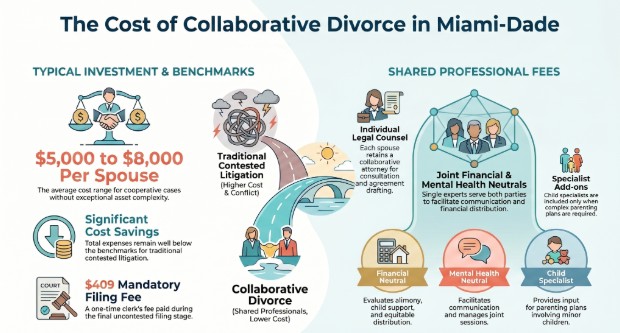
Collaborative divorce costs for Miami-Dade families are structured around shared professional fees rather than competing attorney and expert witness expenses — producing a total per-spouse cost that is significantly lower than contested litigation in Florida’s largest trial court.
Miami-Dade Divorce Filing Fee
Every dissolution of marriage filed in Miami-Dade County as of 2025 carries a clerk’s filing fee of $409 at the Lawson E. Thomas Courthouse Center, 175 NW 1st Avenue, Miami, FL 33128. Summons issuance adds $10.
Service of process through the Miami-Dade Sheriff’s Office adds $40 to $70 as of 2025. These base fees apply to every divorce filing — collaborative or contested — and represent the minimum entry cost regardless of how the case proceeds.
Collaborative Divorce Cost Breakdown for Miami Families
Florida collaborative divorce cases as of 2025 typically resolve for $5,000 to $8,000 per spouse when both parties cooperate fully, and the case does not involve exceptional asset complexity.
Miami-Dade cases with significant international holdings, multi-property real estate portfolios, or closely held business interests may exceed that range, but the shared professional model keeps total costs below the $15,000 to $30,000 range typical of contested litigation. Key cost components for a Miami-Dade collaborative divorce include:
- Each spouse retains one collaborative attorney who bills for consultation sessions, Participation Agreement drafting, joint session attendance, and preparation of the marital settlement agreement.
- One Certified Divorce Financial Analyst serves both parties, evaluating equitable distribution, alimony scenarios, and child support calculations — thereby replacing two competing expert witnesses.
- One licensed mental health professional facilitates communication across all joint sessions, with fees shared between both parties.
- A child specialist joins the team when minor children are involved and the parenting plan complexity warrants specialist input across Miami-Dade’s multiple municipalities.
- Court filing costs of $409 plus summons and service fees are paid once at the uncontested filing stage.
How Miami-Dade Collaborative Divorce Costs Compare to Contested Litigation
Contested litigation in Miami-Dade’s 11th Judicial Circuit as of 2025 averages $15,000 to $30,000 per spouse, or more, when attorney retainers, hourly billing during discovery and hearings, competing expert witnesses, mandatory mediation fees of $200 to $400 per hour across two to four court-ordered sessions, and certified parenting course fees are included.
Miami-Dade mediation costs alone — required before any contested case proceeds to trial — add $1,600 to $3,200 per couple before any attorney preparation fees are counted.
Collaborative divorce eliminates mandatory mediation costs, competing expert witness fees, discovery expenses, and contested motion practice entirely.
For a full comparison of collaborative divorce costs across Florida, the cost breakdown covers each process in detail. The economics of collaborative divorce explains how shared professional costs produce lower total fees for both spouses.
How Does Carolann Mazza, P.A., Handle Child Time-Sharing for Miami-Dade Families?
Child time-sharing and parental responsibility in Miami-Dade County are governed by Section 61.13, Florida Statutes, under Florida’s best interests of the child standard. Miami-Dade County’s 11th Judicial Circuit Family Division requires all parties to a contested divorce to complete a certified parenting course and participate in court-ordered mediation before a case proceeds to trial — adding mandatory procedural steps that extend contested timelines and introduce additional costs.
Collaborative divorce replaces that mandatory court process with a structured, private alternative. Carolann Mazza, P.A., handles children’s issues as a core component of every Miami-Dade collaborative case involving minor children.
A child specialist joins the collaborative team when warranted — evaluating school district boundaries across Miami-Dade’s municipalities, extracurricular schedules, extended family relationships, and the logistical realities of the family’s specific neighborhood — so the parenting plan reflects the child’s actual life rather than a generic judicial template.
Child support is calculated under Section 61.30, Florida Statutes, using Florida’s income shares guidelines. The financial neutral models multiple child support scenarios — including the effect of different time-sharing splits on the monthly support obligation — so both Miami-Dade parents understand the financial implications of each parenting arrangement before committing to final figures.
For Miami-Dade parents with existing time-sharing orders requiring modification, Carolann Mazza, P.A., handles post-judgment modification through the out-of-court settlement process — without returning to Miami-Dade’s 11th Judicial Circuit unless both parties fail to reach an agreement.
What Legal Issues Does Collaborative Divorce Resolve for Miami Families?
Collaborative divorce in Miami resolves every substantive family law issue under Florida Statutes Chapter 61 through negotiated agreement rather than contested motions or judicial hearings at the Lawson E. Thomas Courthouse Center in Miami-Dade County.
Equitable distribution under Section 61.075, Florida Statutes, requires Florida courts to divide marital property equitably — weighing marriage duration, each spouse’s economic circumstances, and contributions to the marital estate.
In Miami-Dade collaborative cases, a neutral Certified Divorce Financial Analyst builds shared distribution scenarios that account for the county’s distinct asset profile: Brickell luxury condominiums, Coral Gables business interests, Coconut Grove real estate holdings, foreign investment accounts, and executive compensation structures common to Miami’s international business community.
Alimony in Florida is governed by the 2023 Alimony Reform Act, which eliminated permanent alimony and capped durational alimony at 50% of the marriage length for marriages under 20 years.
Miami-Dade collaborative divorce gives both spouses direct control over alimony amount, duration, and payment structure — negotiating terms that account for Miami’s cost of living, the international mobility of high-earning spouses, and the specific financial interdependencies built across long Miami-Dade marriages.
The tax treatment of alimony under the Tax Cuts and Jobs Act of 2017 eliminates deductibility for the paying spouse on all post-2018 agreements — a calculation that carries particular significance for Miami-Dade’s high-income professional and executive population. IRS Publication 504 confirms the current federal tax treatment applicable to Florida divorce agreements finalized after December 31, 2018.
The firm handles divorce services across all five resolution areas — equitable distribution, alimony, child time-sharing, parental responsibility, and child support — for Miami-Dade County families entirely through out-of-court processes.
Florida’s full statutory framework governing collaborative proceedings is documented in the Collaborative Law Process Act.
Contact Us Today For An Appointment
Frequently Asked Questions
Does Carolann Mazza serve Miami and Miami-Dade County clients?
Carolann Mazza, P.A., serves Miami and Miami-Dade County clients as part of the firm’s South Florida service area covering Broward, Palm Beach, and Miami-Dade counties. Call (954) 527-4604 to schedule a confidential consultation for your specific Miami-Dade location.
Where are collaborative divorce cases filed for Miami residents?
Collaborative divorce cases for Miami residents are filed at the Lawson E. Thomas Courthouse Center, 175 NW 1st Avenue, Miami, FL 33128, as an uncontested dissolution of marriage — only after both spouses reach full written agreement on all issues entirely outside of court.
Is collaborative divorce recognized by Miami-Dade’s 11th Judicial Circuit?
Collaborative divorce is fully recognized by Miami-Dade County’s 11th Judicial Circuit under Florida’s Collaborative Law Process Act, Section 61.56, Florida Statutes, effective July 1, 2017. Marital settlement agreements reached through the collaborative process carry the same legal force as court-ordered judgments once filed and approved.
Can collaborative divorce handle Miami cases involving international assets?
Collaborative divorce handles Miami international asset cases by assigning a neutral Certified Divorce Financial Analyst to evaluate cross-border holdings, foreign accounts, and international business interests jointly — without the formal discovery procedures and court orders that contested litigation in Miami-Dade’s 11th Judicial Circuit requires.
How long does collaborative divorce take for Miami-Dade families?
Collaborative divorce for Miami-Dade families typically takes four to eight months, with FACP survey data showing 85.1% of Florida collaborative cases reach full agreement and 60% conclude within six months — compared to six months to two years for contested proceedings in Miami-Dade’s 11th Judicial Circuit.
What does collaborative divorce cost for Miami families?
Collaborative divorce for Miami families typically costs $5,000 to $8,000 per spouse as of 2025. Contested litigation in Miami-Dade’s 11th Judicial Circuit averages $15,000 to $30,000 or more — not including the $409 filing fee, mandatory mediation costs, and certified parenting course fees required before trial.
Does Miami-Dade County require mediation before a divorce trial?
Miami-Dade County’s 11th Judicial Circuit requires all parties to a contested divorce to complete a certified parenting course and participate in court-ordered mediation before trial. Collaborative divorce eliminates both requirements — the process is voluntary, private, and conducted entirely outside of court.
Does Carolann Mazza offer mediation for Miami clients?
The firm offers divorce mediation to Miami clients through Mazza’s certified mediator credential — a distinct process from collaborative divorce that uses a single neutral professional to facilitate negotiation, rather than a full multidisciplinary team with dedicated legal representation for each spouse.
Miami-Dade families with complex asset structures, international holdings, or co-parenting needs across multiple municipalities resolve every issue privately with Carolann Mazza, P.A. Schedule a confidential consultation today.

About the Author
Carolann Mazza
Florida Family Law Attorney (The Florida Bar, admitted 2001) · Florida Supreme Court Certified Family Mediator (certified 2011, No. 25475F) · Super Lawyers, Family Law, 2022–2026
Carolann Mazza is the founder of Carolann Mazza, P.A., a non-litigation family law firm she opened in Fort Lauderdale in 2003. Practicing family law in Florida since 2001 and admitted to the State Bar of Texas in 1997, she resolves divorce and family conflicts exclusively through Collaborative Divorce, mediation, and out-of-court settlement — keeping families out of court while preserving relationships, dignity, and children’s wellbeing. She serves Broward, Palm Beach, and Miami-Dade counties.