
Miami-Dade Divorce Filing Checklist: Fees, E-Filing, and What to Expect
Data last verified: February 2026
Most Miami-Dade divorce cases require a $409 dissolution filing fee with the Clerk. You can file online through the Florida Courts E-Filing Portal or file in person at the Lawson E. Thomas Courthouse Center.
After filing, the case moves through service of process and required financial disclosures before a judge can enter a final judgment.
A simplified divorce in Miami-Dade requires both spouses to appear together in person to file.
For any Florida divorce, one spouse must meet the six-month Florida residency requirement before filing.
Choose The Right Divorce Path In Miami-Dade
A Miami-Dade divorce filing begins by selecting the correct case type. Simplified dissolution has strict requirements, while regular dissolution applies when you have children, disputes, or unresolved financial issues.
Simplified Dissolution. Who Qualifies In Miami-Dade
You can use a simplified dissolution if you and your spouse agree on everything and meet the strict rules. This option works best for a true uncontested divorce with no disputes.
To qualify in Miami-Dade:
- At least one spouse must meet Florida’s six-month residency requirement.
- You have no minor or dependent children together.
- The wife isn’t pregnant.
- You both agree on how to divide the property and debts.
- Neither of you wants alimony.
- Both spouses agree the marriage is irretrievably broken, which satisfies Florida’s no-fault dissolution standard.
Both spouses must appear together to file for a Simplified Divorce in Miami-Dade County. Bring a valid photo ID required by the Clerk’s filing instructions.
Simplified dissolution often reaches a final hearing sooner than regular dissolution because the case has no disputed issues requiring litigation steps.
Regular Dissolution. Common Reasons You Cannot Use Simplified
If you don’t meet every simplified requirement, you must file a regular dissolution of marriage. This is the standard process in Miami-Dade.
You can’t use simplified dissolution if:
- You have minor or dependent children together.
- Either spouse wants alimony.
- You disagree about property, debts, custody, or support.
- One spouse won’t sign or appear in person.
Regular dissolution lets the court decide contested issues. You file a Petition for Dissolution of Marriage and serve your spouse.
Regular dissolution typically includes financial disclosures. Contested cases often include mediation and hearings.
If you’re ready to get started, call us now!
Fees And Real-World Costs. What You Will Pay In Miami-Dade
The Miami-Dade Clerk lists the base dissolution of marriage filing fee as $409. Your total out-of-pocket cost can increase based on service of process, summons-related charges, certified copies, and other case-specific filing needs.
Miami-Dade Divorce Filing Fee. What The Clerk Publishes
You pay $409 to file a petition for dissolution of marriage in Miami-Dade County. This is the standard clerk filing fee for a divorce case.
You pay this fee when you open your case through the clerk of court, either in person or through the statewide e-filing system. The fee covers opening the case and putting it on the court’s docket.
If you can’t afford the fee, you can apply for indigent status. Fill out an Application for Determination of Civil Indigent Status and provide your income details.
If the clerk finds you eligible, the court may waive the filing fees or let you pay over time.
Common Add-On Costs People Forget (Service, Copies, Extras)
The filing fee is only the beginning. The total cost often includes service of process, copies, and certified documents.
If your spouse doesn’t sign a waiver, you have to serve them with the petition. The sheriff charges a service fee that varies by location.
Private process servers usually charge more, but they may complete the service more quickly. You’ll also need certified copies of your final judgment.
The Miami-Dade Clerk’s fee schedule lists separate charges for copies and other filings. These small fees add up, especially if you need several certified copies for name changes or financial accounts.
If you use a self-help program or hire an attorney, you’ll face extra costs. Flat fees for uncontested divorces vary, and contested cases can cost much more thanks to hearings, motions, and extra filings.
If you’re ready to get started, call us now!
E-Filing In Miami-Dade. Step-By-Step Portal Workflow (And When Paper Filing Still Happens)
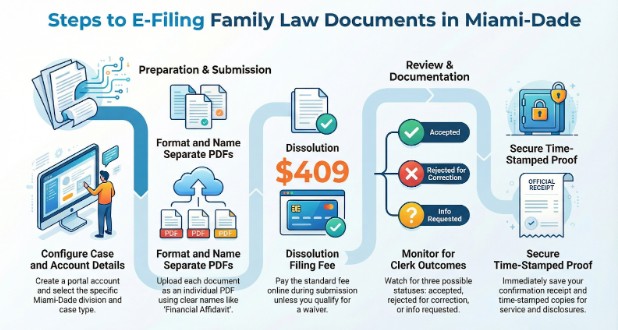
Many Miami-Dade family filings can be submitted through the Florida Courts E-Filing Portal after creating an account and following division-specific routing.
Step 1. Confirm you have the right forms before you upload
Download the correct petition and supporting documents from the Florida Courts Family Law Forms library so your packet matches your scenario, with children, without children, or simplified.
Step 2. Create your e-filing account
Go to the Florida Courts E-Filing Portal and create an account using your email and contact information.
Step 3. Select the correct case type and court location
Choose the correct filing type, for example, dissolution with children or without children, and make sure you are routing to Miami-Dade. Incorrect case type selection or incorrect county routing often triggers an e-filing rejection and requires resubmission.
Step 4. Prepare clean PDFs and upload each document separately
Upload each document as its own PDF, unless the instructions for that form specifically tell you to bundle items. The first PDF is usually the main pleading, such as the Petition for Dissolution of Marriage, followed by supporting documents.
Step 5. Use clear, clerk-friendly file names
Name files so the clerk can identify them instantly. Examples:
- Petition for Dissolution of Marriage
- Civil Cover Sheet
- Financial Affidavit
- Settlement Agreement or Marital Settlement Agreement (if applicable)
Step 6. Pay the filing fee or request a fee waiver if eligible
Most Miami-Dade divorces have a $409 dissolution filing fee shown on the Clerk’s fee schedule. Pay online during submission when prompted, or follow the portal and clerk instructions to request a waiver if you qualify.
Step 7. Submit, then watch for acceptance or a correction notice
After submission, the Clerk reviews the filing. The portal shows one of three outcomes: accepted, rejected for correction, or returned with a request for additional information.
Step 8. Save proof and next-step documents immediately
Save your confirmation receipt, the time-stamped copies of what you filed, and any acceptance notice. These are the records you will need for service, disclosures, and scheduling.
Miami-Dade Nuances. Where Filers Get Stuck
E-filing rejections commonly result from PDF formatting problems and document size limits. Large files or improperly formatted PDFs can be rejected or delayed by the e-filing system, so keep PDFs within size limits and upload clear, readable documents.
Florida court filing rules require filers to redact sensitive identifiers, including full Social Security numbers and full bank account numbers, before filing.
Service of process often causes delays. Filing your petition doesn’t serve your spouse; you must arrange service through the sheriff or a certified process server unless your spouse signs a waiver.
Florida’s mandatory disclosure rules require both parties to exchange required financial documents within 45 days of service of the petition unless an exemption applies.
Check local procedures on the Miami-Dade Clerk e-filing page before submitting. The clerk processes filings for administrative compliance, and a judge reviews and signs final orders.
CollaborativeNow helps you map Miami-Dade divorce filing steps, confirm the $409 fee, and gather the correct forms before e-filing or courthouse submission. Schedule an appointment.
Forms And Documents You Will Need (By Scenario)
You must file specific Florida Supreme Court-approved family law forms based on your situation. The right documents depend on whether you have children, share property, or qualify for a simplified divorce.
Forms Map. What You Need For Each Common Miami-Dade Scenario
1. No Children, Uncontested Divorce
You start by filing the Petition for Dissolution of Marriage form that matches your situation (with children, without children, or simplified) from the Florida Courts-approved family law forms.
If you and your spouse agree on property and debts, attach a signed Marital Settlement Agreement that spells out how you’ll split things.
You’ll also need a Family Law Financial Affidavit. Form 12.902(b) is the Florida Family Law Financial Affidavit short form used when the filer meets the income threshold stated in the form instructions.
Both sides complete mandatory disclosure. After that, each files a Certificate of Compliance with Mandatory Disclosure.
2. Divorce With Minor Children
You file Form 12.901(b) if you have dependent children. This petition covers child support, parental responsibility, and time-sharing.
You’ll need to submit a detailed Parenting Plan. It should explain your child’s schedule and how you’ll make decisions for your child.
Each parent files a financial affidavit. The court uses these forms to figure out child support.
3. Simplified Dissolution (No Children, Full Agreement)
If you don’t have minor children and you both agree on everything, you might qualify for a simplified process.
It’s worth checking the requirements at Simplified Divorces in Miami-Dade County before you get started.
Both of you file a simplified Petition for Dissolution of Marriage and show up together at the final hearing.
If you have property or debts to divide, you should bring a written agreement that clearly states how you will divide them, consistent with the simplified divorce requirements.
Miami-Dade provides clerk and self-help guidance for selecting forms, but the filer remains responsible for filing the correct Florida Supreme Court-approved forms.
If you’re ready to get started, call us now!
What To Expect After You File: Timeline, Service, Deadlines, And Final Judgment
A Miami-Dade divorce case moves forward after filing through case assignment, summons issuance, service of process, deadline tracking, mediation preparation, and final hearing or trial scheduling before a judge signs the final judgment.
The Post-Filing Sequence: From Case Number To Service To Next Steps
The clerk assigns a case number and issues a summons after filing. The filing spouse must serve the other spouse with process.Florida procedure provides 120 days to complete service.
Here’s a straightforward Timeline of Divorce in Florida if you want to see the details. A filer can use the sheriff or a certified process server in Miami-Dade for service.
The respondent has 20 days after service to file an Answer. A filer can request a clerk’s default when the respondent does not respond within the deadline.
The court may require financial disclosure, parenting classes, and mediation before a final hearing in cases that remain disputed.
Miami-Dade divorce cases commonly go to mediation before trial. A mediator supports settlement discussions on property division, support, and parenting schedules.
A settled case proceeds to a final hearing where the judge reviews the agreement and enters the final judgment. A contested case proceeds to trial, where the judge decides unresolved issues before entering the final judgment of dissolution of marriage.
Common Delays And How To Avoid Them (Miami-Dade Practical Checklist)
Miami-Dade divorce filing delays most often stem from incomplete paperwork, missed deadlines, service failures, and disclosure errors. Use the checklist below to move the case from filing to final judgment with fewer avoidable interruptions.
Service Of Process Not Completed
What happens: The case stalls until service is completed and documented, and the timeline continues running.
How to avoid it: Start service immediately after filing. Track attempts and keep proof of service progress. Florida’s civil rules generally require service within 120 days of filing.
Wrong Case Type Or Incorrect Portal Routing
What happens: The Clerk rejects the filing for correction or returns the submission for resubmission.
How to avoid it: In the e-filing portal, select the correct dissolution category and confirm Miami-Dade routing using the Clerk’s e-filing guidance.
Missing Forms Or Incomplete Packets
What happens: The Clerk rejects the filing or requires re-filing with missing documents.
How to avoid it: Use Florida Courts-approved family law forms and match the packet to the scenario, with children, without children, or simplified.
Financial Affidavit Or Disclosures Are Missing Or Inconsistent
What happens: Mediation scheduling and hearings can pause until disclosures are corrected and exchanged.
How to avoid it: Complete financial affidavits carefully and on time. Keep income, expenses, assets, and debts consistent across all documents.
Not Following The Miami-Dade Local Process For Scheduling Next Steps
What happens: Hearing requests are delayed, rejected, or reset due to local procedural requirements.
How to avoid it: Double-check Miami-Dade Family Court requirements before scheduling hearings or filing follow-up requests.
Showing Up To Mediation Unprepared
What happens: Mediation is continued or ends without resolution, which extends the case timeline.
How to avoid it: Bring required documents and arrive with a clear settlement proposal covering parenting, support, and property terms.
Missing Court Notices Or Order Deadlines
What happens: The court denies requests, resets dates, or requires corrective filings after a missed deadline.
How to avoid it: Monitor the portal, email notices, and calendar for every deadline on the same day each notice is issued.
If you are filing without a lawyer, use the Florida Courts’ approved dissolution forms for the specific scenario. The correct petition and required attachments reduce rejections and avoidable delays.
If service, disclosures, or mediation steps are slowing your Miami-Dade case, CollaborativeNow offers collaborative divorce and mediation support to keep things organized. Contact us.
Contact Us Today For An Appointment
Frequently Asked Questions
How much does it cost to file for divorce in Miami-Dade County?
Miami-Dade’s clerk lists the dissolution-of-marriage filing fee at $409. Total cost increases when the case requires summons issuance, service of process, and certified copies.
Can I file for divorce online in Miami-Dade?
Yes. Many divorce documents can be filed electronically through the Florida Courts E-Filing Portal, and the Florida Courts notes you can file family documents through the e-portal or by hand at your local clerk.
Where do I file divorce papers in Miami-Dade if I want to file in person?
If you are not e-filing, you generally file with the Miami-Dade Clerk’s family court intake in person at the clerk’s office for family cases. Florida Courts notes you can file by hand at your local clerk of court office.
What is a simplified divorce in Miami-Dade, and who qualifies?
A simplified divorce is a faster process for couples who meet strict eligibility criteria. The Miami-Dade Clerk lists requirements and states the dissolution fee, and the process is limited to cases that fit those criteria.
Do both spouses have to appear in person for a simplified divorce in Miami-Dade?
Yes. Miami-Dade’s Clerk instructions state that both parties must appear together, in person at the Lawson E. Thomas Courthouse Center, to file a petition for a simplified divorce.
What forms do I need to file for divorce in Florida and Miami-Dade?
Florida divorce filings use Florida Supreme Court-approved family law forms. Start with the petition that matches your situation, then add required supporting documents, such as financial forms and parenting documents if children are involved.
What is the six-month residency rule for filing for divorce in Florida?
Florida law requires that at least one spouse live in Florida for six months before filing the petition for dissolution of marriage. If you do not meet this rule, the court may lack jurisdiction to grant the divorce.
What happens after I file for divorce in Miami-Dade?
After filing, the clerk reviews your submission and issues a case number. Next, you usually serve process or obtain a waiver, then exchange the required disclosures before the court can enter a final judgment.

About the Author
Carolann Mazza
Florida Family Law Attorney (The Florida Bar, admitted 2001) · Florida Supreme Court Certified Family Mediator (certified 2011, No. 25475F) · Super Lawyers, Family Law, 2022–2026
Carolann Mazza is the founder of Carolann Mazza, P.A., a non-litigation family law firm she opened in Fort Lauderdale in 2003. Practicing family law in Florida since 2001 and admitted to the State Bar of Texas in 1997, she resolves divorce and family conflicts exclusively through Collaborative Divorce, mediation, and out-of-court settlement — keeping families out of court while preserving relationships, dignity, and children’s wellbeing. She serves Broward, Palm Beach, and Miami-Dade counties.